AMD Targets Apple’s MacBook Neo in New Ryzen AI Laptop Gaming Comparison
AMD has stirred up the familiar Windows vs. macOS debate with a new marketing push that takes aim at Apple’s MacBook Neo. The company is using gaming compatibility as its main argument, claiming that laptops powered by AMD Ryzen AI processors offer a far better experience for players than Apple’s more affordable MacBook option.
The comparison is unusual because AMD is not simply comparing chips. Instead, it is comparing Ryzen-based Windows laptops against a macOS device, which brings operating system differences, software support, game availability, and hardware design into the discussion. That makes the matchup feel less like a direct processor showdown and more like a broader Windows laptop vs. MacBook debate.
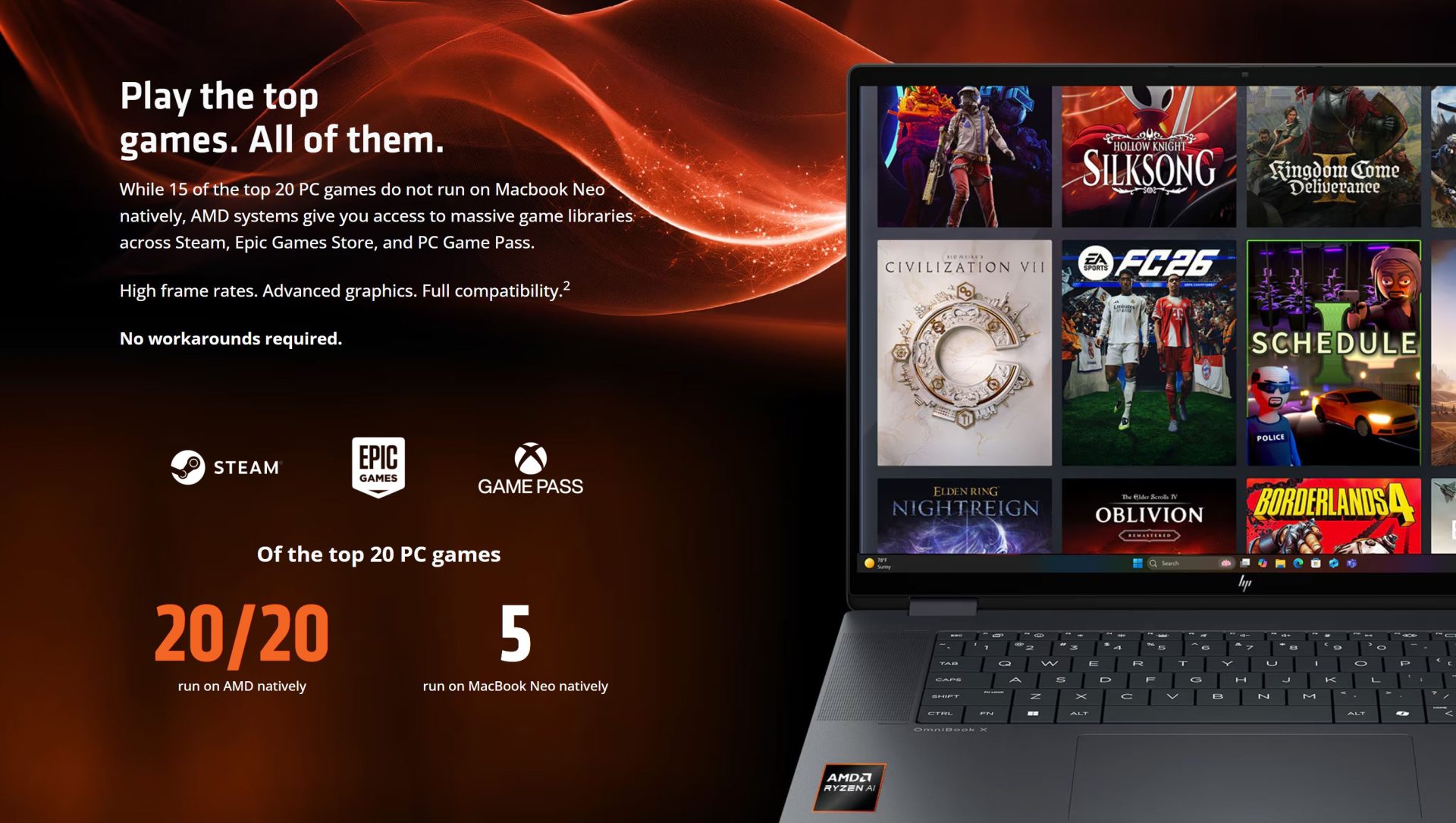
According to AMD’s promotional material, the company says Ryzen AI laptops include “everything MacBook Neo leaves out.” The main focus is gaming, where AMD claims that 15 of the top 20 PC games do not run natively on the MacBook Neo. By contrast, AMD says Ryzen-based laptops can access all 20 titles through major PC gaming platforms such as Steam, Epic Games Store, and PC Game Pass.
AMD’s message is clear: Windows laptops powered by Ryzen chips offer wider game compatibility, fewer limitations, and access to a much larger gaming library. The company also promotes “high frame rates,” “advanced graphics,” and “full compatibility,” while emphasizing that users do not need workarounds to play popular PC titles.
The marketing material also compares an HP Omnibook X Flip powered by the Ryzen 5 220 against Apple’s MacBook Neo. In that comparison, AMD highlights several advantages for the HP laptop, including broader software compatibility, more system memory, touchscreen support, and a wider selection of connectivity ports.
Those are fair points in certain areas. Many Windows laptops do provide more flexible ports, touchscreen options, and better compatibility with traditional PC software. For users who rely on Windows apps, PC games, or multiple accessory connections, a Ryzen-powered laptop may be the more practical choice.
However, the gaming argument is not entirely straightforward. The MacBook Neo is not designed primarily as a gaming laptop, so criticizing it for limited native PC game support feels somewhat predictable. Apple’s laptops are generally positioned around portability, battery life, creative workflows, and ecosystem integration rather than running the largest possible number of PC games.
A more direct and meaningful comparison would have been between AMD’s Ryzen 5 220 and Apple’s A18 Pro chip, which powers the MacBook Neo. AMD does suggest that the Ryzen 5 220 is faster in certain areas, claiming up to 57% better multitasking performance and up to 38% faster content creation performance. Those numbers may appeal to users looking for productivity-focused laptops, especially if they multitask heavily or work with creative applications.
Still, when it comes to gaming performance, compatibility is only part of the equation. The Ryzen 5 220 includes Radeon 740M integrated graphics, which is not built for demanding modern AAA gaming at high settings. While a Ryzen laptop may technically run more PC games than a MacBook Neo, that does not automatically mean it will deliver a smooth, high-end gaming experience across all titles.
That distinction matters. Being able to launch a game is not the same as being able to play it comfortably with strong frame rates and quality visuals. For casual games, older titles, esports games, and lighter PC releases, a Ryzen-based laptop may be perfectly usable. But for graphically demanding games, users would still be better served by a laptop with stronger dedicated graphics.
AMD’s broader point is that Windows laptops remain the stronger choice for PC gaming compatibility. That is difficult to dispute. Windows continues to dominate the PC gaming market, and most major games are developed with Windows support in mind first. Mac gaming has improved in recent years, but native support remains much more limited compared with Windows.
At the same time, the comparison feels carefully chosen. AMD is leaning on the strength of the Windows gaming ecosystem rather than focusing only on raw hardware performance. That makes the campaign effective as marketing, but less useful as a clean chip-to-chip comparison.
For buyers deciding between a Ryzen AI laptop and the MacBook Neo, the best choice depends on priorities. If gaming compatibility, Windows software, touchscreen support, and port selection matter most, a Ryzen-powered Windows laptop could be the smarter option. If battery life, Apple ecosystem features, portability, and macOS are more important, the MacBook Neo may still be appealing.
In the end, AMD’s jab at Apple adds fuel to the long-running Windows vs. MacBook discussion. Ryzen AI laptops may offer broader PC game compatibility, but the MacBook Neo was never meant to be a dedicated gaming machine. The real takeaway is simple: Windows still has the upper hand for gaming libraries, while Apple continues to play to its own strengths in design, efficiency, and ecosystem experience.