Why the new TGV M will carry more passengers without feeling smaller
France’s next-generation high-speed train, the TGV M, is getting ready for passenger service, and one of its biggest promises is simple: more seats, smarter use of space, and improved flexibility without making travel feel noticeably more cramped.
Built by Alstom for SNCF, the TGV M is designed to replace and complement earlier TGV Duplex and Euroduplex trains. At roughly 656 feet long, it is only slightly different in length from its predecessors, yet it can carry far more passengers depending on the interior layout.
In its standard TGV Inoui configuration, the new train is expected to offer up to 600 seats with two travel classes and a bar car. In its maximum-capacity layout, intended for low-cost services, the train can reach up to 740 seats. That is a major increase compared with many older TGV configurations, although capacity has always varied depending on the route, class layout, and whether the train is fitted for premium or budget service.
How the TGV M creates more space
The key reason the TGV M can carry more passengers is not simply tighter seating. Instead, Alstom has redesigned the train’s structure and technical layout to free up usable passenger space.
The most important change is found in the power cars. Traditional TGV trains use powered end cars rather than distributing all traction equipment underneath the passenger coaches, as many electric multiple units do. In the TGV M, these power cars have been shortened by around 13 feet each. The passenger cars themselves are also slightly shorter, by about 3.3 feet.
That may sound counterintuitive, but the new arrangement allows Alstom to fit an additional passenger car into the trainset. In practice, the train becomes more efficient in how it uses its fixed overall length.
Technical equipment has also been reduced in size and moved around. In older TGV trains, some systems were installed in areas such as the bar car, reducing the available space for passengers. In the TGV M, much of that equipment has been relocated into the redesigned power cars. This creates more freedom for SNCF to choose different layouts, including trains with a bar car, trains with more first-class space, or high-capacity trains focused almost entirely on seating.
A double-decker design remains the secret weapon
The TGV M continues one of the most important features of earlier high-capacity French high-speed trains: the duplex layout. Passenger coaches are double-deck, allowing far more people to travel in the same train length than in a single-level design.
This is a major reason the TGV M compares so strongly against other European high-speed trains. For example, Austria’s newer long-distance Railjet trains offer fewer seats despite being longer, while Germany’s ICE 3 Neo carries significantly fewer passengers in a trainset of similar length.
The TGV M’s double-deck architecture, combined with shorter power cars and more compact technical equipment, gives it one of the highest seat capacities among modern European high-speed trains.
Will the TGV M feel cramped?
Higher capacity often raises an obvious concern: will passengers have less room?
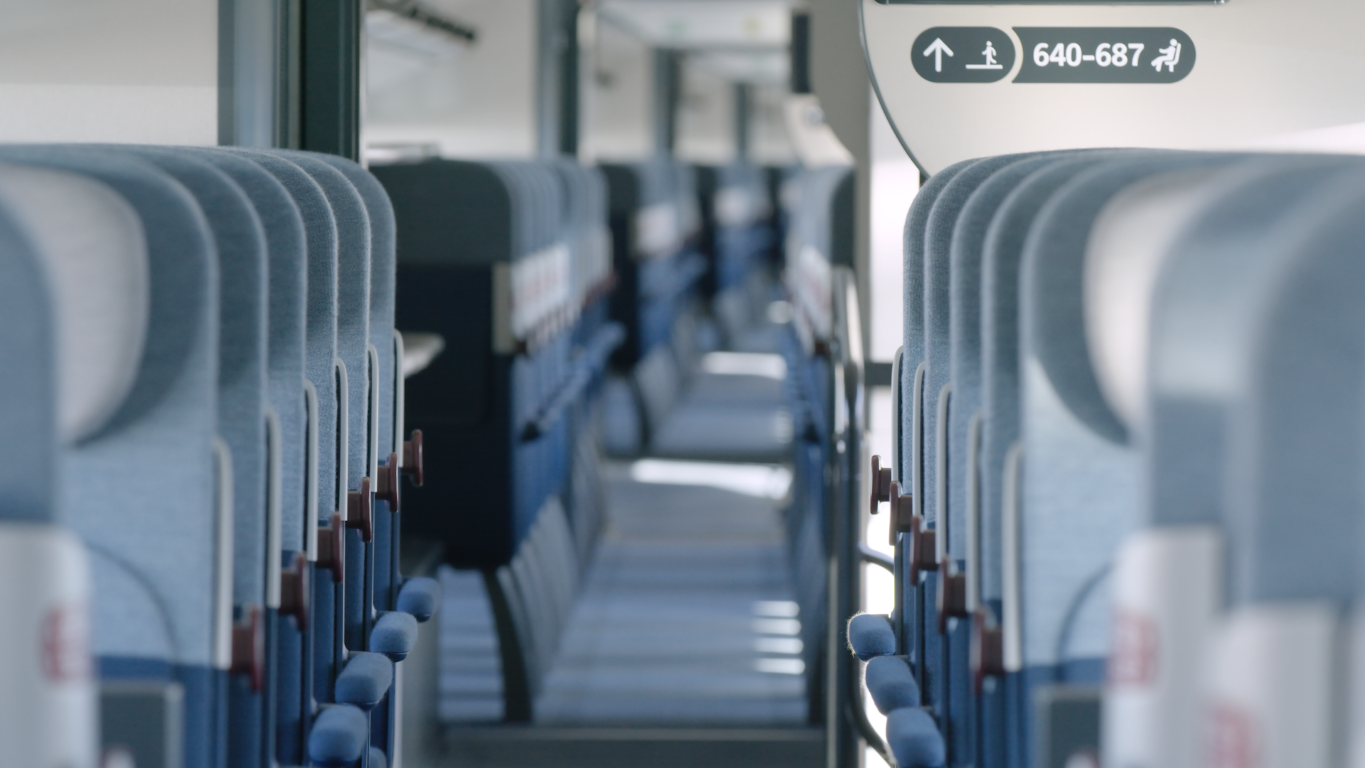
According to Alstom, the answer should be no. Even in the high-capacity version, the company says seat comfort is not reduced compared with the previous generation. Seat pitch in the densest configuration is listed at around 35.6 inches, only slightly more than the roughly 35.4 inches found in the predecessor.
In the regular TGV Inoui layout, seat pitch is said to increase more noticeably, although the exact comparison point is not entirely clear. Either way, the numbers remain far better than typical economy-class airline seating, where passengers are often limited to around 30 to 32 inches of pitch.
That matters for travelers who want to work, read, use a laptop, or simply sit comfortably during longer journeys. The TGV has sometimes been criticized for feeling tight in second class, partly because of interior design choices and limited sightlines in some areas. The TGV M will need to prove in real-world service that its improved layout translates into a more comfortable passenger experience.
Connectivity will also be part of the upgrade. SNCF has already announced WiFi supported by 5G mobile connectivity, which should make the train more attractive for business travelers and passengers who want reliable internet access during long-distance trips.
When will the TGV M enter service?
The TGV M has now cleared an important milestone: approval for operation on the French rail network. Authorization was granted in May 2026, bringing the train closer to its first commercial journeys.
SNCF plans to introduce the first TGV M trains at the start of the French school year, which points to early September 2026. The first version to enter service will be the TGV Inoui configuration, meaning the standard premium SNCF high-speed service rather than the maximum-capacity low-cost layout.
Testing has already been extensive. The trains have completed nearly 621,000 miles of trial running on the French network. The first two trainsets are expected to be delivered in June, followed by four more by the end of August. That would give SNCF six trains ready for the initial passenger launch.
By the end of 2026, the TGV M fleet is expected to grow to 13 trainsets. SNCF has ordered 130 TGV M trains in total, making this one of the most important fleet renewal projects in French high-speed rail.
The Eurostar version will be different
The TGV M is part of Alstom’s Avelia Horizon platform, and a related version will also be used by Eurostar. This international model will be known as Eurostar Celestia.
Eurostar has ordered 30 trainsets, with an option for 20 more. However, passengers will have to wait longer for these trains, as delivery is planned for 2031.
Unlike the highest-capacity French version, the Eurostar Celestia will have fewer seats. It is expected to offer around 540 seats per trainset, which is still about 20 percent more than some of Eurostar’s current trains. For busy services, especially through the Channel Tunnel, two trainsets can run coupled together, offering around 1,080 seats.
The lower seat count is partly due to Eurostar’s market. International routes between major cities such as London, Paris, Brussels, Amsterdam, and potentially destinations in Germany require more space for luggage, premium seating, and different service classes. Eurostar plans three classes for the Celestia: Standard, Plus, and Premier.
The Eurostar version will also need broader technical compatibility. While the French TGV M is designed mainly for France’s 1.5 kV and 25 kV electrification systems, along with French signaling and ETCS, the Celestia will have to operate across more countries and rail networks.
A major step for high-speed rail in France
The TGV M is not just another new train. It represents a major redesign of the French high-speed rail formula: double-deck capacity, shorter and more efficient power cars, flexible interiors, improved connectivity, and lower energy use compared with older generations.
For passengers, the most important question will be how the train feels in daily service. On paper, SNCF and Alstom have managed to increase capacity without sacrificing comfort. The standard Inoui version should offer around 600 seats with first class and a bar car, while the low-cost layout can reach up to 740 seats.
If the real-world experience matches the promise, the TGV M could become one of Europe’s most efficient and passenger-friendly high-speed trains, offering more capacity on busy routes while keeping the comfort advantages that make rail travel competitive with flying.