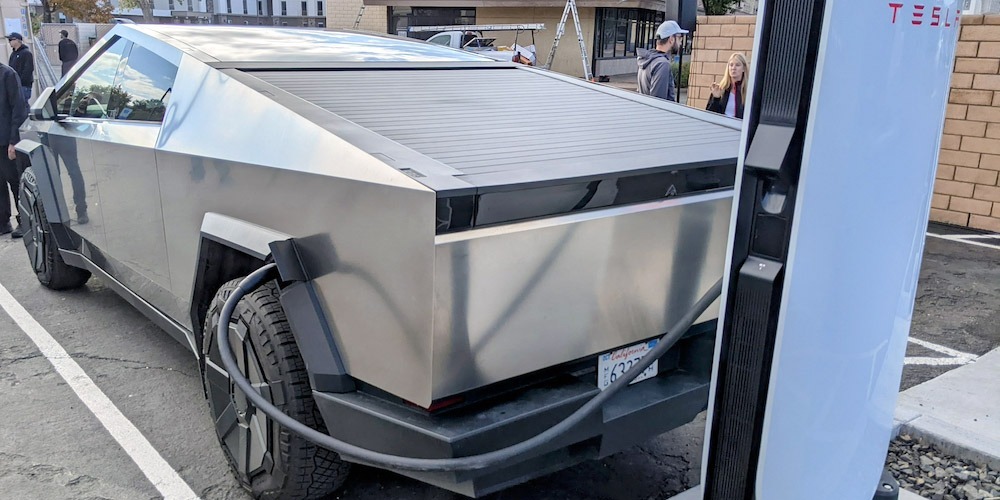
Tesla is making strides in electric vehicle (EV) charging technology, pushing the boundaries with high-speed charging tests that aim to significantly reduce charging times for their Cybertruck. Reports have surfaced from Cybertruck drivers experiencing charging rates beyond the official capacity of certain Superchargers. In response, Tesla’s lead Cybertruck engineer, Wes Morrill, acknowledged that the company is indeed trialing faster charging speeds.
Despite Tesla’s V4 Superchargers being labeled and technically designed for 350kW output, they have been operating within V3 cabinets meant for 250kW. However, some Cybertruck owners were surprised to find their vehicles charging at a rate of 324kW at stations intended for lower speeds. Morrill confirmed that this isn’t a system glitch but is part of deliberate trials involving a combination of V3 cabinets and V4 charging posts at selected stations. While these enhanced speeds aren’t widely available, some drivers may encounter them by chance.
The Cybertruck is notably Tesla’s inaugural model to adopt a more advanced 800V powertrain architecture, which facilitates compatibility with these upgraded V4 Superchargers. At the time of the Cybertruck’s introduction, Tesla engineer Lars Moravy indicated that the truck could be charged in less than 20 minutes using a high-power charger, presumably referring to a typical 20%-80% charging session. Despite this promise, real-world charging tests show a 50% charge taking 20 minutes, and an 80% charge needing twice that time, indicating a slower than expected charging curve.
This slower charge rate could partly be attributed to the 4680 battery cells’ charging characteristics, which have demonstrated a gradual charging pace in models like the Tesla Model Y. However, the Cybertruck is equipped with a newer generation of Cybercell batteries that boast a 10% improvement in energy density. To address the charging issue, Tesla released a software update, version 2024.20.7, enhancing charging performance.
Full realization of the potential charging speeds of the Cybertruck’s 800V system would also require Tesla to proceed with updates to their V4 Supercharger network, and it appears they are actively pursuing this with the 350kW charging speed trials. Such development is timely, with the company gearing up for a significant rollout of Cybertrucks as production of the Foundation Series nears completion.
Further highlighting Tesla’s commitment to innovation in EV technology is the recent showcase of a Cybertruck with 4680 battery cells produced via a dry electrode production process. This methodology not only reduces cost and toxicity but may also lead to improvements in the charging curve, likely contributing to Tesla’s decision to initiate high-speed charging trials.
For EV enthusiasts seeking home charging solutions, the Tesla Universal Wall Connector EV Charger with Dual Plug is available, providing a convenient and efficient way to charge Tesla vehicles.
As the EV industry progresses, Tesla’s efforts in high-speed charging could set a new standard for EV infrastructure, emphasizing the importance of quick and convenient charging solutions for the increasingly mobile and fast-paced modern world.