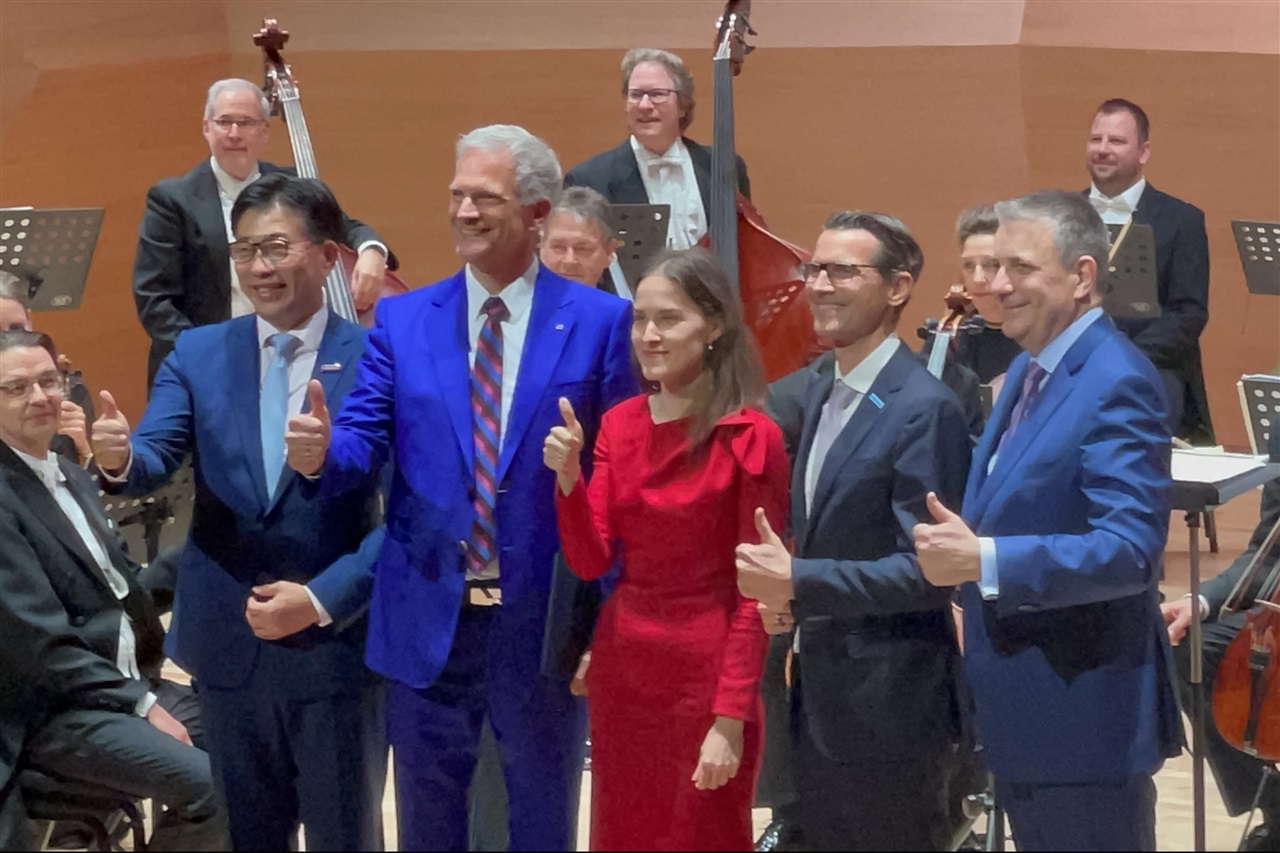
Germany and Taiwan turned an ordinary week in Taipei into a highly symbolic showcase of how diplomacy, culture, and industrial strategy can move in step. On Tuesday evening, guests gathered for a special concert by the Deutsche Philharmonie Merck to celebrate the 25th anniversary of the German Institute Taipei. The timing was no coincidence: the cultural celebration came directly after Monday’s inauguration of Merck’s new semiconductor flagship campus in Kaohsiung, a move that highlights how quickly the German–Taiwan partnership is expanding in both meaning and scale.
The Kaohsiung project is a five-year, EUR500 million investment designed to strengthen Taiwan’s local production capacity for high-end semiconductor materials. The new campus will expand work in thin-film precursors, specialty gases, and formulated materials—key inputs increasingly tied to next-generation technology, including AI workloads and silicon photonics. For Merck, this is more than a regional expansion. It is the company’s first large-scale semiconductor materials technology site of this kind worldwide, signaling a long-term bet on Taiwan’s resilience and on surging global demand for advanced materials that power modern chips.
The anniversary concert placed those industrial headlines into a broader narrative: a relationship built not only on trade, but also on shared values and growing cooperation across many fields.
Karsten Tietz, Director General of the German Institute Taipei, opened the evening by framing the Institute’s 25th anniversary as “a silver wedding anniversary,” comparing the founding of the Institute in 2000 to the start of a marriage. In Germany, he noted, the silver anniversary is often “the biggest party after the wedding,” and he used the metaphor to underscore a sense of confidence about what comes next. Taiwan and Germany, he said, are celebrating with the belief that “the best years are yet to come.”
Tietz also walked the audience through how the Institute has evolved over the past quarter-century—from its early days to its current presence in Taipei 101—while pointing to tangible outcomes that have helped define the relationship. He cited milestones such as visa-free entry for Taiwanese travelers, a double-taxation agreement, and expanding collaboration in renewable energy, emissions trading, AI, and microelectronics. He also highlighted the breadth of cooperation by mentioning rural development as the newest area of coordination, with the latest agreement signed just last week.
With his own tenure beginning last summer, Tietz said he arrived with a clear mission: to deepen and widen cooperation between Taiwan and Germany across the board. That effort, he added, is now supported by the largest personnel expansion in the Institute’s history, with six new positions added over three years.
One of the evening’s most memorable moments came when Tietz drew inspiration from Merck’s extraordinary corporate longevity—357 years of adapting through political, economic, and technological change. He said he wanted the German Institute Taipei to one day look back on a comparable legacy, joking that the Institute still has centuries to go. “We have 325 years to go,” he told the audience, turning the number into a playful challenge: “Come on, Taiwan. We can do this.”
He also thanked Merck for bringing its orchestra to Taipei, adding a humorous clarification that classical music may be one of Germany’s cultural strengths, but it isn’t standard corporate policy. If anyone imagined that all major German companies are required to maintain an orchestra, he said, that isn’t the case—this, he noted, is one of Merck’s unique distinctions.
While the evening was celebratory, Tietz also used his speech to address a far more serious theme: security pressures facing democracies. He spoke about the reality of dealing with increasingly aggressive neighbors, the rise of gray-zone tactics, the need for stronger self-defense, and the strategic risks created by dependence on imported fossil fuels. Quoting Germany’s chancellor—“we have to be able to defend ourselves so that we never actually have to defend ourselves”—Tietz tied European and Asian security interests together.
Germany’s support for Ukraine, he argued, follows the same underlying logic: credibility matters, and abandoning partners has consequences. The war, in his view, is not a distant regional dispute but part of a wider global struggle—authoritarian rule versus democratic rule, human dignity versus oppression, and free trade versus coercive dependence. He summed it up with a line meant to resonate beyond the concert hall: “We are in this struggle together—Germany, Taiwan, Ukraine, and the rest of the free world. We are team freedom.”
Prof. Dr. Simon Thelen, Vice Chairman of the Family Board and Board of Partners of E. Merck KG, followed with remarks that echoed the evening’s theme of “resonance and collaboration.” He gently corrected Tietz’s century-scale calculation, noting that if the Institute is aiming for the kind of timeline Tietz joked about, it actually has 332 years to go.
Thelen described the anniversary as a milestone reflecting the strength of collaboration and shared values between two cultures. He noted that Merck has worked in Taiwan for more than 35 years, advancing innovation alongside customers and partners. As the orchestra prepared to perform works by Schubert, Mozart, and Beethoven, he offered a fitting comparison: diplomacy and partnerships require harmony, just like a symphony. Every instrument matters—and, in the same way, institutions and individuals on both sides play distinct roles in building something larger than any single participant could create alone.
Dr. Eva Langerbeck, Chief Representative and Executive Director of the German Trade Office Taipei, brought the focus back to Monday’s Kaohsiung announcement with concise but pointed comments. She emphasized that the new facility is Merck’s largest investment in Taiwan, exceeding NT$17 billion, and includes the first global semiconductor materials technology center of its kind. For her, the message was clear: this is “very impressive confidence” in Taiwan as a production base and in the long-term strength of the semiconductor industry. Her remarks drew particular attention because, while others offered brief greetings in Chinese, she delivered full paragraphs in Mandarin—an effort that stood out in the room and earned warm applause.
Taken together, the back-to-back events—an advanced semiconductor materials campus launch in Kaohsiung followed by a major anniversary concert in Taipei—captured the layered reality of the modern Germany–Taiwan relationship. It is a partnership expressed in industrial investment, expanding policy cooperation, shared security concerns, and cultural exchange.
And with Merck’s 357-year history invoked as proof that institutions can endure and evolve—and with the anniversary framed as a starting point for the decades ahead—the message from the week was unmistakable: Germany and Taiwan are not just maintaining a relationship. They are actively building one designed to last for generations, anchored in innovation, resilience, and long-term commitment.