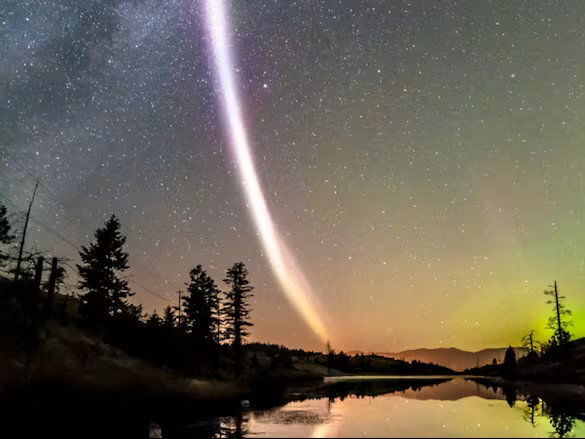
A team of brilliant students from the University of Calgary is on the brink of an extraordinary achievement: launching the city’s first student-built satellite, set to explore a rare and mysterious space weather phenomenon known as STEVE. This SmallSat, named FrontierSat, has successfully passed its final vibration tests and is gearing up for a significant journey.
Scheduled for launch in early 2026 aboard a SpaceX Falcon 9 rocket from California, FrontierSat aims to gather groundbreaking data about STEVE, an intriguing and lesser-known cousin of the aurora. Unlike auroras, which occur when charged particles rain down into Earth’s atmosphere, STEVE’s vibrant purple and green lights are generated through an entirely different, yet unknown mechanism. The mission is driven by the curiosity to unravel this celestial mystery and expand our understanding of space weather.
The small, loaf-sized satellite will be equipped with a mini plasma imager to scrutinize the ionosphere from orbit. This project, primarily funded by the Canadian Space Agency, stands as a testament to the dedication and innovation of over a hundred students in the CalgaryToSpace team. Their passion and hard work over the years have culminated in designing, building, and testing FrontierSat, marking a significant milestone in their academic and professional careers.
As Jonathan Burchill, the mission’s principal investigator, envisions, accumulating a multi-year dataset of STEVE observations could unlock new insights into this enigmatic sky show, enhancing our understanding of space phenomena.
For these budding scientists and engineers, the journey doesn’t just promise data but also a place in shaping future space exploration, putting the University of Calgary on the map in the field of satellite technology and space research. This mission symbolizes not just a scientific expedition but a celebration of curiosity and human ingenuity, as they venture into the cosmic unknown.