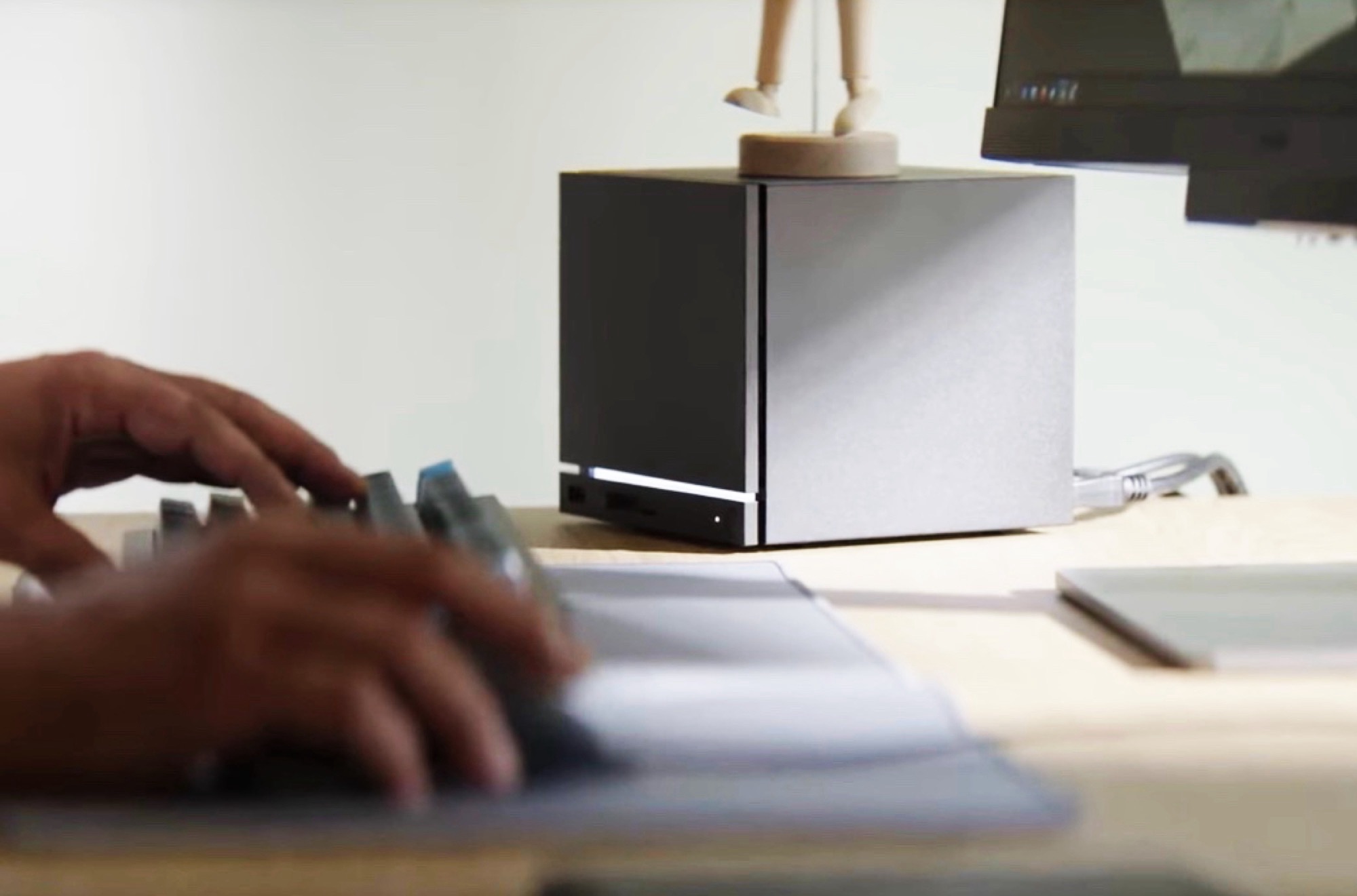
Valve’s new Steam Machine is a small-form-factor gaming PC built to take on living-room consoles without taking over your TV stand. Think of it as the desktop sibling to the Steam Deck: same PC flexibility and SteamOS simplicity, but in a compact cube that delivers far more horsepower than the handheld—while still coming in smaller than a typical console.
At roughly 6.3 inches per side and around 3.1 liters in volume, the Steam Machine is impressively space-efficient. Despite the tiny footprint, it includes an internal power supply and is designed for low-noise cooling, making it a neat fit for media centers and minimalist setups.
Under the hood, Valve uses a custom AMD platform tuned for efficiency:
– CPU: 6-core Zen 4 processor with boost clocks up to 4.8 GHz and a 30 W TDP
– GPU: RDNA 3 graphics with 28 Compute Units up to 2.45 GHz, roughly 9 TFLOPS and 8 GB of dedicated GDDR6 VRAM, with a power budget around 110 W
– Memory: 16 GB DDR5 for the CPU plus 8 GB GDDR6 for the GPU
– Storage: 256 GB or 1 TB SSD options, with microSD expansion
– Networking: Wi‑Fi 6E
– Dimensions: approximately 15.2 x 16.2 x 15.6 cm
Performance lands in a familiar spot for anyone who tracks mobile PC hardware: it’s broadly comparable to systems built around AMD’s Ryzen 5 8640HS paired with a Radeon RX 7600M. In practice, that means modern blockbusters like Cyberpunk 2077, Alan Wake 2, and Dragon’s Dogma 2 can run smoothly at 1080p with high settings. If you’re aiming for 4K, plan on leaning on upscaling tech such as FSR to keep frame rates up while preserving image quality.
Compared to the Steam Deck OLED, the Steam Machine is a major leap forward. Thanks to the larger RDNA 3 GPU with 28 CUs and much higher clocks, the desktop unit delivers more than five times the graphics performance of Valve’s handheld. That’s the difference between “tune for medium” and “comfortably high at 1080p.”
How does it stack up against current consoles? Both Sony’s PlayStation 5 and Microsoft’s Xbox Series X still hold a raw GPU advantage. Based on compute and clock estimates, the PS5 offers about 15.6% more graphics power, while the Series X stretches that to roughly 36.5%. In other words, Valve’s box focuses on efficiency, size, and PC flexibility rather than chasing top-console teraflops.
Who is this for? If you want a quiet, tiny, and stylish gaming PC for your living room that runs SteamOS out of the box, this is an appealing option—especially if Valve prices it aggressively as hinted. You’ll get a big upgrade over handheld gaming, strong 1080p performance in today’s most demanding titles, and the freedom of a PC platform. If you demand uncompromising 4K without upscaling or you’re chasing the absolute highest console-level GPU numbers, the current flagship machines still edge it out.
Bottom line: the Steam Machine brings PC versatility to the console shelf with thoughtful thermals, a smart custom AMD setup, and a form factor that disappears into your entertainment center. Expect smooth 1080p, 4K with upscaling, and a user-friendly living‑room experience—just don’t expect it to outmuscle the PS5 or Xbox Series X on raw graphics.