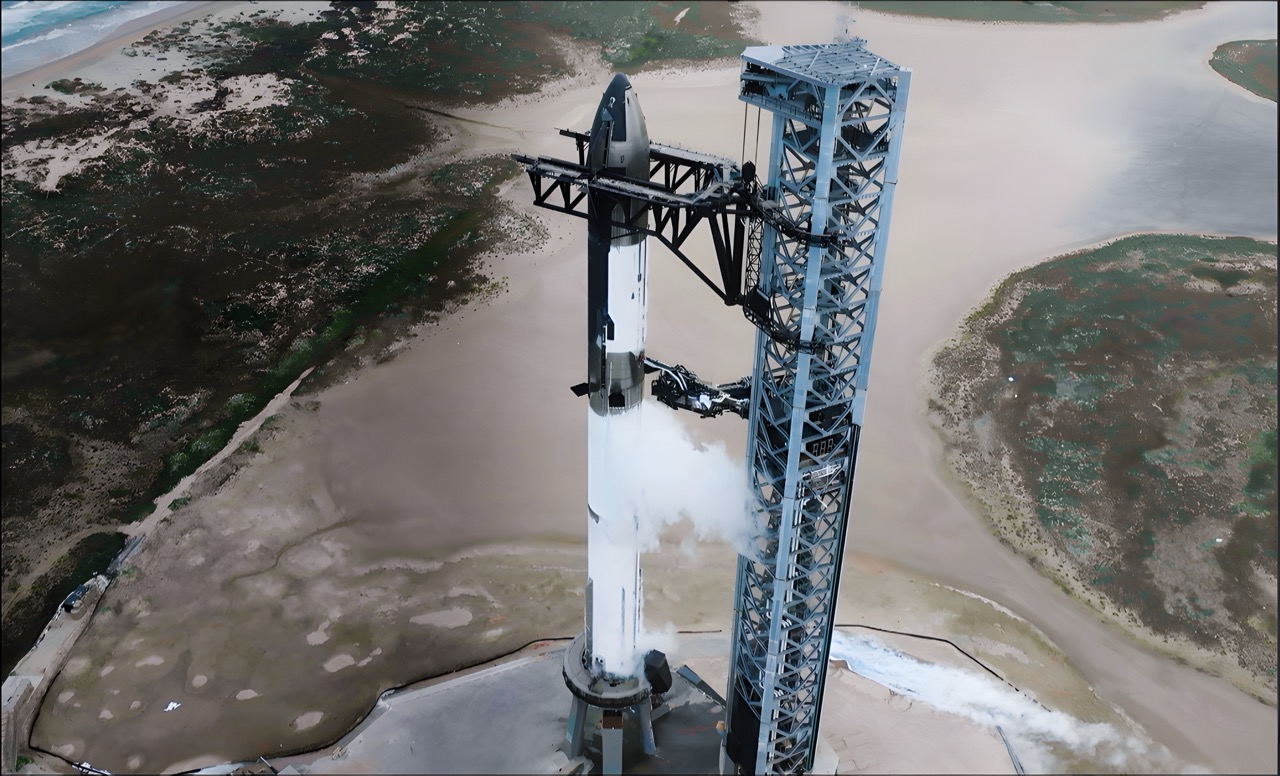
SpaceX’s Starship prototype soared to new heights on its final test flight this past Tuesday, captivating onlookers, including President-elect Donald Trump and SpaceX CEO Elon Musk. As the world’s largest rocket ascended from the launch pad, the Starship’s sixth test was nearly a flawless operation. This milestone paves the way for a larger, more advanced model to take the stage in future endeavors.
Engineers at SpaceX had made strategic modifications to the Starship, shedding over 2,000 heat shield tiles to reduce weight. Despite these adaptations, the rocket couldn’t yet accommodate a full payload of sensors, stretching its limits by carrying only a banana to showcase its weightlessness capability.
Impressively, the Starship rocketed to an altitude just shy of 200 kilometers, reaching speeds of 25,000 kilometers per hour. During its voyage, the two stages of the rocket parted ways at a speed of approximately 3,000 miles per hour. However, a malfunction prevented the super-heavy booster from returning to the launch site in South Texas as planned. Instead, it ended with a water landing in the ocean.
The Starship itself reached its intended orbit of 190 kilometers, where, as expected, one engine fired to initiate its return journey to Earth. Successfully re-entering the atmosphere, the spacecraft made a smooth landing in the Indian Ocean.
Though the Starship Block 1 test program demonstrated remarkable potential, both rocket stages require further development. The ultimate aim remains ambitious: to achieve complete reusability for the Starship and its first stage, revolutionizing space travel.