SpaceX Seeks Approval for 100,000 Next-Gen Starlink Satellites to Power AI Connectivity
SpaceX is preparing for a massive expansion of its Starlink network, filing a new request with the U.S. Federal Communications Commission to launch and operate up to 100,000 third-generation satellites. If approved, the plan would dramatically increase the size and capability of the company’s low-Earth orbit internet constellation.
The proposed V3, or Gen3, satellite system would operate in non-geostationary orbit across two closely positioned orbital layers. These satellites would fly at altitudes of around 323 to 327.5 kilometers and 473 to 477.5 kilometers, with orbital inclinations ranging from 26 degrees to 96.9 degrees. This flexibility would allow SpaceX to expand coverage, improve network performance, and support a much larger number of users and devices worldwide.
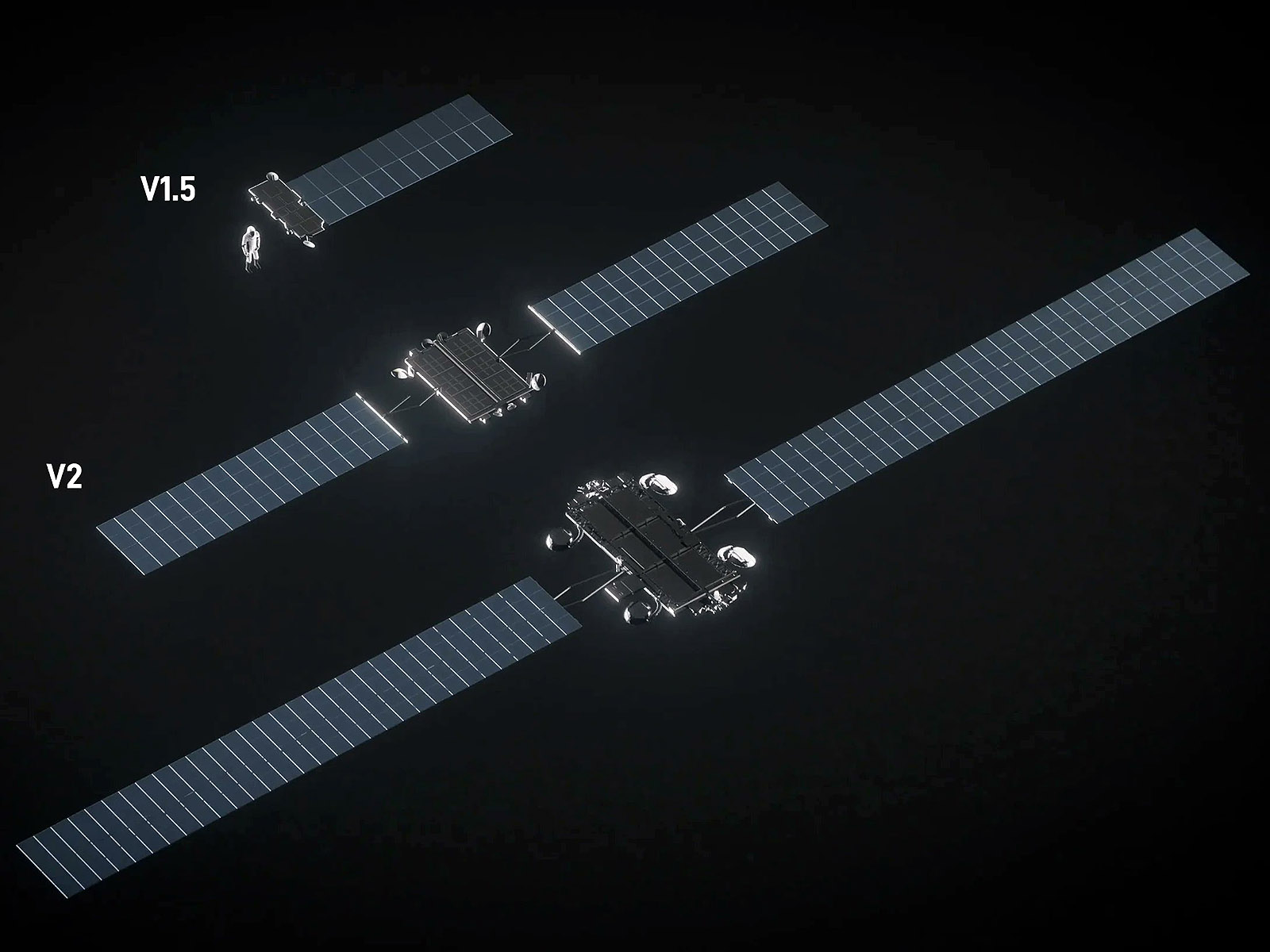
The new satellites are expected to be far larger and more powerful than the current Starlink models. Each Gen3 satellite could weigh up to two tons, nearly three times the mass of today’s Gen2 satellites. Because of their size and weight, SpaceX would likely rely on its Starship rocket to deploy them at scale.
The company is pitching the Gen3 constellation as a major step forward for satellite internet, especially in an era where artificial intelligence is expected to demand huge amounts of bandwidth. SpaceX says the new satellites could deliver roughly ten times more download capacity, reaching around 1 terabit per second per satellite. Uplink performance could improve even more significantly, with a projected 22-fold increase. Combined radio frequency and laser-based backhaul could reach about 4 terabits per second for each satellite.
SpaceX argues that this level of capacity will be essential as AI-powered devices, industrial automation systems, government networks, businesses, and consumers require faster, lower-latency connections. The company says AI applications will increasingly depend on high-capacity uplinks capable of handling real-time visual, spatial, and audio data. In its view, the United States needs this kind of infrastructure to stay competitive in the global AI race.
If approved, the scale of the project would be unprecedented. SpaceX currently has roughly 10,700 Starlink satellites in orbit, while its existing authorization for the second-generation network allows for about 15,000. A 100,000-satellite Gen3 approval would represent a huge leap and would far exceed the number of active satellites currently operated by all companies combined.
The proposal is likely to attract close scrutiny. SpaceX already operates the largest satellite constellation in low-Earth orbit, and its satellites are frequently involved in collision-avoidance planning. Adding tens of thousands more spacecraft would significantly increase the number of objects that must be tracked, managed, and maneuvered to maintain orbital safety.
Astronomers may also raise concerns about the impact of an even larger satellite network on night-sky observations. While SpaceX has worked on reducing satellite brightness in recent years, a constellation of this size could intensify debate over how much commercial activity low-Earth orbit can safely and responsibly support.
The filing also arrives at a time when satellite broadband competition is heating up. A 100,000-satellite network would give SpaceX a major advantage in global coverage, bandwidth, and low-latency connectivity, potentially making it harder for rivals to catch up.
For now, the FCC will need to review the technical, safety, and spectrum-sharing details before deciding whether to grant approval. If SpaceX gets the green light, its Gen3 Starlink constellation could become one of the most ambitious space infrastructure projects ever proposed, reshaping satellite internet and positioning low-Earth orbit as a critical backbone for the AI-driven digital economy.