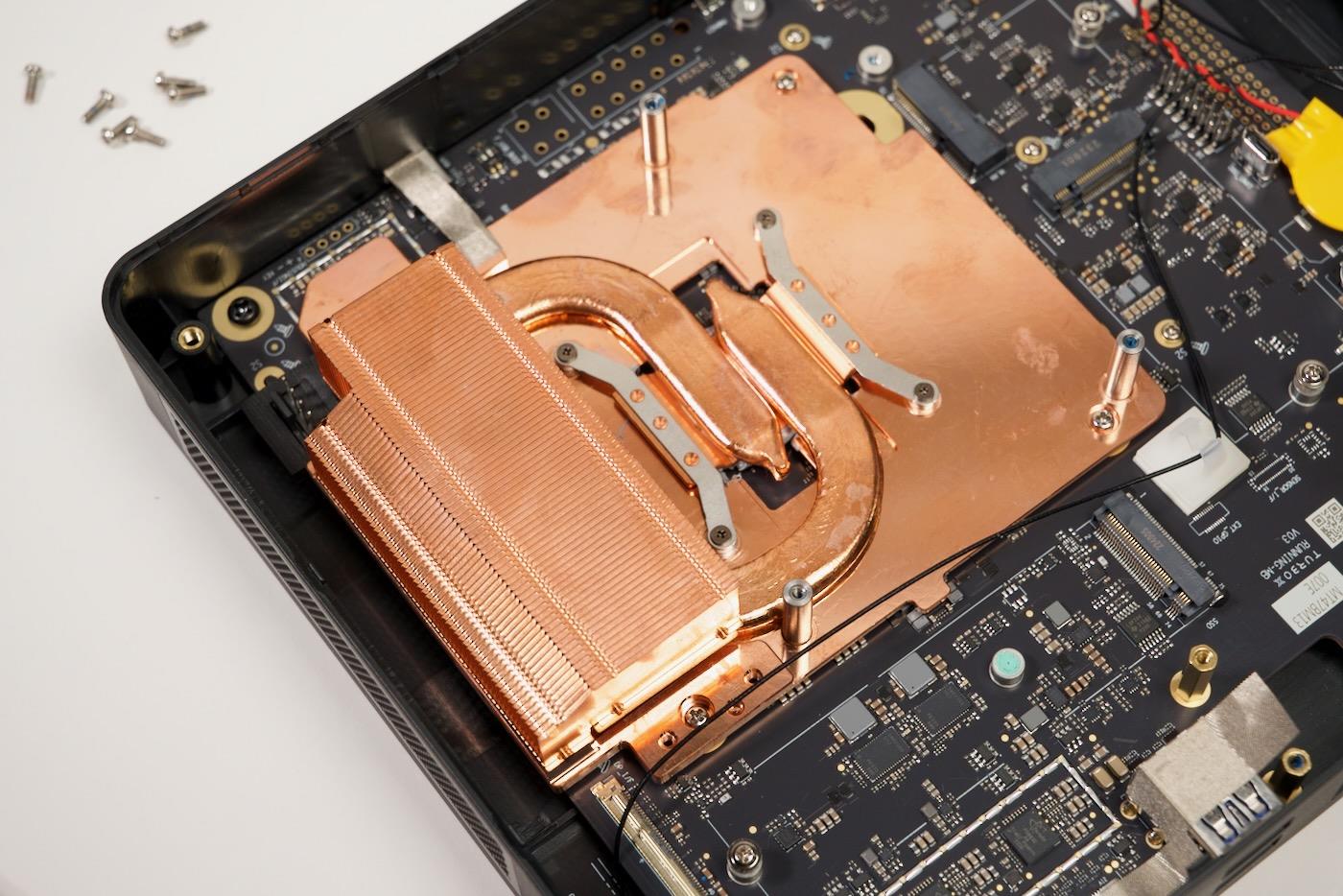
Qualcomm has paved the way for developers to seamlessly integrate their applications with the Snapdragon X Elite platform through the introduction of the Snapdragon Dev Kit, priced at $899. This development kit showcases an impressive capability, as evidenced by a Cinebench 2024 benchmark that revealed the chipset could exceed the 100W power threshold when running without thermal and power constraints. One developer, driven by curiosity about the device’s internals, conducted a teardown, uncovering some fascinating details.
The internal structure of the Snapdragon Dev Kit is dominated by a substantial copper heatsink, complemented by a single fan that efficiently expels hot air to manage the thermals of the Snapdragon X Elite. Jeff Geerling, rather than just using the kit for standard code testing, decided to explore the hardware in-depth. His teardown revealed that a significant portion of the Dev Kit’s interior is dedicated to the cooling apparatus, enabling the chipset to operate at higher wattages and deliver peak performance.
Interestingly, the design includes extensive exhaust vents, a testament to the elaborate cooling system’s role in tempering the Snapdragon X Elite’s temperatures. Geerling noted that the kit becomes notably audible under heavy loads, likely due to the large cooling fan spinning at high speeds.
The thick copper heatsink indicates that maintaining 100W of operation in slim Windows 11 notebooks would be challenging, as the chipset would quickly hit thermal limits in such confined spaces. However, the Snapdragon Dev Kit highlights that Qualcomm has the potential to rival Apple’s Mac mini lineup with future releases.
Rumors suggest that Qualcomm is developing two successors to the Snapdragon X Elite, slated for launch in the first half of 2026. One of these successors may feature an 18-core CPU configuration and hardware-accelerated ray tracing, possibly appearing in upcoming NUC systems. But that’s a discussion for another day. For now, those interested in a detailed look at Geerling’s teardown process can find additional information through his published content.


