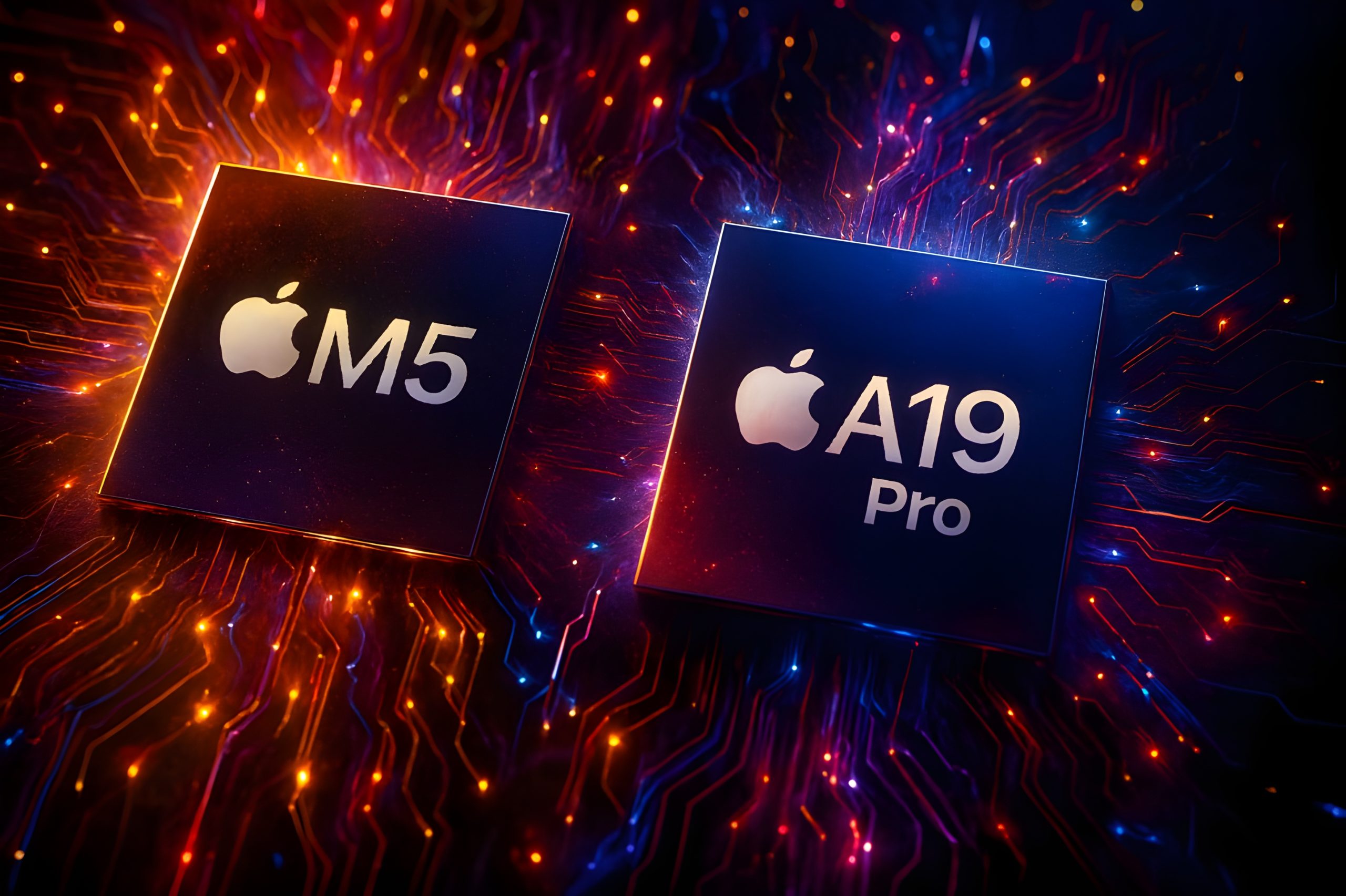
Apple’s A19 Pro and the newly announced M5 silicon have more in common than ever. Look past the different product lines and you’ll notice a clear architectural throughline: the A19 Pro feels like a scaled-down M5 built for phones. The result is iPhone 17 Pro hardware that looks strikingly close to Mac-class silicon in design and capability.
Here’s how the two chips stack up.
CPU
– M5: 10-core CPU with 4 high‑performance cores and 6 efficiency cores
– A19 Pro: 6-core CPU with 2 high‑performance cores and 4 efficiency cores
GPU
– M5: 10-core GPU with a dedicated Neural Accelerator in each core and support for third‑generation ray tracing
– A19 Pro: 6-core GPU with a Neural Accelerator per core and hardware‑accelerated ray tracing
Neural Engine
– Both chips include a 16-core Neural Engine for on-device AI and machine learning workloads
Unified memory and bandwidth
– M5: Up to 153 GB/s of memory bandwidth, using 16 GB (base) of LPDDR5X unified memory at 9600 MT/s
– A19 Pro: Up to 75.8 GB/s of memory bandwidth, using 12 GB of LPDDR5X unified memory at 9600 MT/s
What this means in practice
– Shared architecture, different scale: The A19 Pro mirrors the M5’s design philosophy, then scales it for a smartphone’s power and thermal envelope. The biggest differences are core counts and memory bandwidth.
– Mac-level ideas on iPhone: With high-efficiency and high-performance CPU cores, per-core GPU Neural Accelerators, a 16-core Neural Engine, and modern ray tracing, the iPhone 17 Pro and Pro Max inherit many of the same silicon building blocks found in Macs.
– Better developer roadmap: A converging chip strategy makes it easier to build and optimize apps across iPhone and Mac. Developers can target similar GPU features, Neural Engine capabilities, and unified memory behavior across devices.
– Simpler silicon strategy: Unifying core technologies across platforms streamlines Apple’s design process, reduces complexity, and helps features advance in tandem from pocket to desktop.
Bottom line
If you think of the A19 Pro as a smaller iteration of the M5, you won’t be far off. The M5 goes bigger with more cores and bandwidth, but the architectural DNA is clearly shared. For users, that means iPhone 17 Pro performance that feels closer to Mac silicon than ever; for developers, it’s a more coherent, scalable platform to build on.