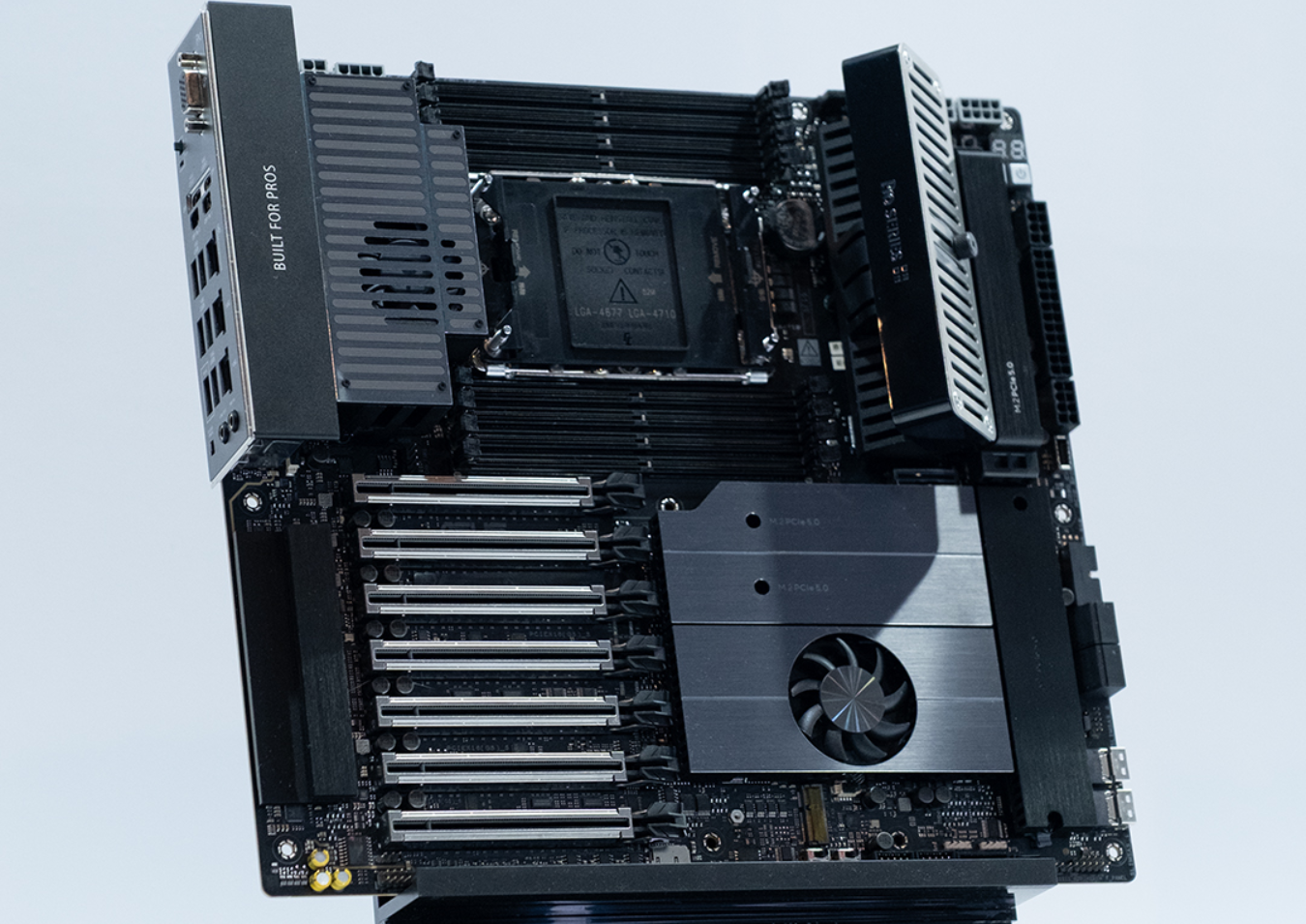
ASUS has quietly lifted the curtain on a monster new workstation motherboard built for Intel’s upcoming Granite Rapids-WS Xeon processors. Designed around the Intel W890 chipset and the new LGA 4710 socket, this next-generation ASUS Pro WS board looks like the spiritual successor to the Pro WS W790-SAGE SE—only bigger, faster, and clearly aimed at professionals who push hardware to the limit.
While ASUS hasn’t officially confirmed the final retail name, it’s widely expected to land as something like the Pro WS W890-SAGE, matching the company’s established naming style for its flagship workstation lineup.
Built for Granite Rapids-WS and serious workstation workloads
The headline feature is future CPU support: the LGA 4710 socket is intended for Intel Granite Rapids-WS Xeon CPUs, which are positioned for high-end workstation performance. ASUS pairs that socket with a feature set that screams “maxed-out build,” whether the goal is heavy content creation, simulation, AI development, rendering, CAD, or multi-GPU compute.
Two platform paths: Mainstream vs Expert
ASUS details two platform configurations tied to this workstation ecosystem:
1) Mainstream platform
– 4-channel memory support
– Up to 80 PCIe Gen5 lanes
2) Expert platform
– 8-channel memory support
– Up to 96 PCIe Gen5 lanes
The ASUS board shown is based on the higher-end “Expert” option, which is where the most demanding workstation users will likely focus.
Up to 2TB of DDR5 and a seven-slot PCIe layout
Memory support is substantial. You get eight DDR5 DIMM slots, with ASUS indicating support for up to 2TB of system memory. That’s the kind of capacity aimed at large datasets, complex scenes, and memory-hungry professional applications.
Expansion is equally aggressive. The board includes seven PCIe x16 slots with reinforced steel slot design. ASUS positions this as capable of running up to seven single-slot GPUs or up to four dual-slot blower-style add-in cards, enabling dense GPU compute setups for tasks like GPU rendering, AI training and inference, or multi-accelerator engineering workflows.
Gen5 storage and workstation-grade connectivity
For fast storage, the board includes four dedicated M.2 PCIe Gen5 x4 slots, each covered by its own heatsink to help maintain sustained throughput during long workstation sessions. Beyond M.2, the board also provides four SATA III ports and two SlimSAS ports, giving builders flexibility for bulk storage arrays or high-capacity project drives.
Cooling design is clearly built for high load. The W890 chipset is cooled by a large active fan, and there’s also additional active cooling over the VRM area combined with a substantial heatsink layout—exactly the kind of thermal approach you’d expect on a platform designed for long, heavy workloads.
Power delivery aimed at top-tier CPUs and multi-GPU builds
This is not a board built for modest power needs. ASUS equips it with an extreme power input configuration: four 8-pin connectors, two 4-pin connectors, and the standard 24-pin ATX connector. That kind of setup hints at the power demands expected from next-gen workstation CPUs and multi-card PCIe Gen5 configurations running flat out.
ASUS also includes practical workstation troubleshooting tools directly on the board, including power and reset buttons plus a debug LED—useful for system integrators, labs, and anyone who frequently upgrades or tests components.
Strong rear I/O and networking options
On the connectivity front, the board is equipped with robust I/O, including at least six USB Type-A ports, two USB Type-C ports, and three LAN ports. For workstations used in production environments—especially those moving large files across networks or working in multi-system pipelines—multiple LAN ports can be a real advantage.
Pricing expectations and availability
Based on its feature set and flagship positioning, this ASUS W890 workstation motherboard is expected to land in the premium bracket, likely around $1500 to $2000 (or potentially more), depending on final configuration and launch market conditions. ASUS also hints that launch timing may not be far off, emphasizing that the “future of workstations is almost here.”
Interestingly, ASUS also associates this motherboard with its ExpertCenter Pro ET900N G3 AI Supercomputer lineup, which is said to feature NVIDIA’s Blackwell Ultra GB300 Superchip. That connection further reinforces the idea that this W890 platform is intended for cutting-edge professional and AI-focused systems rather than typical consumer desktops.
For anyone planning a next-gen Intel Xeon workstation—especially one centered on PCIe Gen5 expansion, massive DDR5 capacity, and multi-GPU compute—this ASUS Pro WS W890 platform looks like it’s being built to set the pace.


