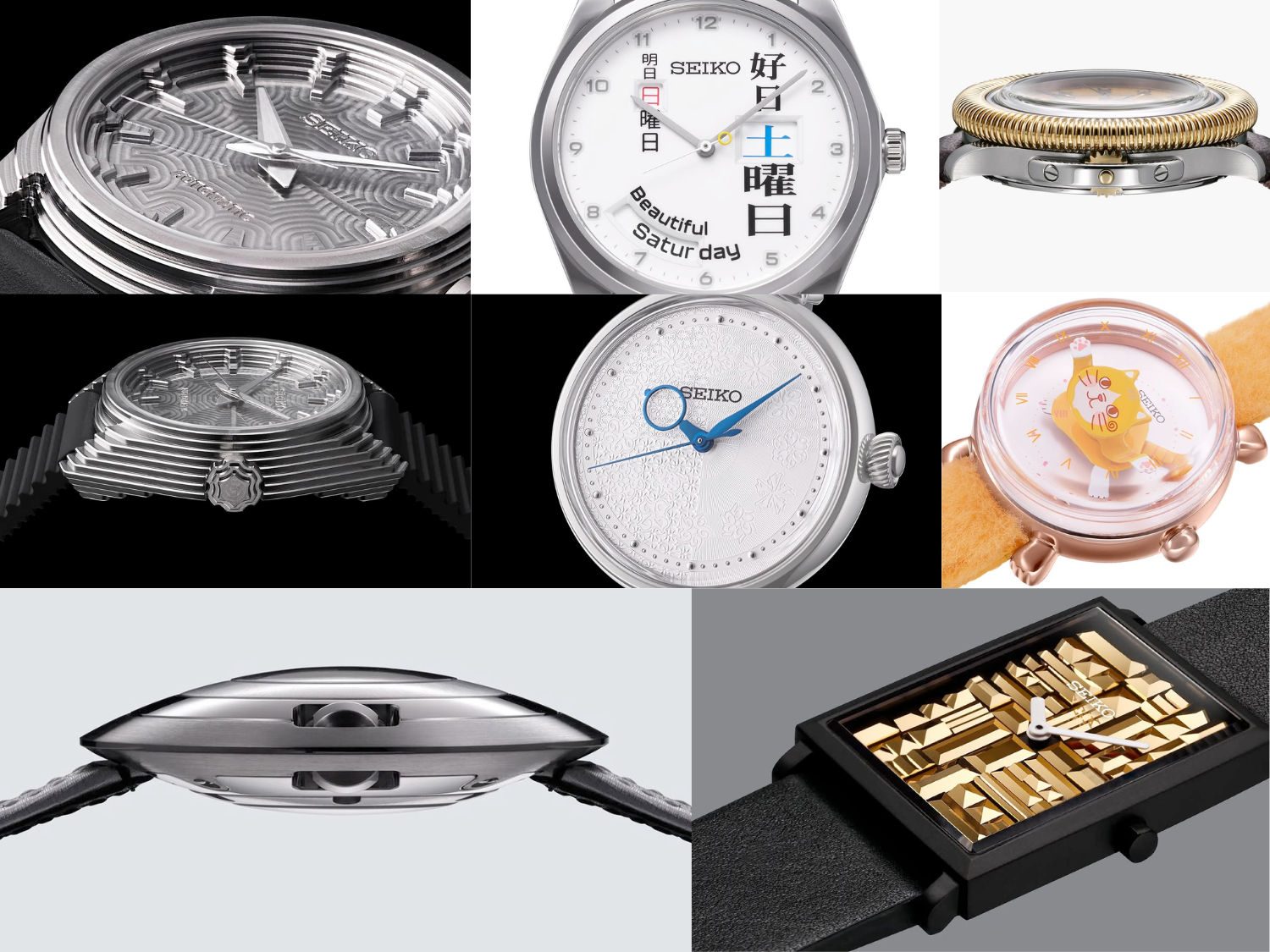
Seiko’s latest Power Design Project exhibition has opened in Tokyo, giving watch fans a rare look at how the brand experiments when it’s not bound by production requirements. Running from March 14 to March 29 at Light Box Studio in Aoyama, the show brings together seven prototype watch concepts created by Seiko’s in-house designers under the theme “Passionately and Obsessively Crafted Watches.”
Rather than teasing upcoming commercial releases, this exhibition is about pure design exploration. Across the seven studies, Seiko plays with machining textures, unconventional case shapes, dial construction, and even a whimsical cat-inspired way to tell time.
One of the standout concepts, created by Naoya Sukeda, spotlights the beauty of manufacturing marks. The metal surfaces intentionally celebrate machining lines, and the watch case is built in a circular, multi-layered stack where the bezel, dial, and crown appear to sit in stepped tiers. Even the strap echoes industrial design, referencing the belts used in manufacturing equipment for a cohesive tool-like aesthetic.
Design director Yu Ishihara takes a very different approach with a concept built around spherical geometry. The case curves smoothly front to back, emphasizing a rounded silhouette that’s enhanced by contrasting polished and brushed finishing. It’s a straightforward idea on paper, but the execution is meant to show how shape and surface treatment can do the heavy lifting in watch design.
Dial texture becomes the main event in a concept by Takuya Matsumoto, known for his involvement with Seiko’s higher-end lines. His prototype divides the dial into four quadrants inspired by seasonal imagery, drawing from scenes such as spring rivers, summer sun, autumn skies, and winter snow. The result is a watch face that changes character depending on where the light hits and which section you notice first.
Kento Ito’s contribution focuses on the tactile ritual of winding a mechanical watch. In this concept, the bezel itself is rotated to wind the movement, turning a familiar interaction into the centerpiece of the design. The hands are offset to free up space for a larger power reserve display, reinforcing the idea that energy and motion are the story this watch wants to tell.
Miho Wada, design director of Credor, proposes a dial that’s almost entirely made from hour-marker elements. Built using 23 individual index components, the surface becomes a reflective field that shifts dramatically under changing light. It’s minimal in layout, but complex in construction—an exercise in turning something as simple as indices into the dial’s defining feature.
Akihiro Hasegawa experiments with how day and date information can be presented. His dial displays the current day in both Japanese and English, while also previewing tomorrow’s date. The concept incorporates Seiko’s familiar color tradition as well, using blue for Saturday and red for Sunday, in a design that blends practicality with visual rhythm.
The most playful concept comes from Yuki Omori and features a cat named Ten-chan as the display itself. The cat’s tail indicates the hours, its feet mark the minutes, and the hands track the seconds. Even the case design joins the theme, with lugs shaped like paws and paw-pad detailing underneath—an imaginative reminder that watch design can be fun without losing craftsmanship.
Seiko is clear that these seven pieces are design studies, not confirmed production watches. Still, exhibitions like this offer a window into the brand’s creative range—and for collectors and enthusiasts, they’re often just as exciting as a standard product launch because they reveal what Seiko’s designers can do when they’re allowed to push ideas to the edge.