NVIDIA is already looking past today’s GPU performance gains and warning that the old playbook for faster graphics no longer works. At GDC 2026, the company laid out a clear message: traditional chip scaling isn’t delivering the dramatic leaps it once did, so the next era of real-time graphics will be powered by RTX innovations and aggressive use of AI.
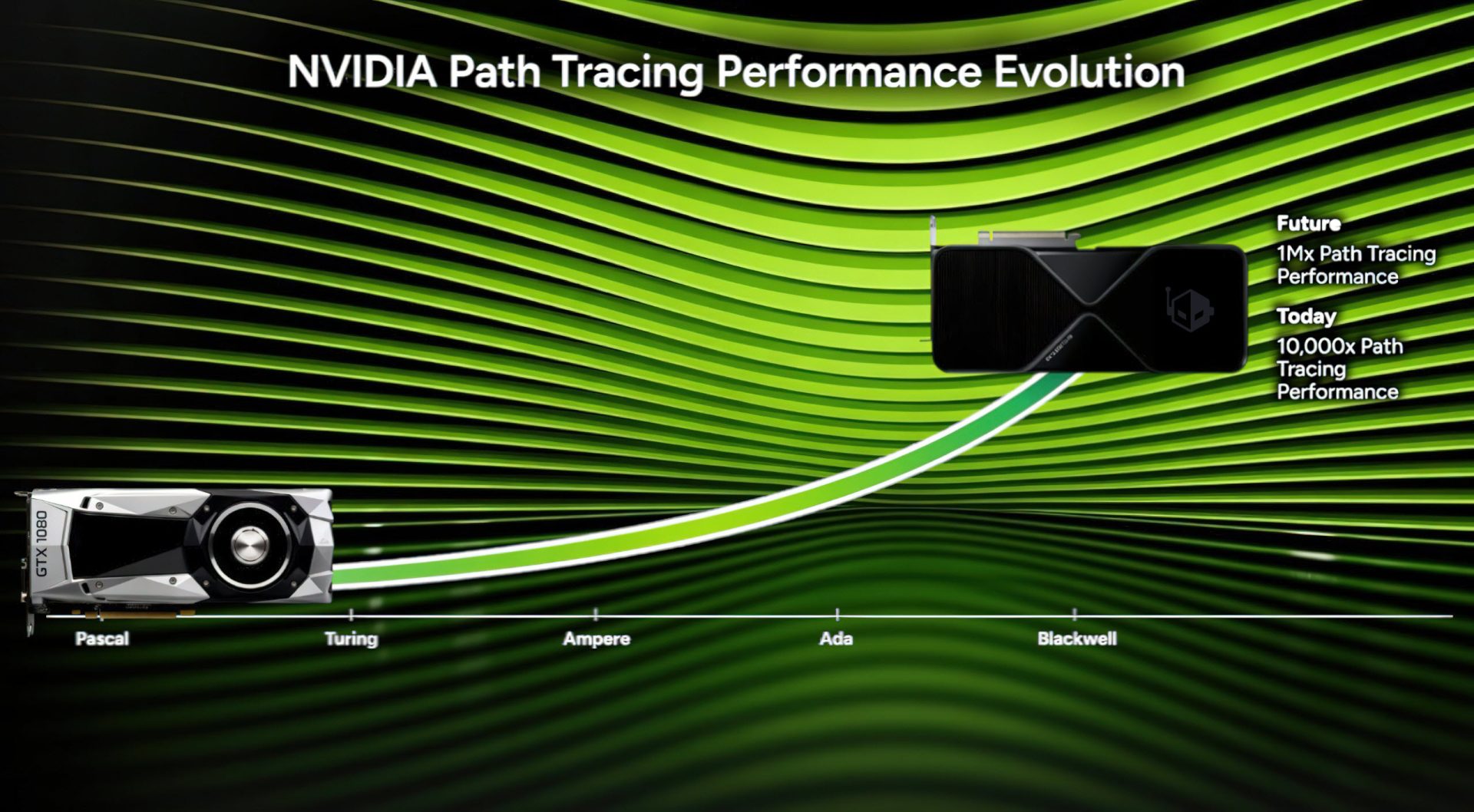
During the event, John Spitzer, NVIDIA’s VP of Developer & Performance Technology, walked through a path tracing roadmap that highlights how each GPU generation has pushed the industry toward more realistic lighting and reflections. The timeline begins with Pascal (the GeForce GTX 10 series) from April 2016. While Pascal was a major architecture at the time, it relied on software-based ray tracing, making true real-time ray tracing and path tracing impractical for most games.
That changed with Turing (the GeForce RTX 20 series) in 2018, which introduced dedicated ray tracing hardware and helped launch the RTX era alongside DLSS. But NVIDIA admits that even with better RT hardware in the generations that followed, the company couldn’t simply “brute force” its way to huge ray tracing performance gains. The reason, according to Spitzer, is straightforward: Moore’s Law isn’t scaling the way it used to, so raw silicon improvements alone won’t deliver the kind of 100x leaps required to make real-time path tracing look like film-quality rendering.
Instead, NVIDIA is betting on “multiplicative” improvements: smarter algorithms, newer RT cores, more capable Tensor cores, and rapidly evolving DLSS features that reduce the workload required to produce high-quality frames. NVIDIA claims that, taken together, these advancements have produced a 10,000x path tracing performance increase from Pascal to today’s Blackwell-era capabilities, thanks to modern RT/Tensor hardware, DLSS 4.5, and SDK-level innovation. DLSS 4.5 is described as being able to infer 23 out of 24 pixels rendered, underscoring just how central AI reconstruction has become to NVIDIA’s real-time graphics strategy.
Even with that claimed 10,000x jump, NVIDIA says it still isn’t “where they want to be.” The end goal is real-time imagery that’s indistinguishable from reality—closer to film rendering than traditional game graphics. And that’s why the company is now pointing to an even more ambitious long-term target: a 1,000,000x (1Mx) improvement in path tracing performance over Pascal with future GPU generations. NVIDIA suggests this could arrive in the era of its next major architecture leaps, potentially as early as the Rubin generation expected around 2027–2028, though the company’s broader point is that the path to that milestone depends far more on AI and rendering techniques than on raw transistor scaling.
Alongside the performance roadmap, NVIDIA also pointed to a growing wave of upcoming path tracing game releases. The company expects more titles to adopt path traced lighting, reflections, and global illumination this year, including:
Resident Evil Requiem (already released)
Pragmata
007 First Light
Control Resonant
Directive 8020
Tides of Annihilation
To push path tracing forward, NVIDIA also detailed two major technologies designed to improve realism and efficiency.
The first is ReSTIR, described as a recent spatiotemporal resampling approach aimed at more accurate path traced global illumination—essentially improving how light transport is simulated in a scene. NVIDIA’s examples emphasized better mirror reflections, improved lighting accuracy, and more believable scenes even with complex details.
The second is RTX Mega Geometry, a technology NVIDIA says is getting an updated version in The Witcher IV. The focus here is tackling the heavy geometric complexity that can bog down path tracing workloads, especially in detailed environments.
Spitzer also highlighted a very practical visual challenge for real-time path tracing: foliage. Leaves and plants introduce enormous geometric detail and “depth complexity” (many overlapping layers per pixel), and they often move dynamically in the wind. NVIDIA’s approach to making this feasible includes opacity micromaps (OMMs), described as a kind of efficient “cookie cut” technique that helps determine whether rays hit or pass through fine details like individual leaves—improving performance without sacrificing visual fidelity.
On the AI side, NVIDIA revisited DLSS and its adoption curve, noting that the technology grew from an unsteady start to support in more than 800 games. The company also claims that roughly 90% of gamers enable it, and that Streamline has helped speed up adoption across more titles.
Looking ahead, NVIDIA says it will roll out DLSS 4.5’s Multi Frame Generation (MFG) 6X mode later this month. The idea is to generate up to six frames, and to add a dynamic mode that can switch frame-generation behavior based on target resolution. NVIDIA says transitions between modes are instantaneous and designed to avoid stutters or frame pacing issues.
Taken together, NVIDIA’s message is clear: the next major leaps in gaming visuals won’t come from brute-force GPU horsepower alone. The roadmap for faster path tracing performance, more realistic lighting, improved neural rendering, and smarter upscaling is increasingly tied to AI-driven rendering techniques and RTX platform advancements—especially as the industry moves toward real-time graphics that aim to match the look and feel of film.