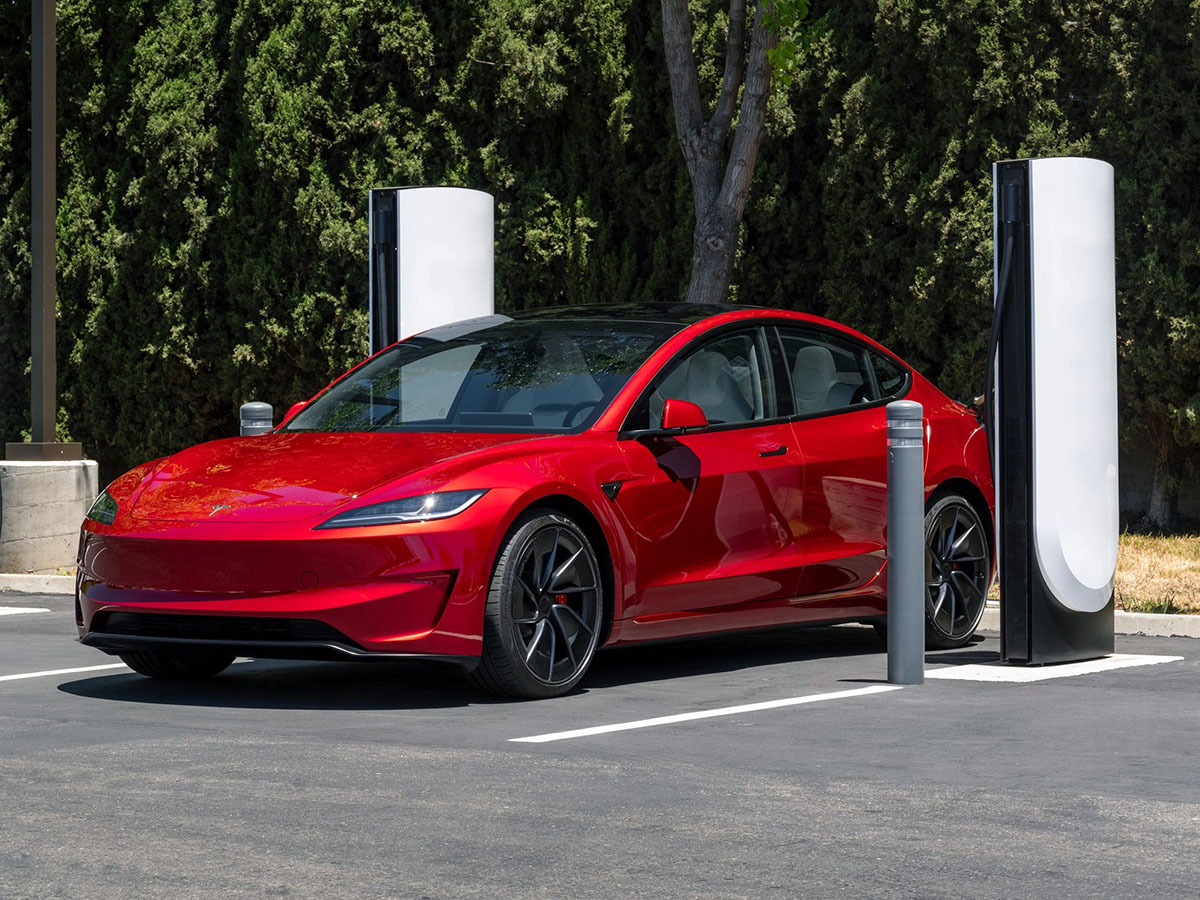
Shave time off your next Supercharger stop: Tesla says its battery preconditioning now adapts to the seasons to help deliver the quickest possible charging speeds. When you set a route to a Supercharger in the car’s Trip Planner, the system uses energy from the high‑voltage battery to warm the pack to the sweet spot for ion transfer. Hitting that ideal temperature on arrival is critical for peak charging performance, especially in cold weather.
What’s new is how the software responds to fluctuating ambient temperatures. By factoring in the weather and time of year, Tesla’s automatic preconditioning can better predict how much heat the pack needs before you plug in. Under the right conditions, the company says this seasonal awareness can trim roughly ten minutes from a Supercharger session. That’s meaningful time saved on road trips or busy charging days.
The benefit is particularly relevant because many Tesla models still run on a 400V architecture with a 250 kW peak, which makes them sensitive to pack temperature if you want consistent fast‑charge speeds. Some rivals are pushing 800V systems and claim ultra‑high charging peaks—up to 1 MW—aimed at ultra‑short top‑ups under ideal circumstances. In that context, smarter thermal prep helps Teslas close the gap in real‑world stops.
Even the Cybertruck, which does use an 800V setup, doesn’t escape the physics. Its 4680 cells aren’t the most thermally efficient, so the charging curve still depends heavily on arriving with a warm battery and a low state of charge. At the latest 500 kW V4 Superchargers, getting to 80% typically takes about 35 minutes in ideal conditions. Optimized preconditioning shaves off some of that time by ensuring the pack is ready to accept higher power earlier in the session.
This approach leans on Tesla’s global Supercharger data and local weather conditions. The company even showcased a time‑lapse of ambient temperatures across its network to underline how dynamic the environment can be from station to station and season to season.
To make the most of it, navigate to the Supercharger in your car rather than just showing up. That triggers preconditioning automatically, letting the battery warm as you drive. Arriving with a lower state of charge further boosts initial charge power, getting you back on the road faster.
The takeaway is straightforward: thermal management is the hidden lever behind fast charging. By adapting preconditioning to the seasons, Tesla is squeezing more real‑world speed out of existing hardware, reducing wait times without changing the car’s peak power rating. For drivers, that means fewer minutes parked and more miles covered.