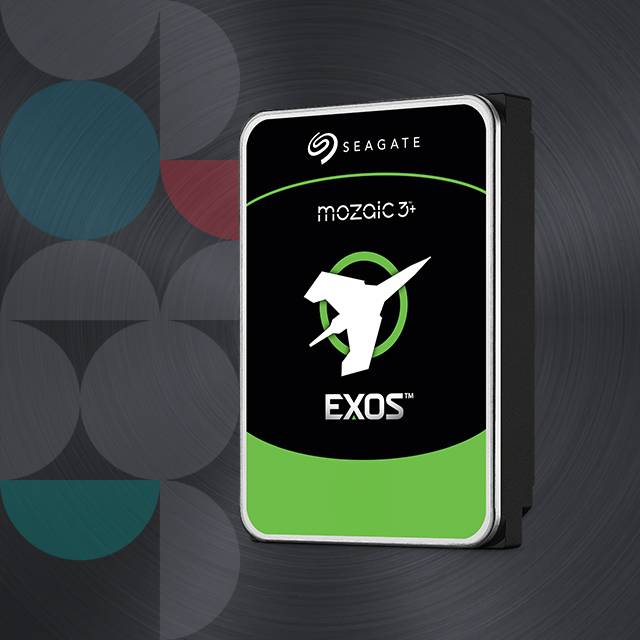
Seagate® Technology Holdings plc (NASDAQ: STX), a pioneer in data storage solutions, has introduced a new chapter in technology with the launch of the Mozaic 3+™ platform. This revolutionary development leverages the company’s advanced implementation of Heat-Assisted Magnetic Recording (HAMR) technology to achieve record-breaking areal densities exceeding 3TB per platter, with future projections reaching up to 5TB.
The Mozaic 3+ platform is the powerhouse behind Seagate’s flagship Exos® series, now boasting hard drives with capacities of 30TB and upwards. These high-capacity Exos drives have begun shipping to hyperscale cloud clients in the current quarter, indicating a significant industry shift.
With a focus on solving industry challenges, Seagate’s areal density advancements allow for more data storage without increasing physical footprint. Transitioning from the prevalent 16TB conventional hard drives to the new Exos 30TB drives powered by Mozaic 3+ technology essentially doubles storage capacity within existing data center spaces.
Additionally, the Mozaic 3+ platform achieves this capacity increase using comparable material components to past hard drives, allowing for marked reductions in both acquisition and operational expenditures for data centers. This includes an impressive 40% improvement in power efficiency per terabyte and a 55% decrease in embodied carbon per terabyte compared to traditional 16TB drives. These improvements resonate with the ongoing pursuit of sustainability in large-scale data management.
Seagate CEO, Dave Mosley, asserts that Seagate is the sole manufacturer with the areal density capability to reach 3TB per platter and is on the path to achieving 5TB. He highlights the growing importance of areal density as AI and other data-intensive applications necessitate storing immense volumes of raw data sets.
The Mozaic 3+ platform integrates multiple industry-leading innovations:
Superlattice Platinum-Alloy Media: This approach allows for the stabilization of smaller magnetic grains, enabling higher-density recording essential for reliable storage at nanoscopic scales.
Plasmonic Writer: A cutting-edge, miniaturized plasmonic writer featuring an in-house nanophotonic laser precisely writes data to the media surface thanks to HAMR technology.
Gen 7 Spintronic Reader: To complement the plasmonic writer, the integrated reader employs quantum technology, enhancing the sensitivity of the magnetic field sensors to read the smaller data grains.
12nm Integrated Controller: The controller, a custom-developed system-on-a-chip, orchestrates the technology, offering performance up to three times that of previous generations.
John Rydning, Research Vice President at IDC’s Global DataSphere, emphasizes that improvements in hard drive areal density are key to the efficient expansion of mass storage in data centers. Seagate’s innovation arrives at a crucial time to influence the trajectory of increasingly higher capacity hard drive products for the foreseeable future.
Aside from cloud datacenters, the Mozaic 3+ technology is suitable for a host of applications across enterprise, edge, NAS, and video and imaging (VIA) markets.
To discover more about the Mozaic 3+ technologies and product offerings, interested parties can find additional information and resources on this dedicated page.
About Seagate Technology, the company has held the forefront of sustainable mass-data storage innovation for over 45 years, delivering more than four billion terabytes of data capacity. Seagate’s comprehensive range of storage devices, systems, and services extend from edge to cloud. For further insight into Seagate’s storage innovations, visit http://www.seagate.com and connect via the company’s social media channels including Twitter, Facebook, LinkedIn, and YouTube.