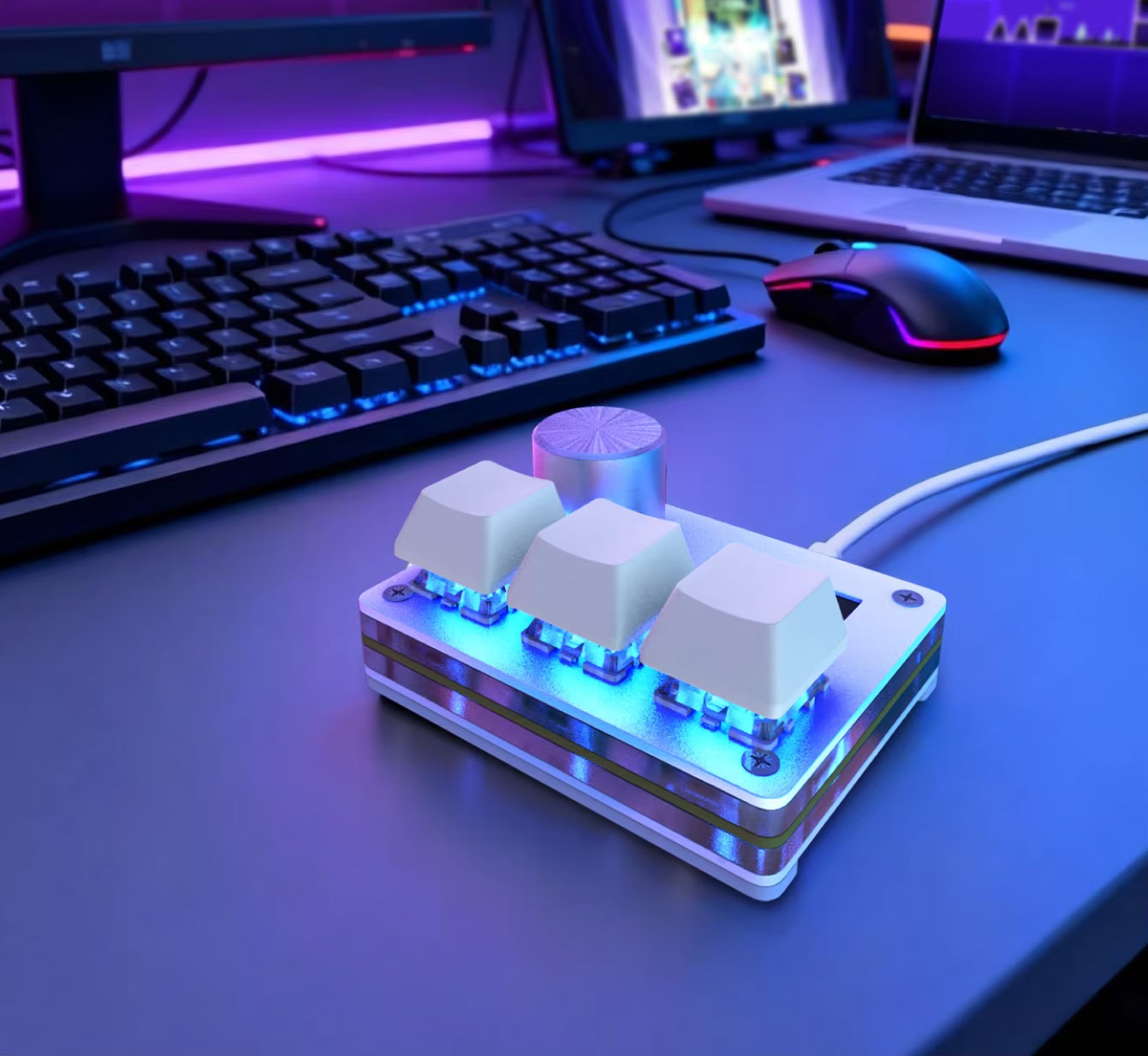
If you play rhythm games like osu! or Geometry Dash, you already know the biggest enemy isn’t always difficulty, it’s latency. That’s exactly the problem the SayoDevice O3C mini is trying to solve: delivering ultra-fast, repeatable inputs with Hall-effect magnetic switches in a tiny keypad that’s currently selling for less than $30 on AliExpress.
Hall-effect switches have quickly become a favorite in competitive gaming, especially for players who care about fast actuation, consistent performance, and rapid key resets. Unlike traditional mechanical switches that rely on metal contacts, Hall-effect designs use magnetic sensors to detect movement. In practical terms, that can translate to cleaner, faster triggering and the ability to recover instantly for repeated taps, a major advantage in high-level rhythm play where every millisecond and every micro-movement matters.
The SayoDevice O3C mini keeps things simple in the best way. It’s a three-key keypad built specifically for speed, and it supports an extremely low customizable actuation point down to 0.05 mm. That means you can set the keys to trigger with a very small press, helping reduce finger travel and improving rapid-fire input consistency. Another key benefit of magnetic sensing is dynamic reset behavior: the switch can reset as soon as it moves upward, rather than needing to pass a fixed point like many standard mechanical switches. For fast alternating presses, that difference can feel significant.
Buyers can choose from several switch options, including Outemu Pink, Gateron KS-20 White, or Gateron Jade Pro Green variants. The keypad also includes hot-swappable switch sockets, and it supports magnetic pole/axis setups with a simple one-click calibration process, making it easier to tweak or replace switches without turning the device into a project.
Where the O3C mini gets especially interesting is how much extra functionality is packed into such a small, budget-friendly device. It has a 0.96-inch IPS color display that can show real-time telemetry such as key travel distance and a keystroke counter. For players who like to fine-tune settings, being able to see this data live can make dialing in actuation and feel much more straightforward. The screen can also be customized through a web-based configuration tool, letting you add custom text, user IDs, or even images.
Next to the display sits a programmable aluminum rotary knob. Depending on how you map it, the knob can handle practical tasks like volume control or be used for scrolling through song lists, which is a nice quality-of-life upgrade for rhythm game setups.
Design-wise, the keypad uses an ABS plastic chassis and includes customizable RGB backlighting for those who want a more personalized look. It’s clearly built to be compact and functional rather than luxurious, but it aims to deliver the performance features people usually associate with much more expensive Hall-effect gaming keyboards.
As with many popular budget peripherals, user feedback online is mixed. Plenty of comments praise the input responsiveness and low-latency feel, while others point out that to fully capitalize on high polling rate claims like 8000 Hz, the device’s underlying scan rate also needs to match for truly optimal theoretical performance. In other words, real-world performance may feel great for most players, but the most technical users are still debating whether it hits the absolute ceiling that the specs suggest.
Price is a big part of the appeal. The SayoDevice O3C mini has been spotted on AliExpress for around $29.13 at a discount, compared to a listed MSRP of $68.37. For players looking to experiment with Hall-effect speed, ultra-low actuation, and a purpose-built rhythm keypad without spending premium keyboard money, it’s positioned as a surprisingly feature-rich entry point.