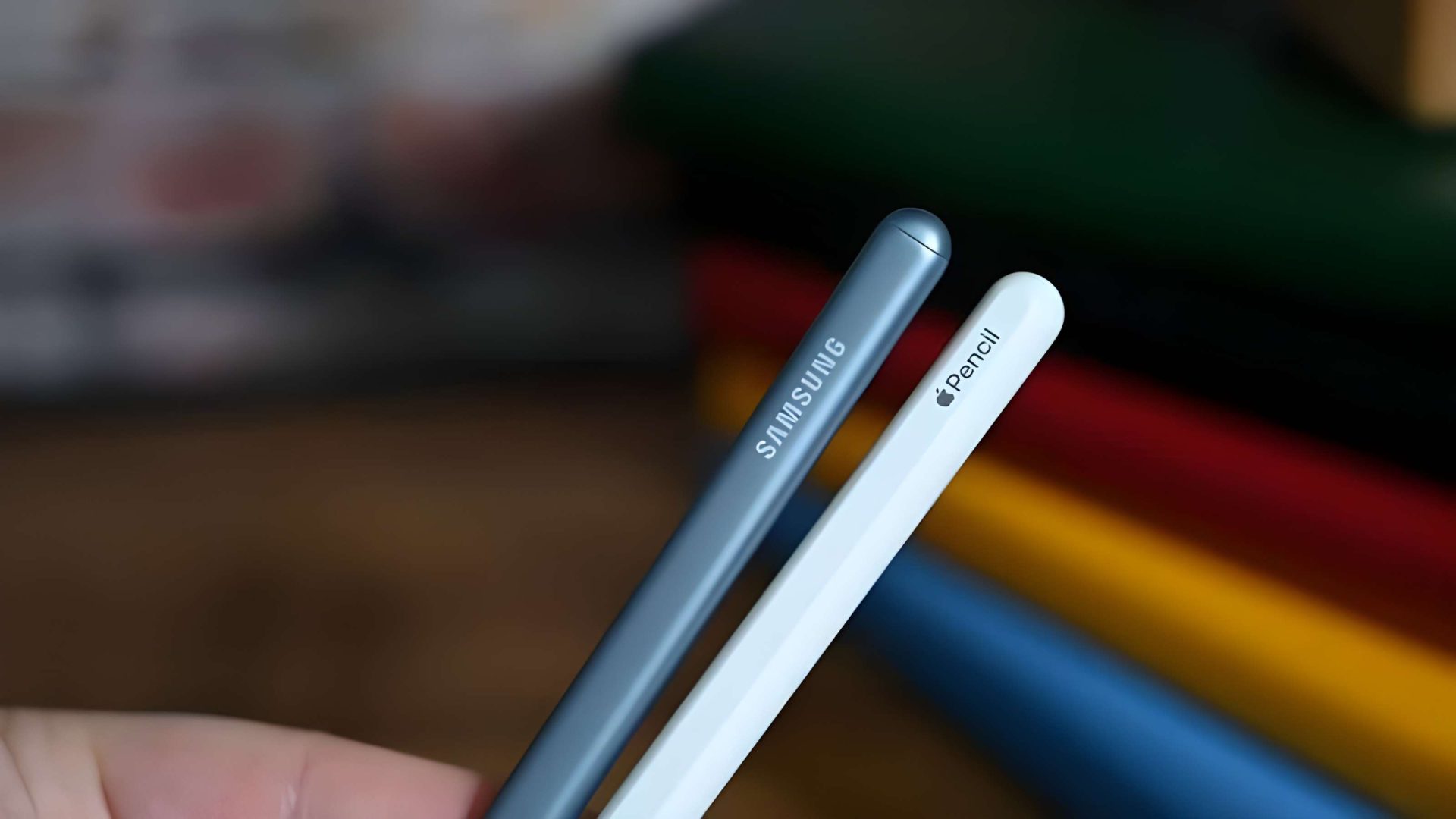
Samsung has been in the stylus game for a long time. The first S Pen arrived in 2011, giving Galaxy Note and later Galaxy Ultra users a built-in digital pen years before Apple introduced the Apple Pencil in 2015. But a new rumor suggests Samsung may be ready to rethink how the S Pen works at a fundamental level—and in the process, bring the S Pen much closer to the technology used in Apple’s latest Pencil.
The big difference comes down to what powers the stylus and how the display detects it. On many Galaxy phones and tablets that support S Pen input, Samsung relies on a special digitizer layer under the display. That digitizer creates an electromagnetic field that the S Pen can use for power and precise tracking, allowing the pen to function without needing a large internal battery. Newer S Pens do include a small battery, but mainly to support Bluetooth features such as remote gestures and “Air Actions,” rather than basic writing and drawing.
The rumored next-generation S Pen could flip that approach. According to a tipster, Samsung may move toward a system where the stylus itself generates signals—capacitive and Bluetooth—that the screen detects directly. In that setup, the phone or tablet wouldn’t need to continuously emit an electromagnetic field to power the pen, potentially allowing Samsung to simplify the digitizer hardware inside the device.
If Samsung goes this route, it could have a few major consequences, especially for a future flagship like the Galaxy S27 Ultra. First, the S Pen would likely need a larger battery than current models, since it would be responsible for producing the necessary signals. That opens the door to more advanced wireless charging options for the pen, including the possibility of Qi2.2-style charging support. However, it also raises practical questions about power sharing and how Samsung would manage charging reliably while keeping the stylus compact enough to fit into an Ultra phone chassis.
Beyond power and charging, this shift could also set the stage for new features that users typically associate with high-end creative styluses. If Samsung is indeed aiming for the same class of experience, the next S Pen could add gesture-based controls such as squeeze actions, more refined haptic feedback to improve precision and “feel,” and motion-based tools like a gyroscope-driven barrel-roll effect for better brush control in drawing and design apps.
Of course, none of this is official yet, but it’s a notable rumor because it suggests Samsung isn’t just updating the S Pen with small tweaks. Instead, the company may be considering a deeper redesign that changes how the S Pen communicates with the device, how it’s powered, and what kinds of advanced input features it can deliver. If this ends up launching with a future Galaxy Ultra model, it could mark the biggest evolution of the S Pen experience in years—especially for users who rely on the stylus for note-taking, editing, and digital art on the go.