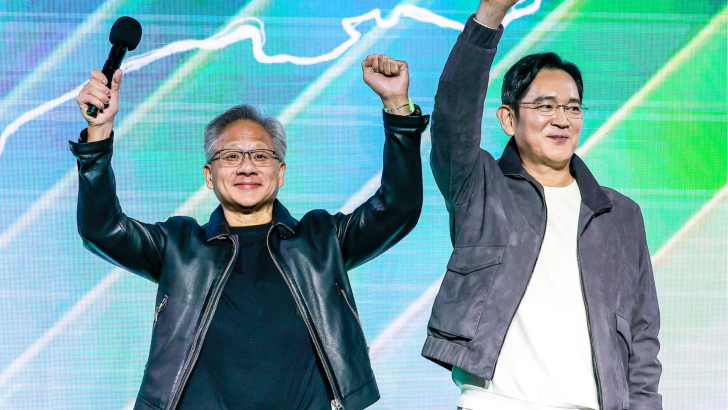
Samsung and NVIDIA are taking their 25-year partnership to the next level with a plan to build a full-scale AI factory powered by more than 50,000 NVIDIA GPUs. This AI megafactory is designed to infuse intelligence into every step of Samsung’s manufacturing pipeline, accelerating the development and production of next-generation semiconductors, mobile devices, and robotics.
At the heart of the initiative is a vision to unify Samsung’s complex global operations into a single intelligent network. AI will continuously analyze, predict, and optimize production conditions in real time, from fab floors to final assembly. To scale this capability, Samsung will lean on NVIDIA’s accelerated computing stack and build advanced digital twin manufacturing environments using NVIDIA Omniverse libraries.
Digital twins will serve as virtual replicas of Samsung’s fabrication processes, allowing teams to visualize entire factories, detect anomalies early, implement predictive maintenance, and fine-tune production before any changes touch the physical world. Samsung plans to roll out this AI-driven infrastructure across its global manufacturing hubs, including its site in Taylor, Texas.
Beyond the AI megafactory, the two companies are deepening their collaboration across critical technologies that underpin AI-era hardware and software:
– HBM4 memory: Joint work on HBM4 combines Samsung’s 6th‑generation, 10nm‑class DRAM with a 4nm logic base die, targeting speeds up to 11 Gbps to feed data-hungry AI workloads.
– Computational lithography: Samsung reports a 20x performance gain in its lithography pipeline by adopting NVIDIA cuLitho and CUDA‑X for optical proximity correction, using AI to more quickly predict and correct circuit pattern variations.
– EDA acceleration: In partnership with leading Electronic Design Automation providers, Samsung and NVIDIA are developing next‑generation GPU‑accelerated EDA tools to speed IC design, verification, and manufacturing preparation.
– Foundation models: Samsung is training bespoke AI models using NVIDIA accelerated computing and the Megatron framework for large language models.
– Intelligent robotics: Collaboration includes the NVIDIA RTX PRO 6000 Blackwell Server Edition platform and the NVIDIA Jetson Thor robotic platform to enable smarter, AI‑capable robots for industrial and commercial use.
– AI‑RAN networks: Samsung is working with NVIDIA, Korean telecom operators, academia, and research institutions to integrate AI into radio access networks, improving performance, efficiency, and network adaptability.
Why it matters: This move signals a shift toward AI‑native manufacturing and design. With a fleet of 50,000 GPUs and a robust digital twin strategy, Samsung aims to shorten time‑to‑market, improve yields, and boost quality across its products. The expanded scope—spanning HBM4 memory, GPU‑accelerated EDA, advanced lithography, robotics, and AI‑enhanced networks—positions the partnership as a cornerstone of the AI hardware and infrastructure ecosystem.
As the AI factory scales globally, expect broader adoption of digital twins in fabs, faster chip development cycles, more capable AI models, and intelligent automation across factories and networks. For the semiconductor and device industries, this collaboration sets a new benchmark for how AI, accelerated computing, and real‑time simulation can reshape production at massive scale.