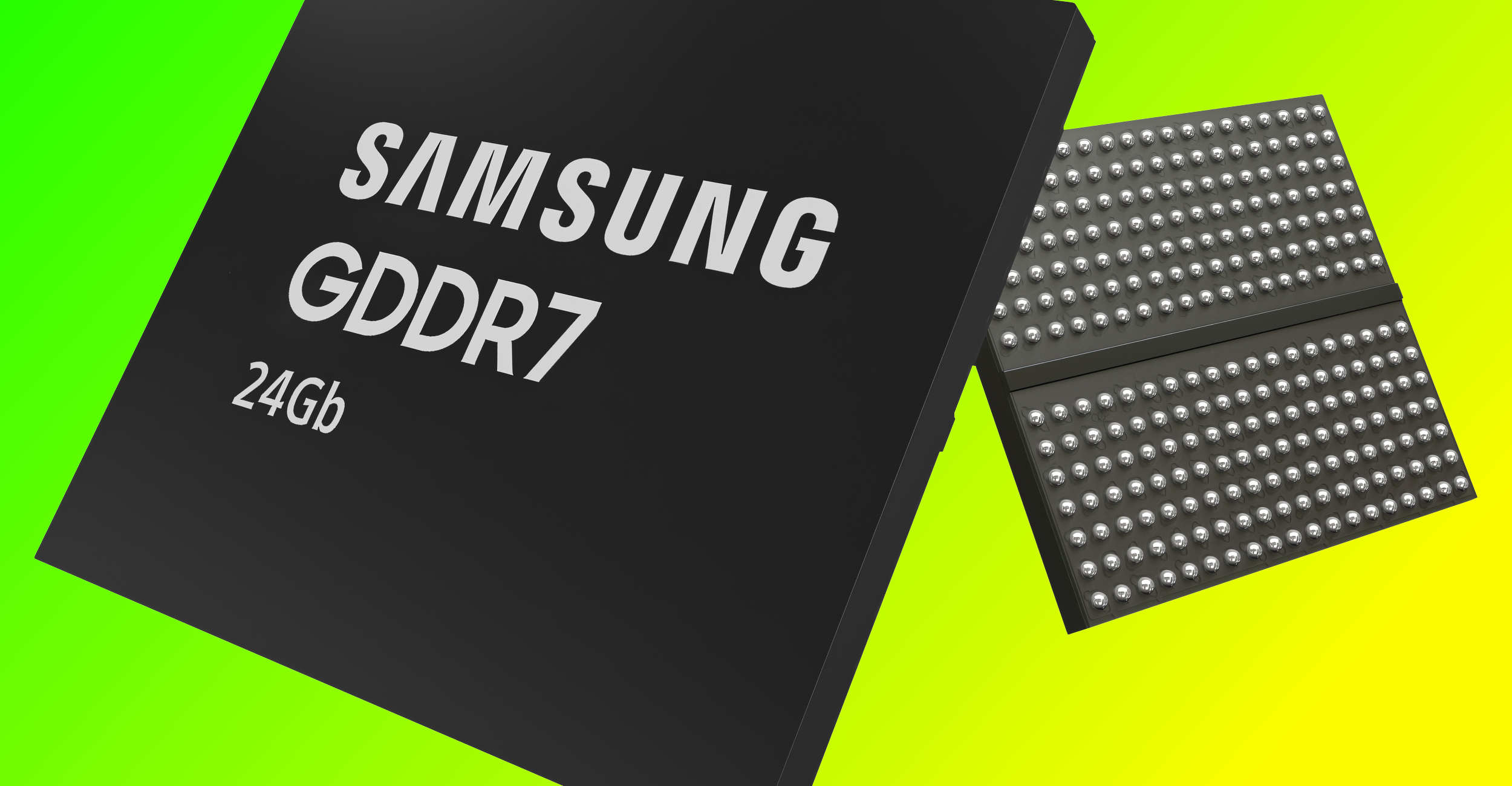
Samsung is propelling the realm of graphics technology into the future by unveiling its groundbreaking GDDR7 memory, boasting an impressive 24 Gb capacity. This cutting-edge development ushers in a new era of enhanced performance and non-standard memory sizes for next-generation GPUs. With GDDR7 memory, Samsung is setting a new benchmark, outpacing the limitations of standard GDDR6 and GDDR6X memory capacities.
Traditionally, graphics cards have been equipped with memory capacities like 8 Gb (1 GB) or 16 Gb (2 GB). However, Samsung’s innovation supersedes these capacities, introducing a remarkable 24 Gb (3 GB) feature, marking the highest capacity the company has ever crafted for graphics cards. This advancement translates to the ability to maintain the same number of memory modules while significantly increasing capacity. For instance, graphics cards that previously maxed out at 8 GB with four modules can now achieve a substantial 12 GB.
Employing 10nm DRAM technology, Samsung’s GDDR7 entices with a 50% density enhancement over its predecessor, GDDR6, all without increasing the physical size of the memory. This makes it a transformative upgrade that offers more without the need for additional space.
As Samsung reveals, this new GDDR7 memory initially targets speeds of 40 Gbps, with the possibility of pushing boundaries to 42.5 Gbps. To put this in perspective, the current peak memory speed in the RTX 40 series hovers around 22.4 Gbps, with speculation around the RTX 50 series hinting at potential speeds of up to 32 Gbps in the RTX 5090 model. Samsung’s innovations are potentially paving the way for even later models or might serve as groundbreaking updates for existing models.
Examining the potential impact of this technology further illustrates its prowess:
– A hypothetical graphics card equipped with eight of these GDDR7 modules at 40 Gbps and a 256-bit memory interface might achieve a total capacity of 24 GB, accompanied by a staggering maximum bandwidth of 1280 GB/s.
– If expanded to twelve modules with a 384-bit memory interface, this could scale up to a 36 GB capacity, with bandwidth soaring to 1920 GB/s.
– Extending further saturation, sixteen modules at a 512-bit memory interface could harness a 48 GB total capacity with an astonishing maximum bandwidth of 2560 GB/s.
As this advanced memory configuration undergoes validation by key GPU manufacturers this year, Samsung eyes the horizon for production commencement next year. While remaining tight-lipped about specific customers or precise production timelines, Samsung’s strides in GDDR7 memory technology are undeniably poised to redefine graphics card capabilities, setting the stage for heightened performance and evolved computing experiences.