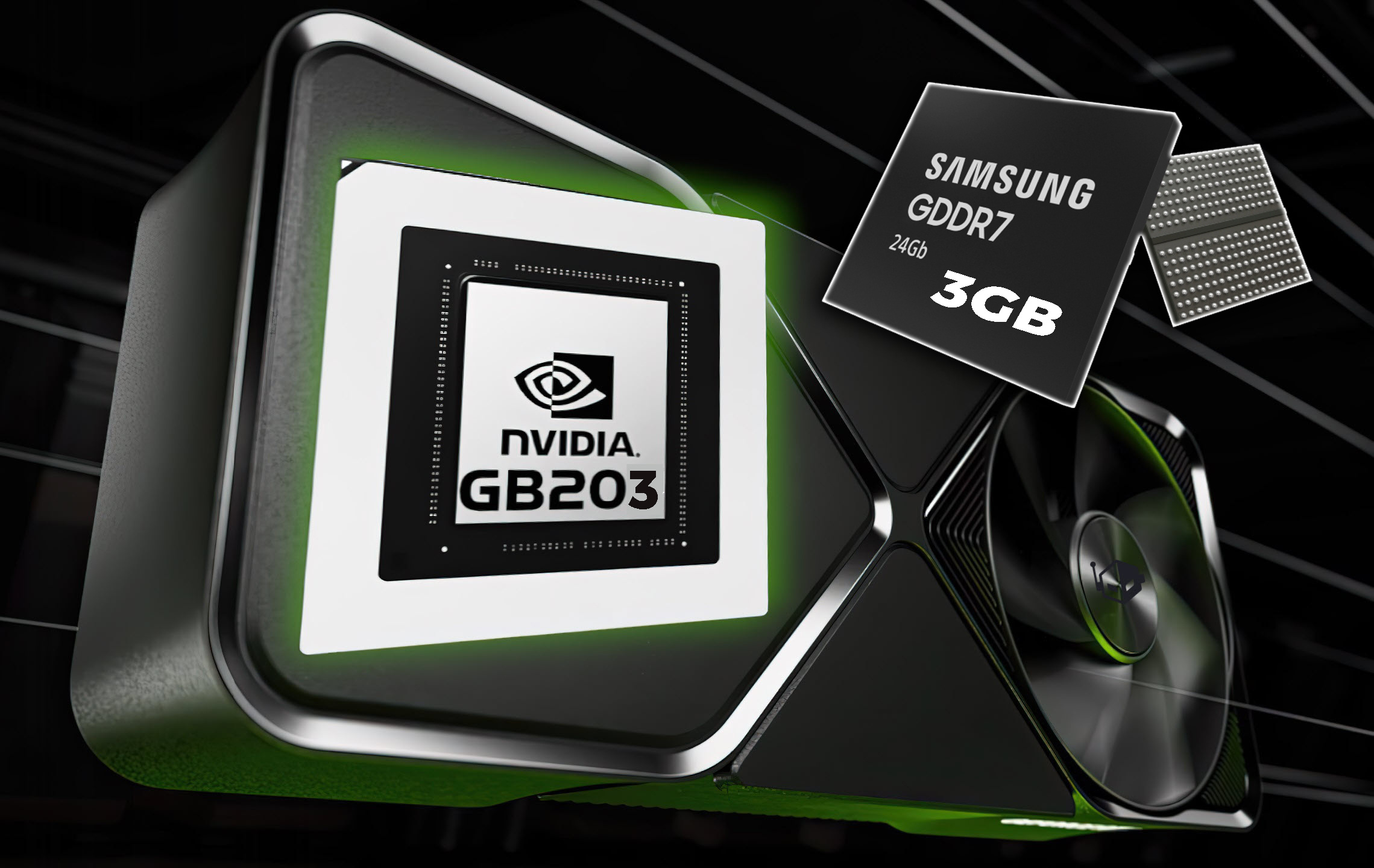
Higher-capacity GDDR7 memory is finally rolling into the market, and it could end up being a big deal for next-gen graphics cards. Samsung has now moved its 24Gb (3GB) GDDR7 memory chip into mass production at 28Gbps, while even faster 32Gbps and 36Gbps versions are already in the pipeline in a sampling stage.
If that sounds familiar, it’s because these 3GB GDDR7 modules have already been spotted in official footage showing an NVIDIA GeForce RTX 5090. Now, Samsung’s own product listing confirms the chip is no longer just a preview piece—it’s heading into full-volume production, signaling that higher-density GDDR7 memory is ready for broader adoption.
The mass-produced part is the 28Gbps model, which aligns with what most GeForce RTX 50-series GPUs are believed to use. One notable exception is the RTX 5080, which is typically associated with faster 30Gbps GDDR7 memory. Meanwhile, Samsung’s two higher-speed 3GB GDDR7 options—32Gbps and 36Gbps—are listed as sampling parts, meaning they exist, they’re being tested by partners, but they’re not yet shipping at the same scale as the 28Gbps version.
The 28Gbps 3GB chip tied to the RTX 5090 visuals carries the identifier “K4vcf325zc-sc28.” Samsung’s faster variants follow the same naming pattern: “K4vcf325zc-sc32” for 32Gbps and “K4vcf325zc-sc36” for 36Gbps. Those model numbers matter because they strongly suggest Samsung is building a full speed stack around the same 24Gb (3GB) GDDR7 capacity—giving GPU makers options to balance cost, performance, and availability.
Why this matters for gamers and PC builders is simple: 3GB GDDR7 modules make it easier to offer more VRAM without requiring a wider memory bus. That opens the door for cleaner VRAM upgrades across product stacks. For example, a card like a potential GeForce RTX 5070 Super could move to 18GB of VRAM instead of 12GB, which would be a meaningful boost for modern games, heavier textures, and higher-resolution settings.
There’s also the performance angle beyond capacity. Faster memory speeds translate into higher memory bandwidth, which can improve gaming performance in bandwidth-sensitive scenarios—especially at higher resolutions, with ray tracing, or in titles that push large amounts of data through the GPU.
The big question is which chips end up in future “Super” class refreshes. Samsung’s production-ready 28Gbps modules are already here, so they’re the safest bet for near-term VRAM capacity bumps. But if NVIDIA (and other GPU vendors) decide to adopt the 32Gbps or even 36Gbps sampling parts later on, refresh models could gain both higher VRAM and a bandwidth uplift at the same time. One rumor floating around is that a GeForce RTX 5080 Super could be a candidate for the faster 32Gbps 3GB GDDR7 modules, though nothing is confirmed.
Timing is still uncertain. DRAM pricing has been rising, and higher memory costs can affect launch schedules and product planning—especially for graphics cards that need large amounts of high-speed VRAM. Even so, Samsung moving 3GB GDDR7 into mass production is a strong sign that the supply side is ramping up, and that higher-capacity GDDR7-based GPUs are becoming increasingly realistic for upcoming releases.
In short: Samsung’s 3GB GDDR7 at 28Gbps is now in mass production, and 32Gbps/36Gbps versions are already being sampled. If GPU makers take advantage of these higher-density modules, the next wave of graphics cards could bring the VRAM increases many gamers have been asking for—potentially paired with faster memory bandwidth for an extra performance edge.


