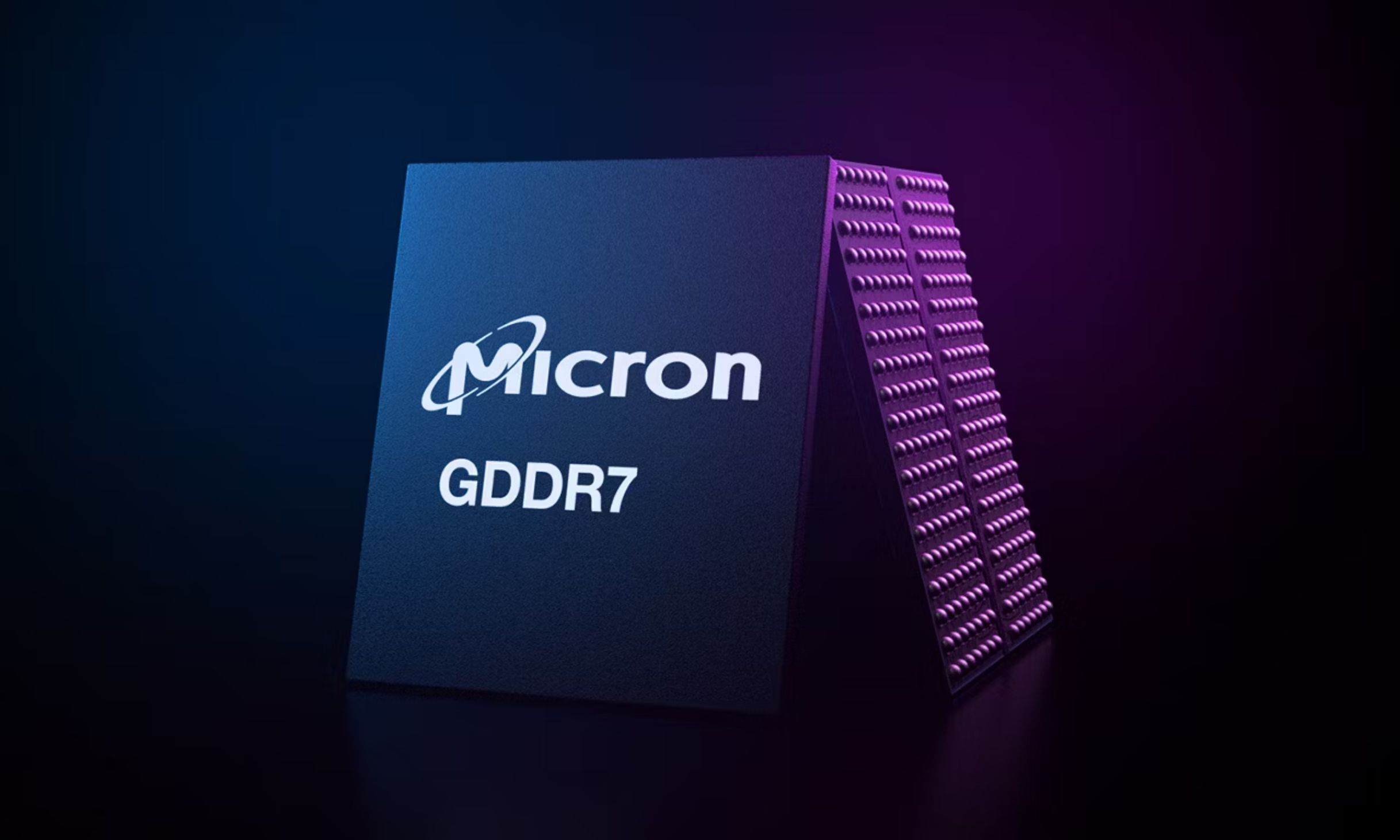
Micron is pushing its next wave of GDDR7 graphics memory toward a sweet spot that matters most right now: bigger VRAM pools, higher bandwidth, and smarter efficiency for both cutting-edge games and fast-growing AI workloads. In its latest update, the company highlights upcoming 24Gb GDDR7 memory chips paired with 36 Gbps data rates, positioning them as a meaningful step up from today’s top-end GDDR7 offerings.
GDDR7 first arrived on consumer graphics cards with NVIDIA’s GeForce RTX 50 series, bringing a noticeable jump over previous generations in speed and overall throughput. Current flagship implementations reach up to around 30 Gbps on the fastest cards, while many configurations sit closer to the 28 Gbps baseline. On the professional side, the newest high-end workstation GPUs have also embraced GDDR7 at very large VRAM capacities, showing how quickly the standard is expanding across gaming and creator markets.
Micron’s 36 Gbps target raises the ceiling again. Compared with 30 Gbps, it’s roughly a 20% increase in raw memory speed, which can translate into better performance in bandwidth-heavy scenarios such as high-resolution textures, ray tracing, and demanding frame generation workflows. The other big part of the story is density: 24Gb chips enable higher VRAM capacity per memory package, making it easier for GPU makers to ship higher-memory graphics cards without radically changing board layouts.
These higher-density modules aren’t purely theoretical. 3GB-per-package designs have already appeared in shipping products, including large-memory professional GPUs and high-end laptop graphics configurations. What’s changing next is that the faster 36 Gbps class of chips is expected to become more common, potentially showing up in future refreshes or next-generation launches as availability improves over the coming product cycles.
Why does this matter so much for real-world gaming performance? Modern PC games are consuming VRAM at an aggressive pace. Real-time ray tracing needs constant access to huge amounts of geometry, materials, lighting data, and shadow information. Ultra-high-resolution textures and high refresh rate displays raise the data load even further, and open-world design increases the volume of assets that must stay ready at any moment. On top of that, AI-assisted rendering is no longer a novelty—upscaling, frame generation, denoisers, and other neural graphics techniques all add models and buffers that fight for space in memory.
When a GPU runs out of fast local memory, it starts shuffling assets in and out more often. That’s when players notice familiar immersion breakers like texture pop-in, stutters, uneven frame pacing, and sudden dips during heavy ray-traced scenes. By increasing both VRAM capacity and bandwidth, next-gen GDDR7 is designed to keep larger datasets resident on the GPU, reducing these bottlenecks and helping maintain smoother, more consistent rendering at 4K and beyond.
Micron also frames GDDR7 as a key enabler for AI on the PC and workstation side. More bandwidth and better efficiency can improve on-device AI inference for creation tools, media workloads, and collaboration features, while helping hybrid computing workflows that spread tasks across CPU, GPU, and NPU hardware. Architectural refinements and lower operating voltages are also aimed at improving performance per watt, which is becoming increasingly important as GPUs scale up.
To illustrate what 36 Gbps GDDR7 can deliver, here are example bandwidth figures by memory bus width along with typical VRAM capacities based on common “sites” (memory package placements):
128-bit at 36 Gbps: 576 GB/s and about 12 GB (4 packages)
192-bit at 36 Gbps: 846 GB/s and about 18 GB (6 packages)
256-bit at 36 Gbps: 1152 GB/s and about 24 GB (8 packages)
320-bit at 36 Gbps: 1440 GB/s and about 30 GB (10 packages)
384-bit at 36 Gbps: 1728 GB/s and about 36 GB (12 packages)
512-bit at 36 Gbps: 2304 GB/s and about 48 GB (16 packages)
Micron has also previously talked about even higher densities and speeds beyond 36 Gbps down the road, while other memory makers have been signaling future chips that push both capacity and data rate further still. The larger industry reality, however, is that supply constraints remain a major factor. Memory manufacturers are still working through shortages, which can delay the arrival of the most advanced configurations in mainstream products.
Even with those constraints, the direction is clear: faster GDDR7 and higher-density VRAM are becoming foundational to the next era of graphics and AI computing. For gamers, that means fewer compromises at higher resolutions, more stable ray tracing, and less hitching in massive open worlds. For creators and AI users, it means more responsive local inference and better throughput for modern neural graphics and generative workloads. As the next waves of discrete GPUs arrive, GDDR7 with 24Gb density and 36 Gbps bandwidth looks set to play a major role in what “high performance” means over the next several years.