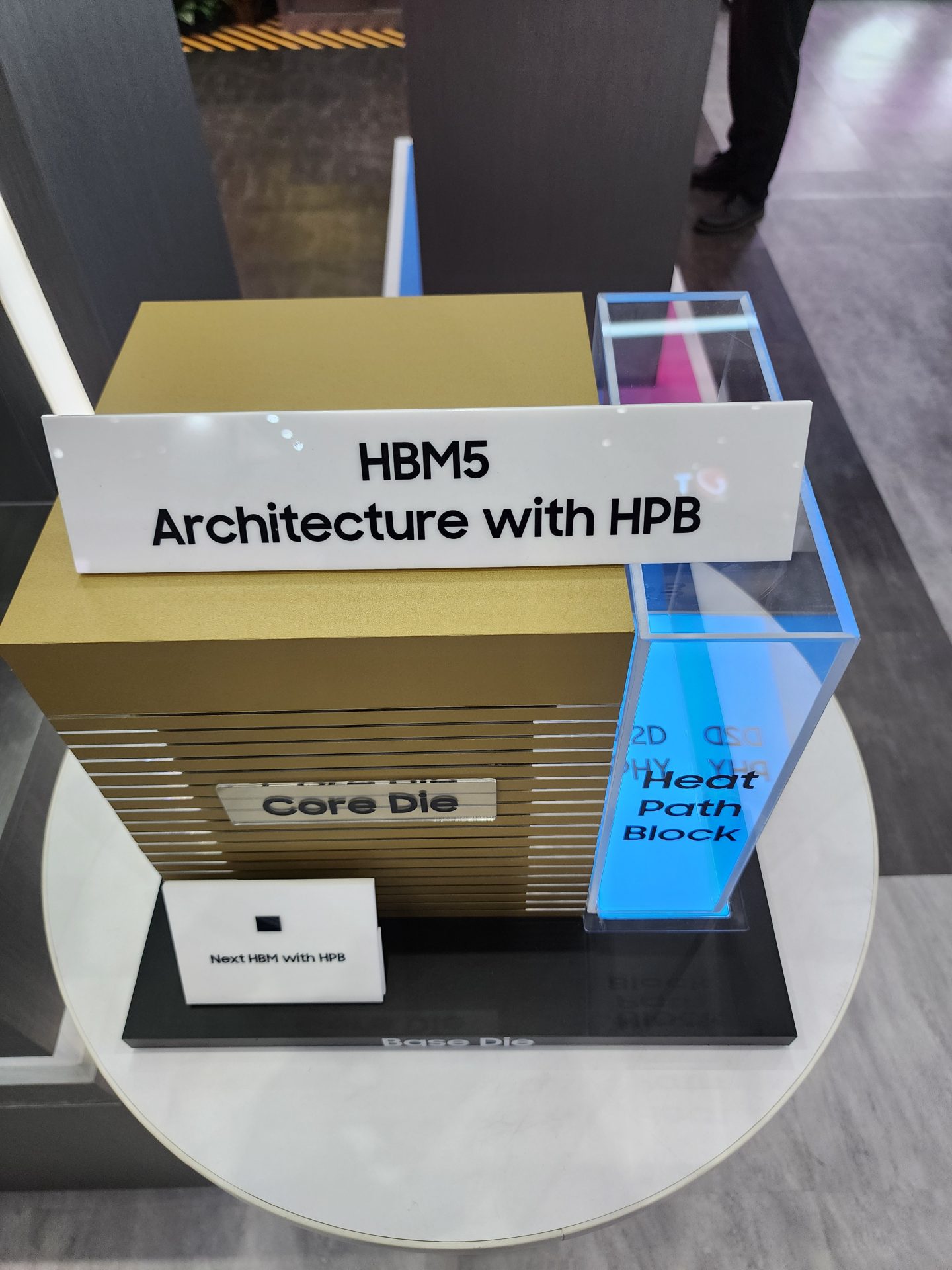
Samsung is moving ahead with next-generation HBM5 memory development, and one of its most important upgrades could be a new thermal design called HPB, short for Heat Block Path. The feature is being prepared to help future high-bandwidth memory stacks manage heat more effectively as AI accelerators, GPUs, and data center processors demand faster and denser memory.
The race for advanced HBM memory is intensifying. Samsung, SK Hynix, and Micron are all developing future HBM standards as demand continues to surge from companies building powerful AI servers and high-performance computing systems. HBM has become a critical component for modern AI hardware because it delivers extremely high bandwidth while sitting close to the processor, allowing faster data movement and better efficiency compared to traditional memory solutions.
As HBM stacks become taller, faster, and more complex, heat management is becoming one of the biggest engineering challenges. More memory layers mean more performance, but they also create more heat in a very compact space. Without improved cooling structures, future HBM designs could face limits in speed, power efficiency, and long-term reliability.
Samsung’s HPB technology appears to be designed specifically to address that issue. The company has previewed a structure showing how HBM5 memory could incorporate Heat Block Path alongside the DRAM core stack. In this design, the HPB section sits next to the core die stack on the same base die and is connected through a die-to-die physical interface, also known as D2D PHY.
The HPB structure is expected to match the height of the DRAM stack, allowing it to work closely with the memory layers. As heat builds up inside the dense HBM stack, the HPB pathway would help move that heat away more efficiently and transfer it toward the cold plate. This could improve cooling performance and help keep next-generation HBM memory operating at higher speeds without thermal bottlenecks.
This approach shows how important thermal innovation has become for the future of AI memory. HBM5 is not just about increasing bandwidth or adding more capacity. It also requires smarter packaging, better heat dissipation, and improved power handling. If Samsung’s HPB design works as intended, it could play a major role in helping future GPUs and AI accelerators achieve higher performance while staying within practical thermal limits.
Samsung is not the only company working on advanced cooling ideas for future HBM products. Other memory manufacturers are also exploring integrated cooling methods to improve thermal resistance as HBM evolves. However, each company is expected to use its own proprietary design, materials, and manufacturing processes. Samsung’s HPB is likely based on its internal packaging and memory development technologies, while competitors may follow different engineering paths.
The timing also gives memory makers room to refine these designs. The first GPUs and accelerators using HBM5 memory are not expected to arrive until around 2028 or 2029. That means Samsung and other HBM manufacturers still have several years to test, optimize, and validate these technologies with major chip partners.
For the AI hardware market, this development is significant. Data centers are pushing for more powerful accelerators that can train and run larger AI models, but memory bandwidth and energy efficiency remain major limiting factors. HBM5 with improved thermal features could help unlock higher bandwidth, larger memory capacities, and better sustained performance for next-generation AI chips.
Samsung’s Heat Block Path preview suggests that the future of HBM memory will depend on much more than raw speed. Advanced cooling, 3D stacking, base die design, and chip packaging will all be essential parts of the next leap forward. As the competition in high-bandwidth memory grows, HPB could become one of Samsung’s key technologies in the push toward faster, cooler, and more efficient HBM5 memory.