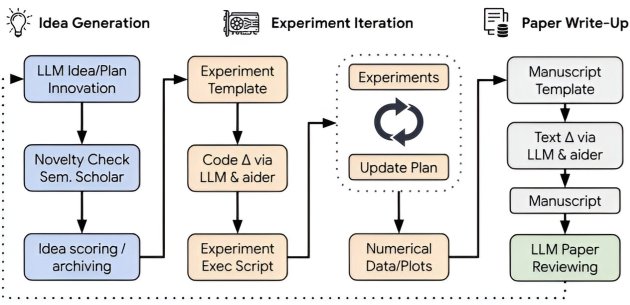
Artificial intelligence (AI) has made incredible strides since its establishment as an academic discipline in 1956. It took several decades to gain momentum, but with the advent of deep learning in 2012 and the transformative transformer architecture in 2017, the pace of progress in AI has rapidly accelerated. One of the latest advancements promises to propel this field even further by introducing a system with the capacity for autonomous scientific research – aptly named “The AI Scientist.”
Crafted through the collaborative efforts of experts from institutions like Sakana AI in Japan, the University of Oxford, and the University of British Columbia, The AI Scientist represents a monumental leap in research methodology. Traditional research can be a slow and laborious process, often limited by human constraints. In contrast, The AI Scientist leverages large language models (LLMs) to work tirelessly around the clock, overcoming these limitations to expedite scientific discovery.
As of its current development stage, The AI Scientist’s primary focus is on self-improvement, investigating ways to enhance its capabilities. The creators of this system assert that it can already produce academic papers that meet academic research standards. This indicates that not only can the system comprehend complex scientific concepts, but it can also communicate its findings effectively within the academic community.
Looking ahead, the prospects of such technology are astounding. A fully realized version of The AI Scientist has the potential to significantly accelerate important research across multiple fields. It could greatly aid in developing new treatments for diseases, such as cancer, addressing the challenges of climate change, and unraveling the mysteries of dark matter and gravity.
Those who are interested in the broader implications of AI and its potential impact on society might find valuable insights in Mustafa Suleyman and Michael Bhaskar’s book “The Coming Wave: Technology, Power, and the Twenty-first Century’s Greatest Dilemma.” This work explores the intersection of technology and power, and the challenges that arise in this dynamic landscape.
As AI continues to evolve, it is clear that systems like The AI Scientist have the potential to redefine the pace and reach of scientific endeavor, creating opportunities for advancements that once seemed beyond our grasp. The benefits of such autonomous research solutions extend beyond academic circles, with the promise of improving quality of life and expanding our understanding of the universe.