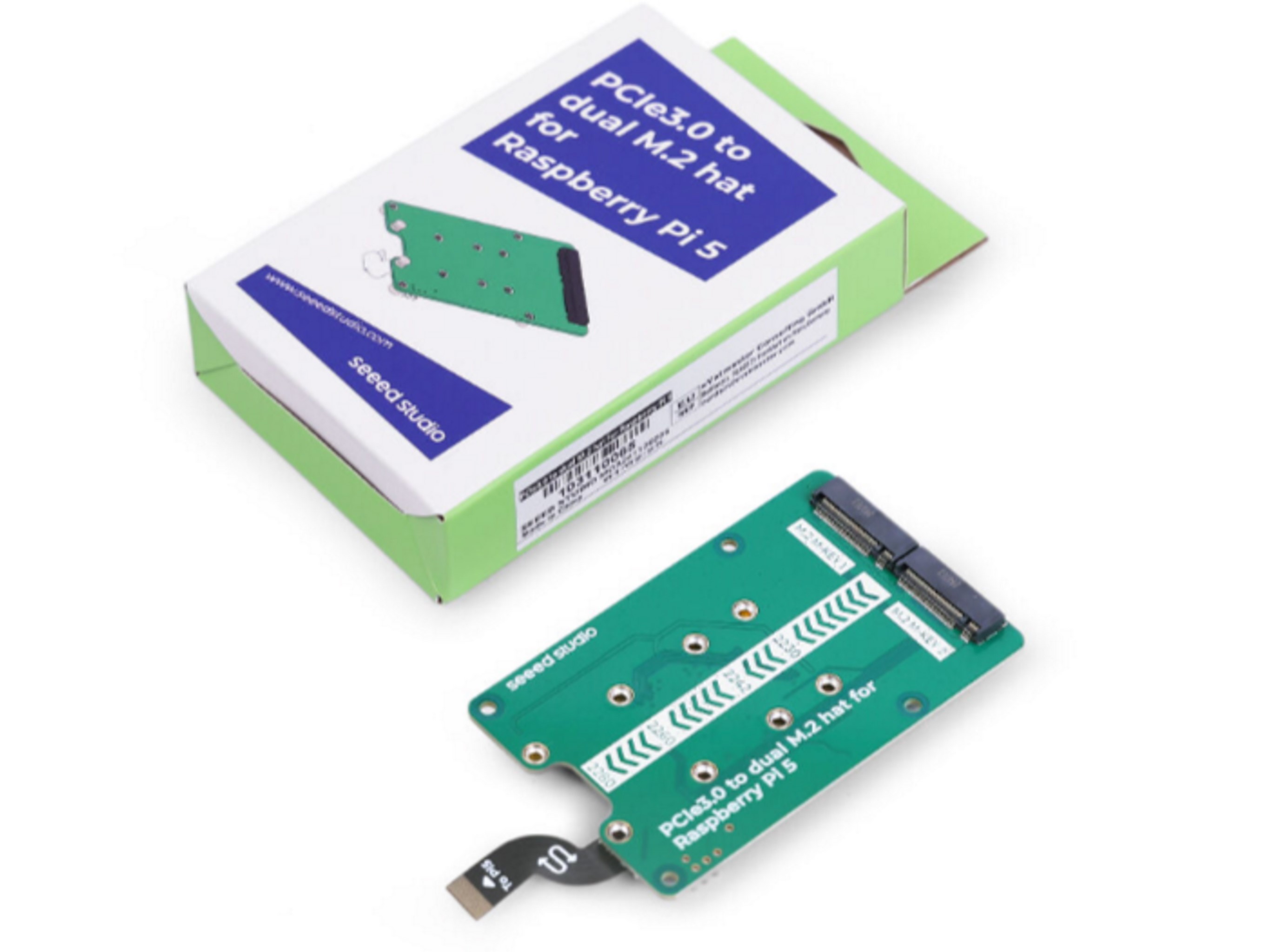
A newly unveiled expansion board from Seeed Studio is set to revolutionize the capabilities of the Raspberry Pi 5 by introducing dual M.2 slots. These slots are designed for SSDs and AI accelerators, bringing a new level of performance and utility to this already versatile platform. Seeed Studio crafted the PCIe 3.0 switch to dual M.2 HAT specifically for the Raspberry Pi 5, utilizing a special PCIe connector that ensures high-speed connectivity and compatibility with high-performance peripherals.
This innovative board supports a variety of M.2 module formats, such as 2230, 2242, 2260, and 2280. While initially crafted for SSD storage expansion to give Raspberry Pi 5 users increased space and speed, these slots are equally adept at supporting AI accelerators like the Hailo-8, enhancing machine learning capabilities.
At its core, the expansion board is driven by the ASM2806 chip, which delivers PCIe 3.0 capabilities. Sequential read speeds can reach an impressive 822 MB/s, with writing speeds close behind at 716 MB/s. Despite the robust performance figures, the Raspberry Pi 5’s PCIe interface can somewhat limit modern SSDs like the Crucial P3 in reaching their full potential. Nonetheless, this board enables users to boot directly from an SSD, adding significant functionality to the single-board computer.
Unlike typical Raspberry Pi accessories, this expansion board distinguishes itself by mounting underneath the Raspberry Pi 5. This setup leaves the GPIO pins free and clear, allowing additional expansion boards to stack atop it while maintaining full access. However, this design poses a challenge with the official Raspberry Pi case due to increased height. Luckily, Seeed Studio offers a solution, providing 3D printing blueprints so enthusiasts can create a custom case fit for their enhanced system.
Available now for $45 USD, the expansion board is shipped from China. Those eager to get their hands on this cutting-edge piece of tech may need to practice patience as they await its arrival. This new addition to the Raspberry Pi ecosystem promises to unleash further potential for hobbyists and professionals alike, enhancing what the Raspberry Pi 5 can achieve in both storage and processing capabilities.