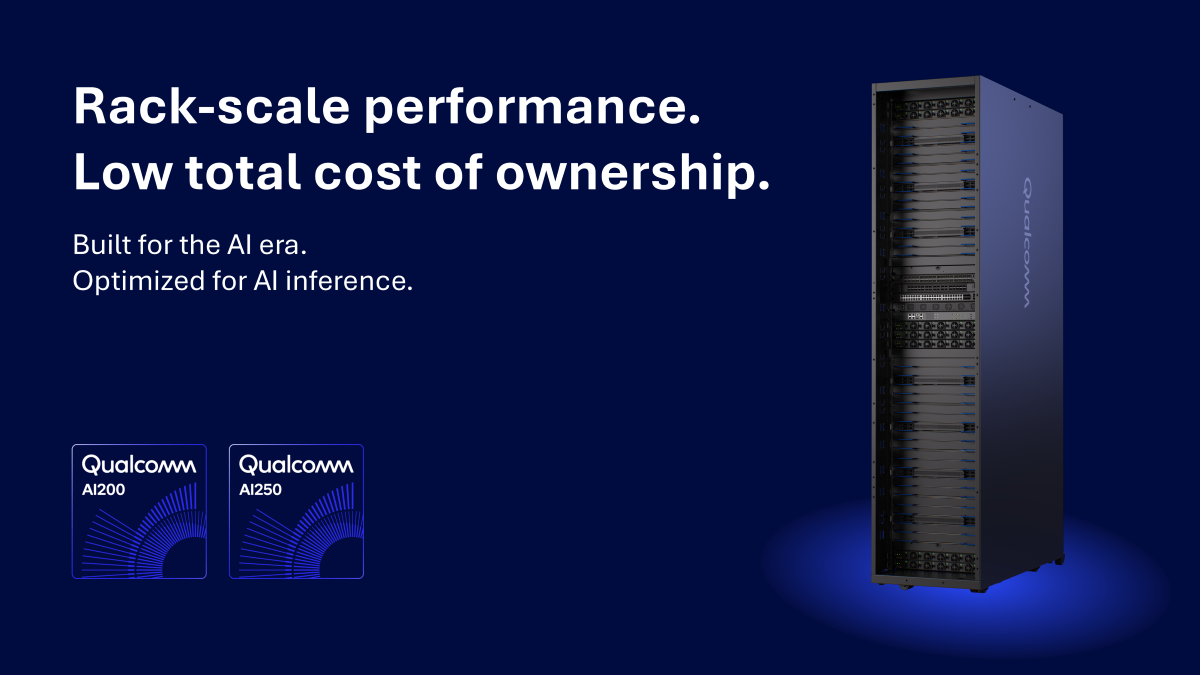
Qualcomm’s new AI200 and AI250 accelerators signal a bold shift in data center strategy, prioritizing efficient, scalable AI inference at the rack level while steering away from HBM in favor of mobile-class LPDDR memory. It’s a calculated move aimed at reducing cost and power draw for real-world inferencing—where total capacity and efficiency often matter more than peak bandwidth.
Instead of the high-bandwidth memory used by many flagship AI accelerators, these solutions pack up to 768 GB of LPDDR directly on the accelerator package. Qualcomm describes this as a near-memory approach designed to limit data movement, improve thermals, and cut costs—key levers for inference at scale.
Why LPDDR over HBM for inference
– Lower power per bit transferred, boosting overall energy efficiency
– More affordable than contemporary HBM stacks
– Higher memory density per package, useful for large models in inference
– Reduced heat output, easing thermal design and cooling
There are clear trade-offs. LPDDR’s narrower interfaces deliver less bandwidth and higher latency than HBM, and deploying mobile-class memory in 24/7, high-heat server environments is less battle-tested. As a result, these racks are purpose-built for inference rather than heavy model training or the largest, most bandwidth-hungry workloads.
What’s inside the AI200 and AI250 platforms
– Direct liquid cooling to handle sustained operation more quietly and efficiently
– PCIe and Ethernet interoperability for flexible deployment
– Rack-level power draw of about 160 kW, relatively modest for modern AI infrastructure
– Hexagon NPUs at the core, expanding inference capabilities with support for advanced data formats and features
This launch lands squarely in a fast-evolving market where many chipmakers are bringing inference-first silicon to the forefront. Recent competitor moves highlight the same trend, with new platforms focused on real-world deployment efficiency rather than chasing only the highest training throughput. Qualcomm’s approach gives cloud providers and enterprises another option: a rack-scale system tuned for cost-effective, thermally sensible, high-capacity inference.
Bottom line: If you need a rack designed to serve large inference workloads with strong memory capacity, lower operating costs, and sensible power envelopes, Qualcomm’s AI200 and AI250 are compelling new entries. For massive model training or the most bandwidth-intensive tasks, traditional HBM-based solutions from incumbent vendors will still be the default choice. But for scalable, efficient inferencing, this LPDDR-first strategy is a timely and thoughtful pivot.