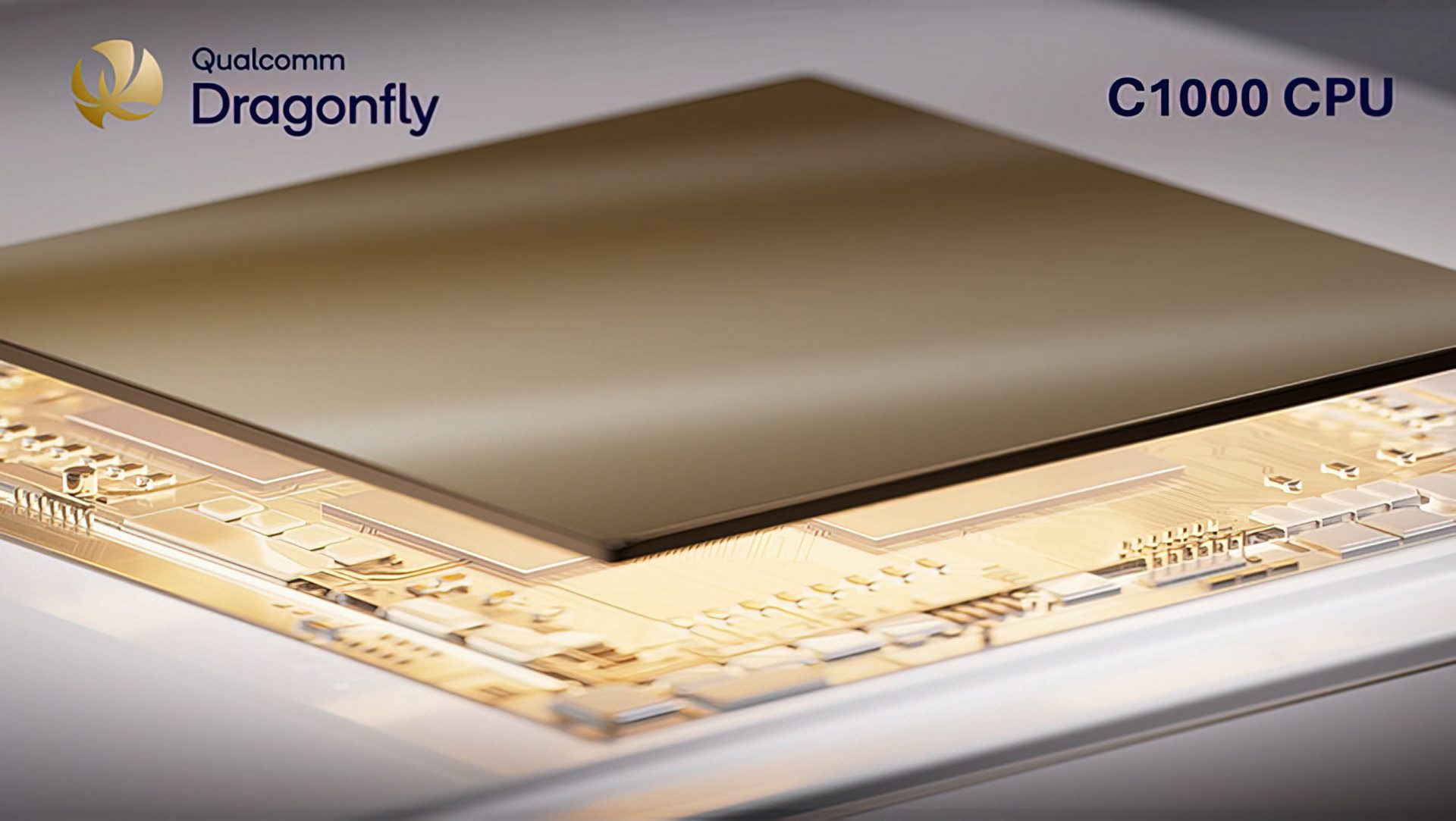
Qualcomm Unveils Dragonfly C1000, Its First Data Center CPU Built for Agentic AI Workloads
Qualcomm is making a major move into the data center processor market with the launch of Dragonfly C1000, its first CPU designed specifically for large-scale server environments. Built around the company’s custom Oryon architecture, the new chip is aimed at agentic AI, general-purpose cloud computing, and high-throughput enterprise workloads.
The Dragonfly C1000 marks a significant expansion for Qualcomm, which is best known for its leadership in mobile processors, connectivity platforms, and AI acceleration. With this new CPU, the company is targeting the fast-growing server processor market, where demand is rising sharply due to generative AI, autonomous AI agents, hyperscale cloud services, and data-intensive computing.
At the heart of the Dragonfly C1000 is Qualcomm’s Oryon CPU core architecture. The company says the design has been optimized for strong per-core performance, with clock speeds exceeding 5 GHz. Qualcomm is also aiming for leadership in single-threaded performance, an important metric for workloads that depend on fast response times, low latency, and efficient task execution.
The chip is designed with agentic AI in mind. Unlike traditional AI workloads that simply process prompts or run predefined models, agentic AI systems can plan, reason, coordinate tools, and perform multi-step tasks. These workloads require fast CPUs to manage orchestration, scheduling, memory movement, and communication between accelerators. Qualcomm is positioning Dragonfly C1000 as a processor capable of handling these demanding tasks at scale.
One of the most notable features of the Dragonfly C1000 is its multi-chiplet design. This approach allows Qualcomm to scale performance, input/output capabilities, and packaging flexibility more effectively than a single large monolithic die. The primary CPU chiplet is expected to include more than 250 cores, giving the platform a high level of parallel processing capability while still focusing on strong individual core performance.
Qualcomm claims the Dragonfly C1000 can deliver more than twice the performance per watt compared with current server CPUs. While the company has not yet shared detailed benchmarks or direct comparisons, the emphasis on efficiency is central to its data center strategy. Power consumption is one of the biggest challenges for hyperscale operators, especially as AI infrastructure continues to expand. A processor that can deliver more compute performance while using less energy could help reduce operating costs and improve total cost of ownership.
Connectivity is another key part of the Dragonfly C1000 platform. Each CPU is expected to support more than 2 TB/s of PCIe Gen7 bandwidth, along with CXL connectivity. This will allow the processor to communicate quickly with next-generation AI accelerators, memory expansion devices, storage systems, and other high-performance components inside modern data center servers.
The chip is also designed to work alongside Qualcomm’s own AI accelerator products. In this role, the Dragonfly C1000 can act as a host CPU for generative AI systems, helping keep accelerators fully utilized by reducing bottlenecks in CPU-side processing. High-speed connectivity and low-overhead orchestration will be important for AI clusters where GPUs, XPUs, and dedicated AI accelerators must operate efficiently together.
Qualcomm’s data center CPU plans appear to include multiple use cases. The company is positioning its server CPU portfolio for agentic AI orchestration, general-purpose cloud workloads, and AI head node systems. For cloud providers, this could mean better performance per total cost of ownership for internal workloads, while also offering improved performance per virtual CPU for elastic third-party cloud services.
The Dragonfly C1000 will also offer an optional high-bandwidth capacity memory attachment. This feature is designed to increase memory capacity and bandwidth, which is increasingly important for AI, analytics, large databases, and advanced cloud workloads. As models and datasets continue to grow, memory performance has become a critical factor in overall system efficiency.
Reliability and security are also major priorities for enterprise and hyperscale data centers. Qualcomm says the Dragonfly C1000 will include advanced reliability, availability, and serviceability features. These include ECC memory correction, fault isolation, and error recovery, all of which are essential for servers that must operate continuously under heavy workloads.
The first platforms based on Dragonfly C1000 are expected to support both air cooling and liquid cooling. They will be designed for OCP ORv2-compliant racks and servers, making them suitable for modern cloud data center deployments. Liquid cooling support is especially important as high-core-count processors and AI systems continue to push thermal limits.
Commercial availability for the Qualcomm Dragonfly C1000 is planned for 2028. By then, the server CPU market is expected to be worth around $200 billion, driven by AI computing, cloud expansion, and growing demand for efficient data center infrastructure.
With Dragonfly C1000, Qualcomm is signaling that it intends to become a serious player in the data center CPU space. The combination of Oryon cores, more than 250 CPU cores, over 5 GHz frequencies, PCIe Gen7, CXL support, and a focus on power efficiency could make the platform an important contender for future hyperscale AI and cloud deployments.
If Qualcomm can deliver on its performance-per-watt claims and secure major cloud partnerships, Dragonfly C1000 could become a key part of the next generation of AI-focused data center hardware.