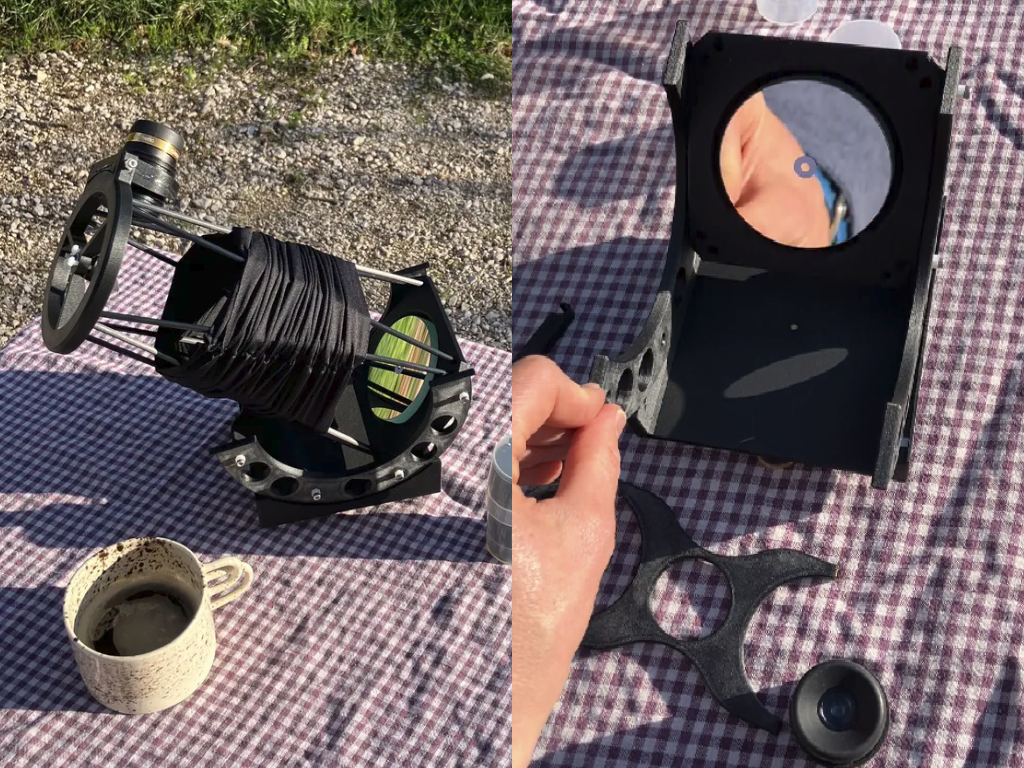
A pocket-sized telescope that actually works sounds like wishful thinking—until you see what developer and hobbyist Lucas Sifoni managed to pull off with a clever 3D-printed build.
In a project shared on November 18, 2025, Sifoni documents the design and real-world testing of an ultra-compact Dobsonian telescope created with one core goal: true portability. The finished scope is designed to slip into the inner pocket of a jacket, with only its carbon rods needing to ride separately. Even with that small exception, the overall form factor is remarkably compact for a functional reflector telescope.
At the heart of the design is a 76 mm parabolic primary mirror paired with a 300 mm focal length, resulting in a fast f/4 optical system. That “fast” setup helps keep the tube short and the overall telescope small, which is essential when you’re trying to build something you can carry like an everyday item rather than a dedicated astronomy kit.
The structure is fully 3D-printed and made using PETG carbon-fiber filament to improve rigidity without adding much weight. Instead of overcomplicating the build with heavy metal parts, the project sticks closely to classic Dobsonian principles: keep it simple, keep it balanced, and make the motion smooth enough that it’s easy to track objects in the sky.
For altitude and azimuth movement (the up-down and left-right motion used to aim at targets), the telescope relies on improvised low-friction pads made from UHMW or HDPE furniture feet, paired with rubber backing. It’s a practical, low-cost approach that supports the Dobsonian idea of using straightforward materials to achieve smooth manual control.
Carbon rods provide key structural support and are intentionally bent into a slight arch so the assembly locks firmly into place. Collimation—crucial for reflector performance—is handled with nylon screws for both the primary and secondary mirrors. The secondary mirror is held in position with magnets, a minimal-hardware solution that helps keep the build compact and easier to assemble.
Focusing is also designed for simplicity. Rather than using a traditional focuser mechanism, the scope uses a friction-based eyepiece holder: the eyepiece slides directly inside a printed tube and stays in place through plastic flexion. That means fewer parts, less weight, fewer points of failure, and no need for extra hardware that would add bulk.
To improve usability outdoors, the build also includes a lightweight Lycra shroud. This helps block stray light (which can reduce contrast while observing) and also slows dew formation on the mirrors—two practical problems that can quickly ruin a small telescope’s performance in the field.
Where the project really earns credibility is in the optical testing and the honesty about limitations. Documentation includes interferograms and star tests from before and after mirror refiguring. Early tests showed the mirror was significantly overcorrected out of the box, a common issue with low-cost optics. After refiguring, the reported results improved notably, with better star symmetry and usable performance around a 0.9 Strehl ratio—roughly 90% of the sharpness a theoretically perfect mirror of the same size could deliver. Of course, a 76 mm aperture still has natural resolution limits, so this isn’t meant to replace larger commercial telescopes for serious deep-sky work.
The takeaway is straightforward: this is not a toy, and it’s not pretending to compete with full-size instruments. It’s a genuinely functional Dobsonian telescope engineered to an unusually small scale, with thoughtful design choices that prioritize portability while still respecting optical fundamentals. The project also makes it possible for others to build on the idea, with publicly shared files, assembly notes, and test results for anyone interested in replicating or modifying the design.