Modern gaming smartphones already prove that serious computing power can live inside tiny devices. Still, one question keeps popping up for curious gamers and DIY fans alike: just how small can a “gaming PC” get and still run a real game?
Tech YouTuber Lecctron recently set out to answer that by chasing a specific goal: finding the smallest possible PC that can run Minecraft. What sounded straightforward quickly turned into a debate over definitions. Plenty of ultra-small boards exist, but if they can’t connect to a monitor in a normal, practical way, do they really count as a usable PC for gaming?
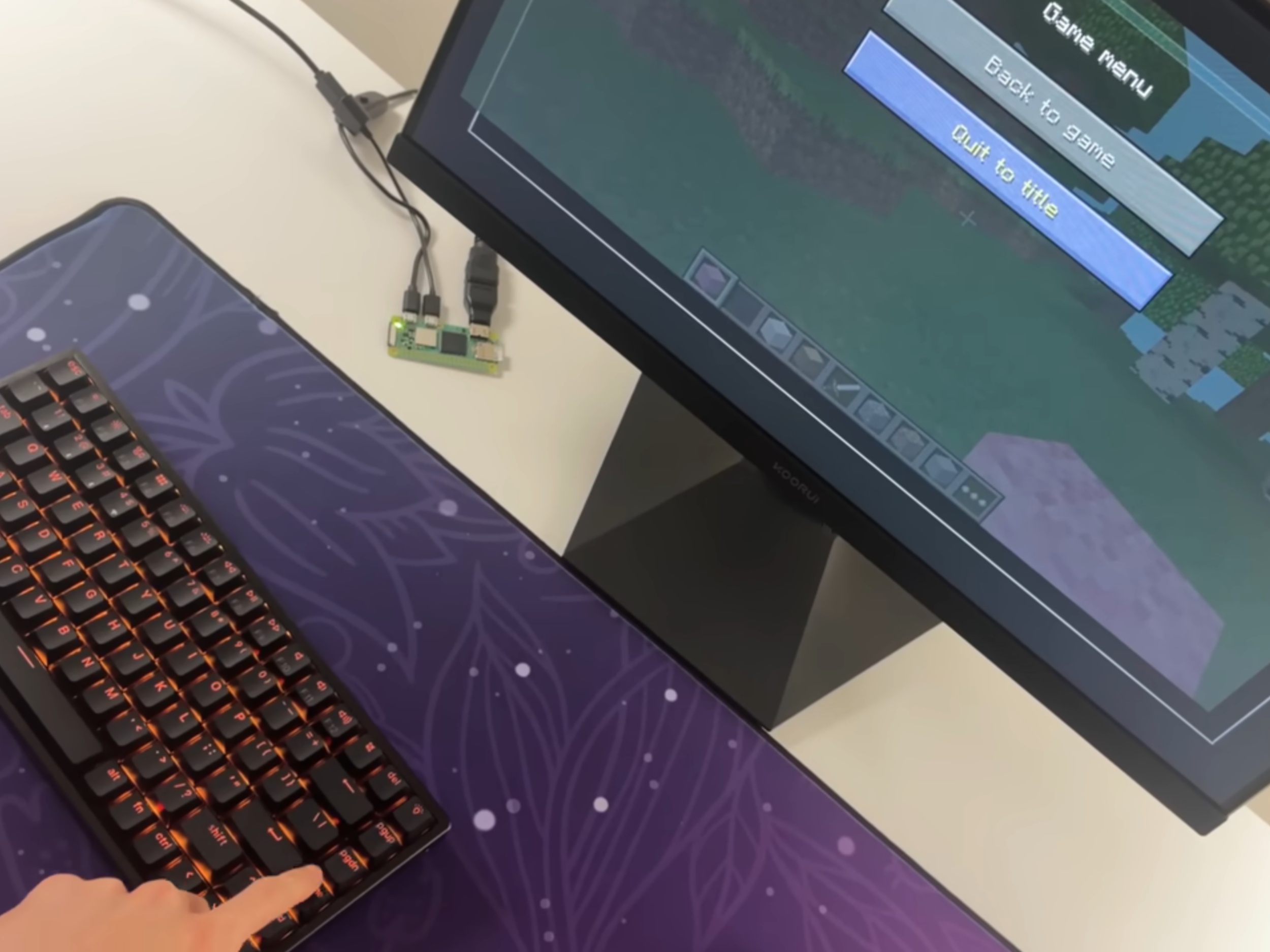
After weighing the options, Lecctron ruled out super-tiny boards that require awkward workarounds just to get video output. Instead, he landed on a device that’s still unbelievably small but actually works like a miniature computer: the Raspberry Pi Zero 2 W.
About the size of a stick of gum, the Raspberry Pi Zero 2 W measures roughly 65 × 30 mm and packs a quad-core CPU, VideoCore IV graphics, and 512 MB of RAM. It supports an operating system and can be hooked up to a display and input devices, making it a realistic choice for a “world’s smallest gaming PC” experiment. While the exact kit used in the video wasn’t available at the time, similar Raspberry Pi Zero 2 W kits tend to sit around the $40 range depending on accessories and availability.
So what can the world’s smallest gaming PC actually play?
To test whether this miniature setup could handle more than just tech-demo bragging rights, Lecctron tried a mix of games and emulators.
Minecraft Pi Edition delivered the headline result: around 60 FPS, though with important limits. The smooth performance came in Creative Mode with a short render distance. It’s not a full modern Minecraft experience, but it does prove the point: yes, a truly tiny PC can run Minecraft in a playable way.
Retro gaming turned out to be where the Raspberry Pi Zero 2 W really shines. PlayStation 1 emulation performed surprisingly well, with games running smoothly enough to be genuinely enjoyable. The test lineup included Doom, Wipeout XL, Silent Hill, Tomb Raider Chronicles, and Final Fantasy IX, all demonstrating that the small hardware can still produce a big hit of nostalgia.
More demanding emulation is where the performance starts to bend. Nintendo 64 games such as The Legend of Zelda: Ocarina of Time and Majora’s Mask do run, but they’re affected by frequent stutters and frame drops. PSP emulation is even more hit-or-miss: lighter titles like LocoRoco and LittleBigPlanet on PSP ran well, while Wipeout Pulse struggled, landing around 15 to 20 FPS.
The takeaway is clear: this isn’t a replacement for a full gaming PC. High-end gaming hardware needs space, power delivery, and—most importantly—cooling. That’s why desktop gaming PCs remain far larger than smartphones and single-board computers.
But the experiment highlights something equally exciting: if your goal is simple gaming, retro emulation, and lightweight titles rather than the latest AAA releases, a tiny single-board PC like the Raspberry Pi Zero 2 W can deliver a fun “mini gaming PC” experience in an almost shockingly small form factor. It’s also a great option for DIY projects, whether you’re building a handheld, a tiny living-room emulator box, or just want to see how far you can push small hardware.