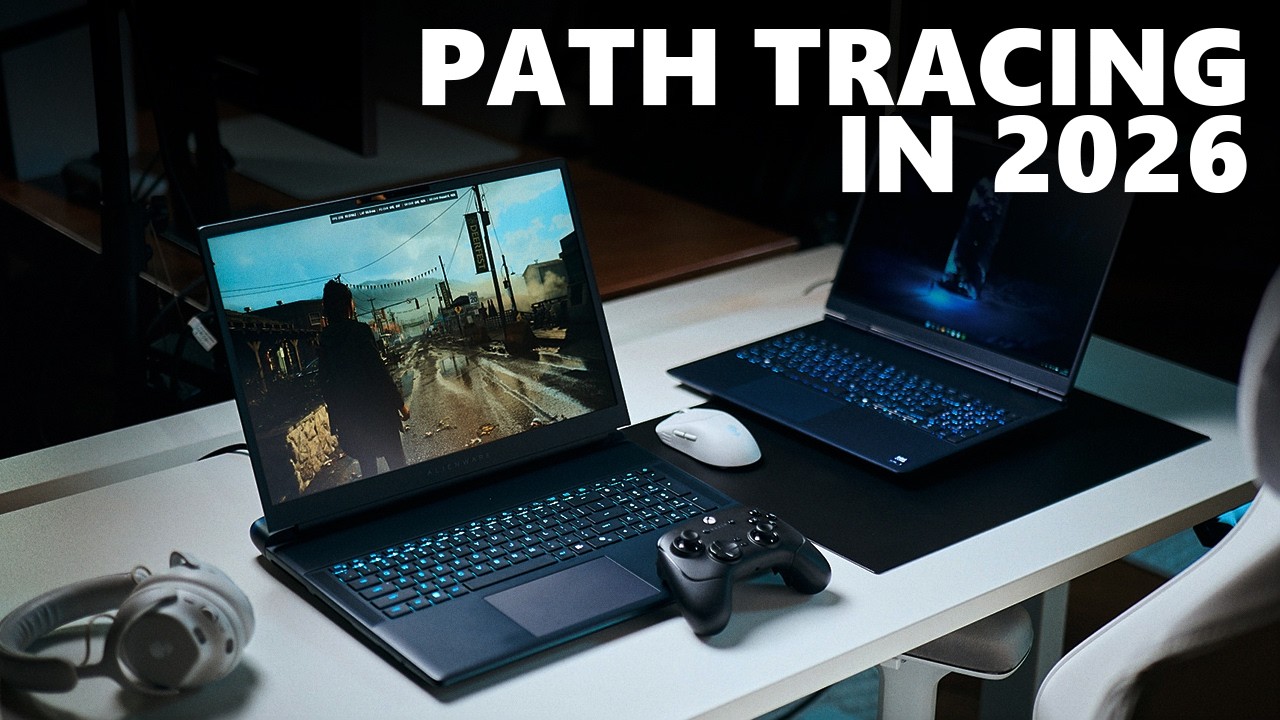
Should You Care About Path Tracing on Gaming Laptops in 2026?
NVIDIA has introduced a fresh upgrade to its DLSS technology suite with DLSS 4.5 Ray Reconstruction, also known as Model F. The big promise is simple: cleaner, sharper, more stable visuals in supported games without demanding a major performance hit. For PC gamers, especially those using gaming laptops, that sounds like a very tempting “free” image quality boost.
But there’s a bigger question worth asking in 2026: should path tracing actually matter to gaming laptop buyers?
Path tracing is one of the most advanced lighting techniques in modern gaming. Unlike traditional rasterized graphics or even standard ray tracing, path tracing simulates light in a more realistic way, creating more natural reflections, shadows, global illumination, and atmospheric effects. When done well, it can make a game look dramatically more cinematic and believable.
The catch is performance. Path-traced games are extremely demanding, and gaming laptops face stricter limits than desktop PCs. Even high-end mobile GPUs have to work within tighter power, heat, and cooling constraints. That means the same visual settings that look smooth on a powerful desktop may be far harder to run on a laptop, especially at high resolutions.
This is where DLSS 4.5 Ray Reconstruction becomes important. NVIDIA’s latest model is designed to improve the quality of ray-traced and path-traced visuals by replacing traditional denoisers with AI-based reconstruction. In simple terms, it helps clean up the image, reduce visual noise, and improve fine detail in lighting effects. The result can be a more stable and polished picture, particularly in scenes with complex reflections, shadows, and indirect lighting.
For laptop gamers, this matters because every bit of efficiency counts. If DLSS can deliver better image quality without requiring a massive increase in GPU power, it gives portable gaming systems a better chance of handling visually demanding titles. Combined with DLSS upscaling and frame generation, ray reconstruction can make path-traced gaming feel more realistic on laptops than it did just a few years ago.
Still, expectations need to be realistic. Path tracing is not something every gaming laptop will handle comfortably. Entry-level and mid-range laptops may still struggle unless settings are reduced, resolution is lowered, or performance-enhancing features are enabled. For the best experience, gamers will likely need a newer high-performance laptop with a powerful NVIDIA RTX GPU, strong cooling, and enough power headroom to sustain demanding workloads.
That does not mean path tracing is irrelevant for everyone else. Even if you do not plan to play every game with full path tracing enabled, DLSS 4.5 Ray Reconstruction can still improve supported ray-traced visuals. Many games now offer flexible graphics options, allowing players to choose between full path tracing, lighter ray tracing, or traditional rendering. This gives laptop users more control over the balance between image quality and frame rate.
The real value of path tracing in 2026 depends on what kind of gamer you are. If you mainly play competitive esports titles, you probably care more about high refresh rates, low latency, and consistent performance than realistic lighting. In that case, path tracing may not be a priority. But if you enjoy cinematic single-player games, open-world adventures, horror titles, or visually rich story-driven experiences, path tracing can add a noticeable layer of immersion.
NVIDIA’s DLSS 4.5 Ray Reconstruction also shows where gaming graphics are heading. Instead of relying only on raw hardware power, modern gaming increasingly depends on AI-enhanced rendering. The GPU still matters, but intelligent reconstruction, upscaling, and frame generation are becoming just as important for delivering smooth performance with premium visuals.
So, do you need a powerful gaming laptop for path-traced games? In most cases, yes. But thanks to technologies like DLSS 4.5 Ray Reconstruction, the hardware barrier is slowly becoming less intimidating. You may not need the absolute most powerful machine to enjoy improved lighting and cleaner ray-traced visuals, but you will still need a capable system if you want to push the most demanding settings.
For anyone buying a gaming laptop in 2026, path tracing should be considered a bonus rather than the only deciding factor. Look for strong overall performance, good cooling, a quality display, sufficient VRAM, and support for the latest DLSS features. If the laptop can also handle path-traced games well, that is a major advantage for future-ready gaming.
In the end, DLSS 4.5 Ray Reconstruction makes path tracing more appealing for laptop gamers by improving image clarity and helping demanding lighting effects look better. It does not magically remove the need for powerful hardware, but it does make high-end visual features more practical than before.
Path tracing on gaming laptops is no longer just a futuristic concept. In 2026, it is becoming a real option for players who want cutting-edge visuals on the go. The key is knowing what your laptop can handle and using DLSS wisely to get the best balance between beauty and performance.