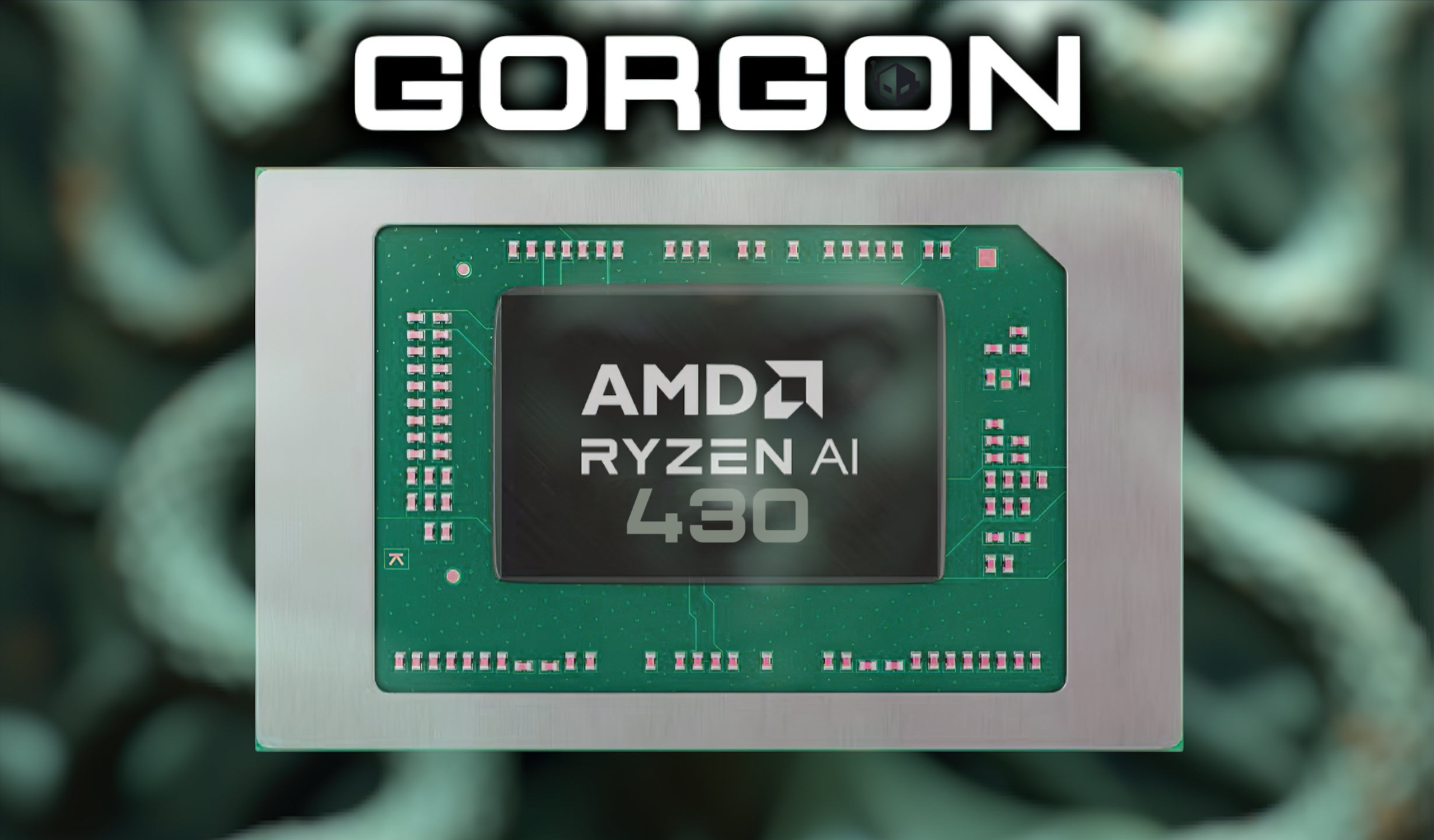
Early benchmark results for AMD’s upcoming Ryzen AI 400 series are starting to surface, and they paint a clear picture of what “Gorgon Point” is all about: a practical refresh rather than a major leap. CPU performance upgrades look modest overall, but there are still some real gains—especially if you’re coming from the Ryzen AI 5 330.
The Ryzen AI 400 family (built from AMD’s Strix/Krackan Point Refresh, also known as Gorgon Point) is expected to deliver refinements such as slightly higher clock speeds and improved integrated graphics across select models. Based on what’s been seen so far, it doesn’t appear to be a generation that dramatically changes the core CPU fundamentals. Instead, it expands the lineup with more options and, in some cases, noticeably stronger iGPU configurations.
One of the most interesting chips in the refresh is the AMD Ryzen AI 5 430. It was first spotted back in December 2025, but a newly discovered PassMark result now gives a better sense of how it performs compared with the Ryzen AI 5 330.
In this PassMark listing, the Ryzen AI 5 430 scores 3,877 points in the single-core test and 13,958 points in the multi-core test. On paper, those numbers don’t suggest a night-and-day transformation—and that’s expected. The Ryzen AI 5 430 doesn’t appear to increase core count, and many key specifications seem similar to the previous model, so massive jumps would be unlikely.
Where things get more interesting is in the comparison data for the Ryzen AI 5 330. There are currently limited submissions for that older chip, and the benchmark database shows two separate entries with different performance numbers. One listing includes a noted iGPU label issue and is based on only a single sample, making it a less reliable baseline.
The more meaningful comparison is against the Ryzen AI 5 330 entry backed by nine submitted samples. Using that broader data set, the Ryzen AI 5 430 comes out approximately 9% faster in single-core performance and about 8% faster in multi-core performance. That’s a respectable improvement for what appears to be a refresh cycle, and it suggests AMD may be leaning on higher operating clocks or other tuning changes to squeeze out extra performance—although the benchmark page itself doesn’t reveal clock speeds.
While CPU gains may be incremental, the integrated graphics side looks far more compelling. The Ryzen AI 5 430 reportedly includes a much stronger RDNA 3.5-based iGPU configuration, moving to four Compute Units instead of two. For buyers focused on better everyday graphics performance, lighter gaming, or GPU-accelerated workloads without a discrete graphics card, that upgrade could be the more meaningful reason to pay attention to this model.
Official specifications should ultimately clarify exactly where the performance uplift comes from and how the full Ryzen AI 400 stack is positioned. For now, the early benchmark suggests this: don’t expect dramatic CPU jumps over Ryzen AI 300, but do expect a measurable boost—and potentially a much nicer integrated GPU experience—depending on the specific SKU.