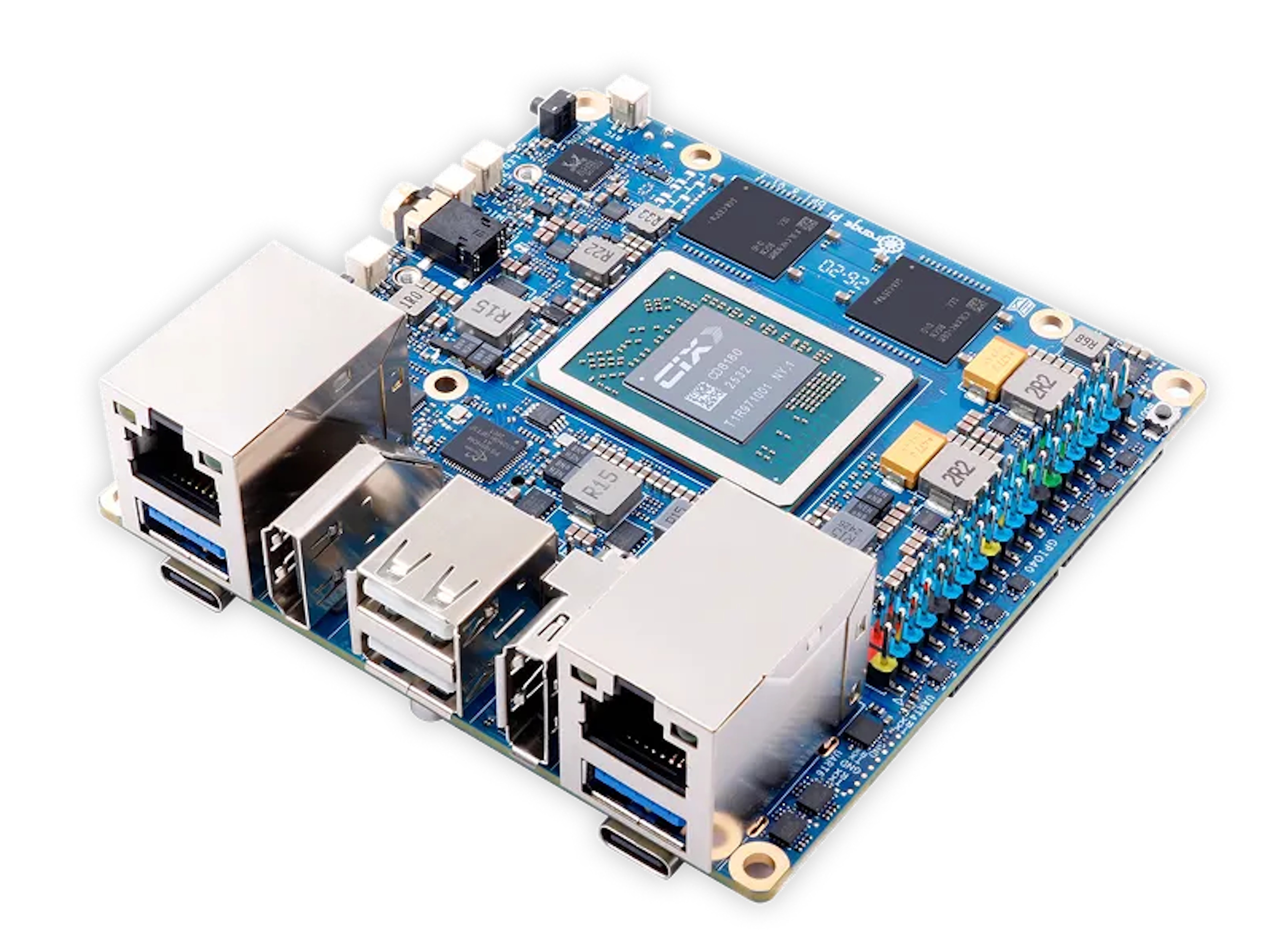
Orange Pi 6 Arrives With 12-Core Power, 45 TOPS AI Performance, Dual 2.5GbE, and PCIe 4.0 Storage
The Orange Pi 6 is shaping up to be one of the most powerful single-board computers in its class, offering a serious performance boost for users who want more than a typical compact development board. With a 12-core processor, high-speed networking, strong AI capabilities, and support for multiple PCIe 4.0 SSDs, this mini PC-style board appears designed for demanding projects such as edge AI, home servers, NAS builds, robotics, media systems, and advanced developer workloads.
At the heart of the Orange Pi 6 is the CIX CD8180 system-on-chip, a 12-core processor that gives the board a major advantage on paper over many popular single-board computers. The board will be available with 8 GB, 16 GB, or 24 GB of LPDDR5 memory, giving users flexibility depending on whether they need a simple development platform or a more capable compact computing system.
One of the biggest highlights is its claimed AI performance. Orange Pi states that the board can reach up to 45 TOPS of AI computing power. However, that figure represents combined performance across the CPU, GPU, and NPU. The dedicated NPU, which is specifically designed for AI workloads, delivers up to 28.8 TOPS. That is still a strong figure for a compact board and could make the Orange Pi 6 an appealing choice for local AI inference, smart camera systems, machine learning experiments, and automation projects.
That said, users should understand that reaching the full 45 TOPS would likely require heavy use of the entire chip, including the CPU and GPU. In real-world use, this may increase power consumption and reduce energy efficiency, especially in always-on systems. For most AI tasks, the NPU’s dedicated performance will likely be the more practical and efficient option.
Storage is another area where the Orange Pi 6 stands out. In addition to microSD card support, the board can accommodate up to two M.2 2280 SSDs. Each SSD is connected through four PCIe 4.0 lanes, which is a major upgrade for users who need fast storage performance. This makes the board especially interesting for compact NAS setups, local servers, databases, media libraries, or development environments that benefit from high-speed SSD access.
For users interested in network storage, a SATA adapter card may also be an option, potentially expanding the board’s usefulness as a home NAS or lightweight server platform.
Networking is equally impressive. The Orange Pi 6 includes two Ethernet ports, each supporting speeds of up to 2.5 Gbit/s. Dual 2.5GbE makes the board suitable for router projects, firewall systems, network appliances, storage servers, and other bandwidth-heavy applications. Wireless connectivity is not built in by default, but Wi-Fi and Bluetooth can be added through an M.2 Key E module.
The board also includes a strong selection of ports. Users get two USB 3.0 Type-A ports, two USB 2.0 ports, and two fully featured USB 3.0 Type-C ports. The USB-C ports also support video output, adding extra flexibility for display setups.
For monitor connectivity, the Orange Pi 6 supports DisplayPort 1.4 with output up to 4K at 120 Hz. HDMI 2.0 is also included, supporting up to 4K at 60 Hz. This makes the board suitable not only for server and AI use, but also for multimedia applications, digital signage, desktop-style setups, and high-resolution display projects.
Camera support is available through MIPI CSI, which could make the board useful for computer vision, smart surveillance, robotics, and AI camera applications. A 40-pin GPIO header is also included, allowing developers and hobbyists to connect sensors, modules, and custom hardware.
Power is supplied through USB Type-C, keeping the setup simple and modern. The board itself measures 90 × 90 mm, making it compact enough for embedded systems while still offering far more expansion options than many smaller boards.
Pricing and release details for the Orange Pi 6 have not yet been announced. Still, based on its specifications, it could become a strong option for users searching for a powerful Raspberry Pi alternative, especially those who need faster storage, stronger AI acceleration, dual 2.5GbE networking, and more memory.
If Orange Pi delivers stable software support and competitive pricing, the Orange Pi 6 could be one of the most exciting single-board computers for developers, makers, AI enthusiasts, and home lab users looking for serious performance in a compact form factor.