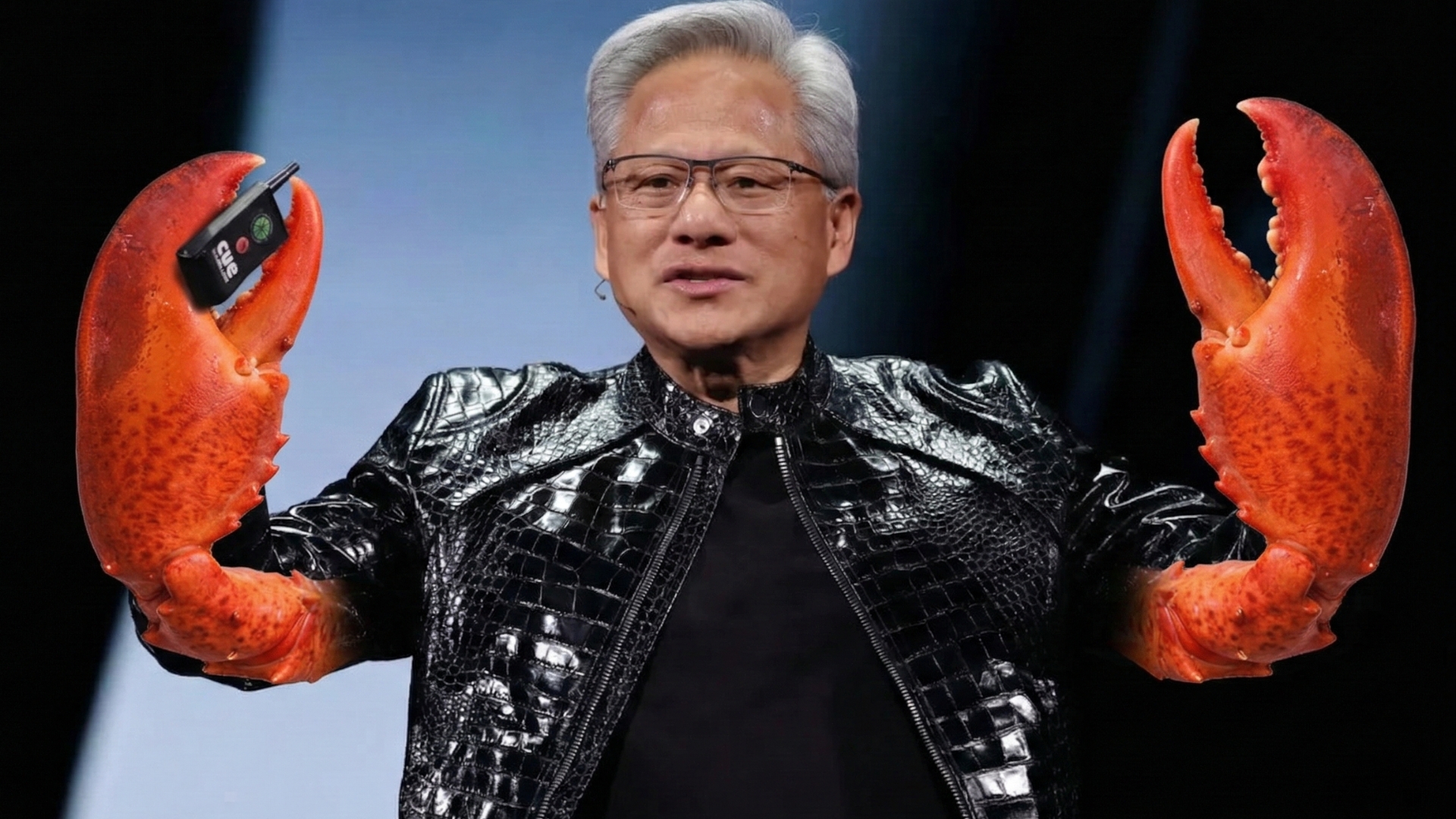
NVIDIA CEO Jensen Huang believes the tech industry has reached a major “agentic AI” inflection point—one that’s already reshaping how people use AI and how much computing power the world will need to keep up. Speaking at the Morgan Stanley conference, Huang pointed to OpenClaw as a breakthrough moment for software, arguing it may be one of the most significant releases ever.
Huang described modern AI as a “5-layer cake,” and highlighted the applications layer as the one that can generate the biggest returns for hyperscalers and leading AI labs. This is where AI agents such as OpenClaw come in. Instead of simply answering questions, agentic AI operates more like a digital worker inside a highly personalized environment—handling tasks in ways that can mirror real human workflows.
In Huang’s view, what makes OpenClaw remarkable isn’t that it’s complicated to implement. It’s that it makes the value of AI feel immediate and practical for everyday users. With the right prompts, agents can complete work that traditionally demanded deep domain expertise and long hours—turning repetitive, time-consuming tasks into something far more automated. That “real-life usefulness” is a big reason OpenClaw has exploded in popularity.
He went even further, comparing OpenClaw’s adoption curve to Linux. Huang claimed Linux took decades to reach its level of adoption, while OpenClaw exceeded that in just weeks—becoming, in his words, the most downloaded open-source software in history over a very short period. Whether you focus on the exact numbers or the broader signal, his message is clear: AI agents are spreading faster than most software platforms ever have.
That rapid adoption comes with a massive side effect: soaring demand for compute. Huang said token usage has surged by roughly 1,000 times with agentic AI. Because agents don’t just generate a single response, they can run extended workflows—doing bulk web research, generating images, performing multi-step analysis, and iterating repeatedly until a task is completed. Each of those actions consumes tokens, and that token growth translates directly into the need for more GPU capacity.
Huang characterized this as a “compute vacuum,” where even large-scale hardware deployments can feel perpetually behind demand as agentic AI takes on more human-like workloads. For NVIDIA and the broader AI ecosystem, that creates a powerful new wave of infrastructure pressure—and opportunity.
On the hardware roadmap, Huang’s comments connect to how NVIDIA positions its architectures for different AI phases. Hopper and Blackwell are closely associated with training-heavy workloads, but the next era may be increasingly shaped by inference and long-context agent behavior. Looking ahead, NVIDIA’s Vera Rubin is expected to target these agentic AI constraints by emphasizing long-context performance, including expanded on-device memory and platforms such as ICMS. With the growing imbalance between token consumption and available compute, Huang’s implication is that demand for next-generation platforms could be enormous.
The larger takeaway from Huang’s remarks is that agentic AI isn’t just a feature upgrade—it’s a usage upgrade. And as AI shifts from “chatting” to “doing,” the compute requirements may scale dramatically faster than most of the industry previously modeled.