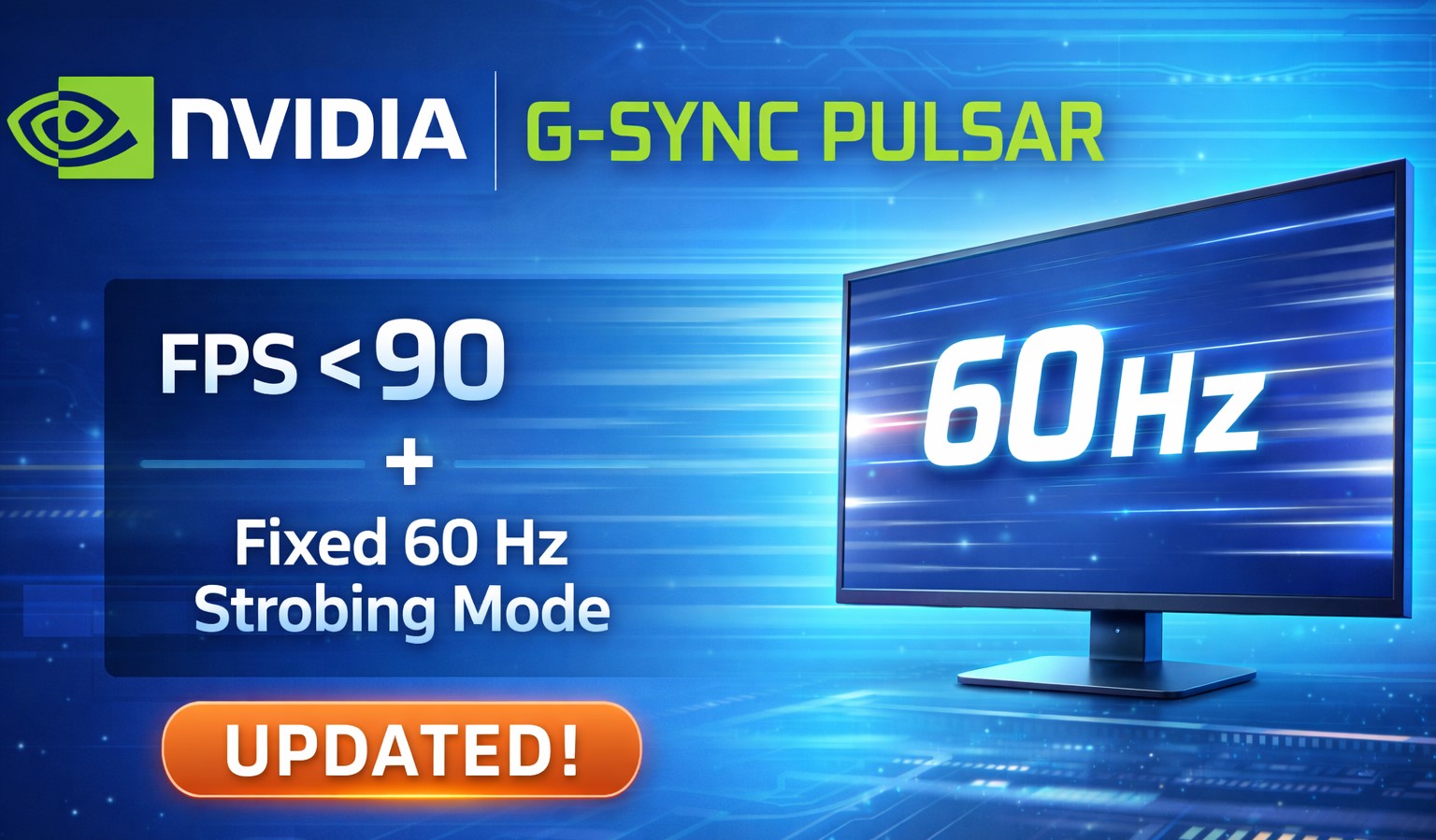
NVIDIA is giving competitive gamers and clarity-obsessed players a meaningful upgrade with its latest G-Sync Pulsar firmware update, improving motion clarity in games that don’t hit ultra-high frame rates. The big news: G-Sync Pulsar should now perform better below 90 FPS, and it also introduces a new fixed 60 Hz strobing mode designed specifically for games locked to 60 frames per second.
First introduced in 2024 and rolled out more broadly in early 2026, G-Sync Pulsar is NVIDIA’s approach to cleaner motion on modern high refresh rate monitors. It blends three key elements into one motion-clarity solution: variable refresh rate (VRR), blur reduction, and backlight strobing. The goal is simple—reduce motion blur so fast camera pans, scrolling, and quick flick shots appear sharper and easier to track.
Until now, the technology delivered its best results when the game’s frame rate stayed close to the display’s refresh rate. That’s why it has been most impressive in high-FPS esports titles running on high refresh rate panels. But when frame rates dropped—especially under 90 FPS—Pulsar could struggle, with players sometimes noticing artifacts and reduced effectiveness. According to NVIDIA, the new monitor firmware update tackles that weakness, helping Pulsar maintain better clarity at lower frame rates where it previously had trouble.
The other major addition is a fixed 60 Hz strobing mode, aimed at a very common real-world scenario: games that are capped at 60 FPS. Many older titles, console ports, and certain locked-frame-rate releases won’t go beyond 60 FPS, even on powerful PCs. On ultra-fast displays like 240 Hz or 360 Hz monitors, that can lead to more noticeable motion blur because each frame remains on-screen longer relative to the panel’s speed. With fixed 60 Hz plus strobing enabled, the backlight behavior is tuned to that 60 FPS experience, which should result in sharper motion, clearer scrolling, and cleaner camera panning in capped games.
Right now, G-Sync Pulsar is still a niche feature limited to a small set of gaming monitors, including models like the ASUS ROG Strix Pulsar XG27AQNGV and the MSI MPG 272QRF X36, along with a few other options from select vendors. Adoption hasn’t gone fully mainstream yet, but updates like this make the feature more relevant beyond only top-tier high-FPS gameplay—especially for players who want better clarity even when performance dips or when a game is locked to 60 FPS.
If you already own a supported G-Sync Pulsar display, checking for the latest monitor firmware could be worth it, particularly if you play a mix of esports titles and 60 FPS-locked games and want the sharpest motion possible on a high refresh rate screen.