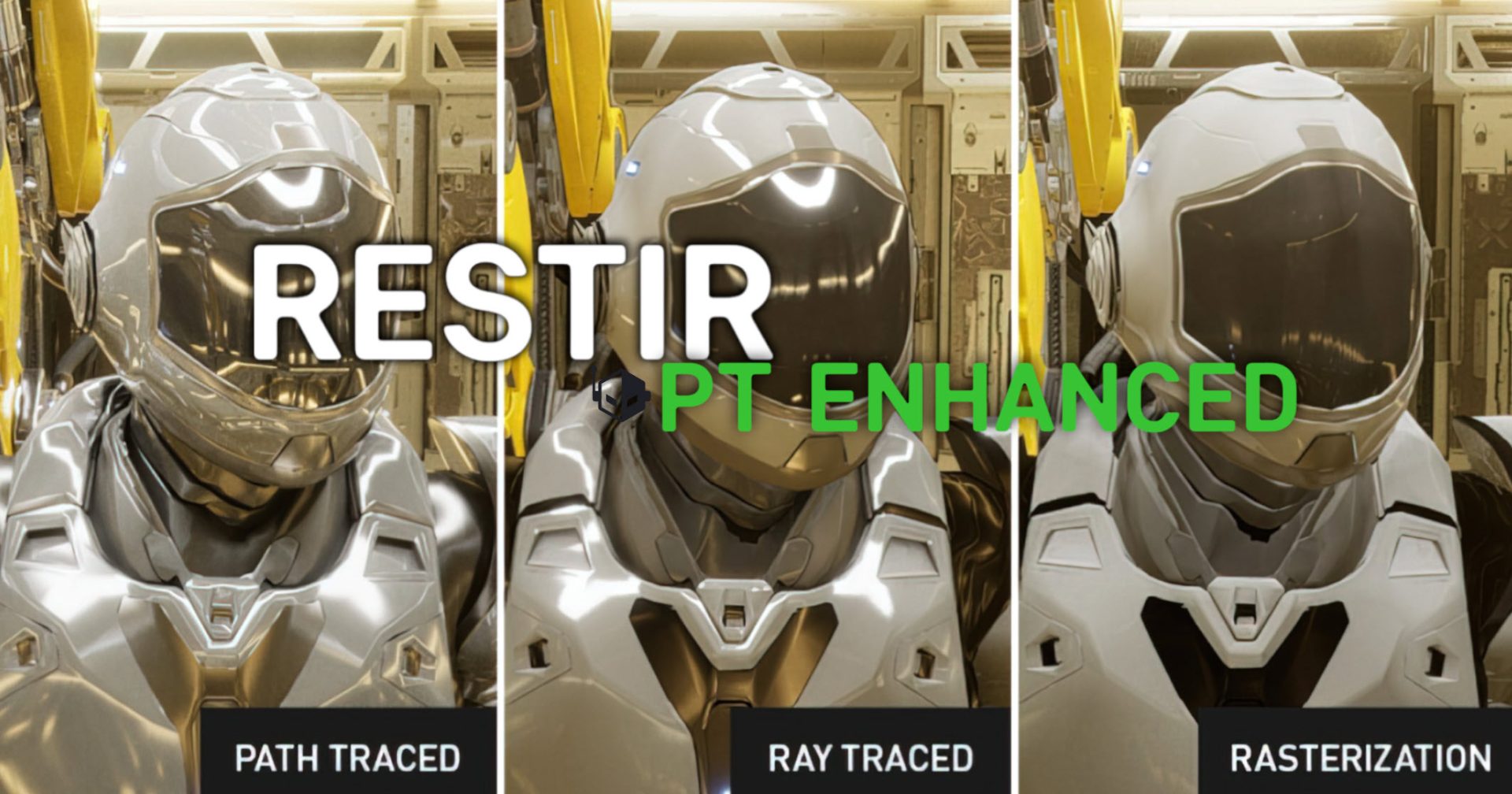
NVIDIA has revealed a newly enhanced version of its ReSTIR path tracing approach, and the implications for PC gaming visuals could be massive. According to the company’s latest research, these updated ReSTIR PT algorithms can boost path tracing performance by roughly 2x to 3x while also improving image stability and reducing common visual problems that can show up in advanced ray tracing and path tracing workloads.
Path tracing is increasingly becoming the “next step” beyond standard ray tracing in modern PC games because it can simulate lighting in a more complete and realistic way. The tradeoff, however, is brutally high GPU demand. Even in today’s top-end graphics cards, path-traced modes can struggle to maintain smooth frame rates without leaning heavily on upscaling and frame generation. It’s similar to where ray tracing was in its early years: impressive results, but too expensive for most real-world gameplay scenarios without compromises.
That’s where NVIDIA’s new work comes in. In its research paper titled “ReSTIR PT Enhanced: Algorithmic Advances for Faster and More Robust ReSTIR Path Tracing,” NVIDIA outlines a set of spatiotemporal resampling improvements designed to significantly cut path tracing cost while preserving (and in some areas improving) visual quality. The company also describes the solution as close to “production ready,” suggesting these changes aren’t just theoretical—they’re meant to be practical for real engines and real games.
So what’s actually changing? NVIDIA’s enhanced ReSTIR PT work focuses on both speed and robustness. On the performance side, the company says it halves the spatial reuse cost, which is a key part of making path tracing feasible at higher frame rates. On the quality side, it targets issues like correlation artifacts and noise during difficult cases such as disocclusion (when previously hidden parts of a scene become visible due to camera movement).
NVIDIA highlights several core upgrades included in the improved approach:
– Lower spatial reuse cost through reciprocal neighbor selection, reducing shift mapping overhead
– New ray footprint thresholds that adapt based on the scene and the materials involved
– Fewer correlation artifacts using sample duplication maps
– Better quality and efficiency by unifying ReSTIR handling for both direct lighting and indirect lighting
– Additional optimizations aimed at reducing color noise and disocclusion noise while improving overall resilience
The research also includes performance data showing how these optimizations stack up. Using a baseline implementation based on publicly available 2022 code, NVIDIA reports an average 2.74x speedup across four tested scenes after applying its cost-reduction techniques. These scenes were chosen to represent different levels of geometric detail and material complexity, which matters because path tracing performance can vary wildly depending on what’s being rendered.
NVIDIA also profiled GPU behavior and found meaningful efficiency improvements. The company reports higher SM warp occupancy, more active threads per warp, and reduced warp latency—signs that the GPU is being utilized more effectively. With additional measures such as Russian roulette (a common rendering technique used to probabilistically terminate less important light paths), the metrics improve further, showing even lower latency and better overall throughput.
Memory use is another important win. Path tracing techniques can be surprisingly heavy on VRAM, especially when multiple buffers are required per pixel. NVIDIA says it reduces storage needs by compressing the ReSTIR PT reservoir and unifying reservoirs for direct and indirect lighting. In practical terms, the paper notes that per-pixel storage drops, and at a 1920×1080 render resolution, memory consumption is reduced from 431 MB to 265 MB. That kind of reduction can help performance, stability, and scalability—especially when games are already competing for VRAM with high-resolution textures, geometry data, and large post-processing pipelines.
The big takeaway is that path tracing doesn’t just need faster GPUs—it also needs smarter algorithms. If NVIDIA’s enhanced ReSTIR PT techniques make their way into game engines and shipping titles, players could see noticeably higher frame rates in path-traced modes, with fewer distracting artifacts and less reliance on extreme performance crutches.
NVIDIA also signals that this is part of a broader direction: combining path tracing with neural rendering and AI-assisted techniques to push image quality forward while keeping workloads manageable. With more games experimenting with full path tracing and more GPUs being built with these workloads in mind, algorithmic leaps like this may be what finally makes “always-on” path tracing feel realistic for everyday gameplay.