DeepSeek V4 has officially arrived, and it’s a meaningful leap forward for anyone tracking large language models, long-context AI, and next-generation inference efficiency. The release focuses heavily on cutting compute and memory overhead while scaling up to truly massive model sizes—exactly the combination enterprises and developers want when deploying advanced reasoning systems, coding assistants, and long-context agents.
One of the standout improvements in DeepSeek V4 is just how aggressively it reduces resource demands at long context lengths. When running a one-million-token context window, the updated model reportedly uses only 27% of the single-token inference FLOPs and just 10% of the KV cache compared with prior expectations. For long-context inference—often one of the most expensive and memory-hungry workloads in modern AI—those reductions can translate into better throughput, lower latency, and more practical deployment on real hardware.
Alongside the optimizations, DeepSeek V4 introduces two distinct model options designed for different production needs.
DeepSeek-V4-Pro targets top-tier capability. It’s positioned for advanced reasoning, coding tasks, and long-context agent workflows, and it comes with a huge total parameter count of 1.6 trillion (1.6T), with 49B active parameters. It supports a one-million-token context length, and output can go up to 384K tokens (as described in the model’s documentation).
DeepSeek-V4-Flash is built for speed and efficiency. It has 284B total parameters with 13B active parameters, also supports a one-million-token context length, and is aimed at high-speed use cases such as chat, routing, and summarization. Like the Pro version, it lists up to 384K tokens of output length in the documentation.
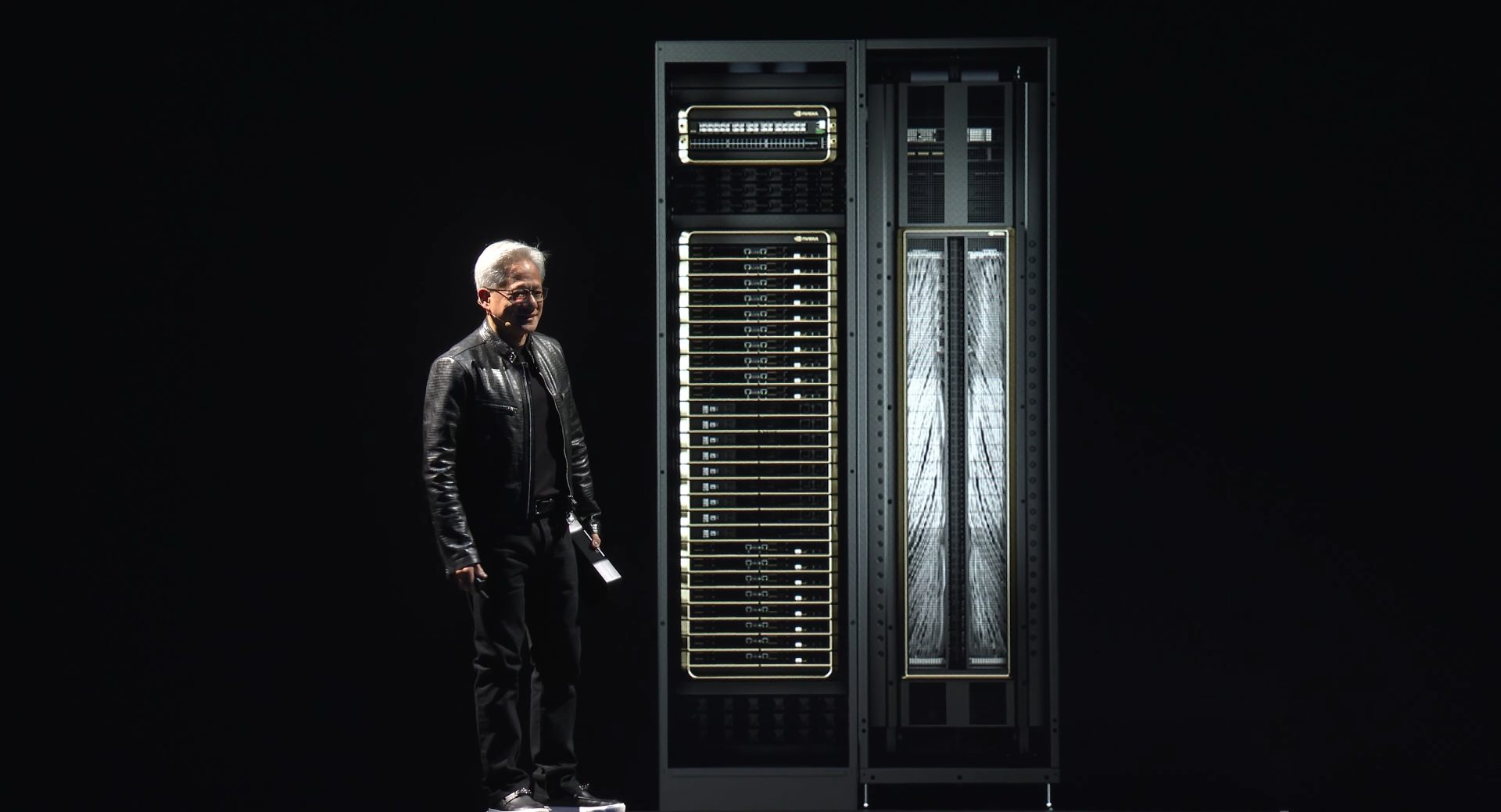
On the hardware side, NVIDIA is pushing “Day-0 support” for DeepSeek V4 on its Blackwell GPU lineup, highlighting that Blackwell is designed to handle both trillion-parameter AI models and the low-latency demands of one-million-token long-context inference. NVIDIA is also framing DeepSeek V4 as something that can be integrated across multiple stages of AI development and deployment—ranging from data center deployment to managed microservices and fine-tuning workflows—while continuing to support open models and open-source software efforts.
Early performance disclosures are also attention-grabbing. NVIDIA shared preliminary figures showing roughly 3,500 tokens per second (TPS) throughput per GPU on GB300 (Blackwell Ultra). Importantly, these are described as baseline numbers that should improve as NVIDIA continues optimizing the software-and-hardware “co-design stack.” The company points to a collection of Blackwell-focused acceleration features intended to benefit models like DeepSeek V4, including NVFP4 support, software stack improvements, optimized CUDA kernels, and advanced parallelization techniques.
A key technical driver behind DeepSeek V4’s speed and efficiency is FP4 (specifically MXFP4) quantization. By using FP4 quantization to accelerate both rollouts and inference passes, DeepSeek V4 can reduce memory traffic and lower sampling latency—two of the biggest bottlenecks when serving large AI models at scale.
Another important angle is broader hardware compatibility beyond NVIDIA. China’s upcoming Huawei Ascend chips—Ascend 950PR and Ascend 950DT, both planned for 2026—are expected to include MXFP4 instructions as well. That suggests DeepSeek V4 is aligning with an FP4-centric direction that could make the model more portable across multiple AI accelerator ecosystems, including domestic Chinese AI hardware.
With DeepSeek V4 now public and GPU vendors already demonstrating day-one support and early benchmarks, the direction is clear: longer contexts, larger models, and more aggressive quantization are becoming the new baseline for modern AI deployment. As more software optimizations land, DeepSeek V4’s performance—especially for million-token long-context inference—could improve further, strengthening its position for real-world, large-scale AI applications.