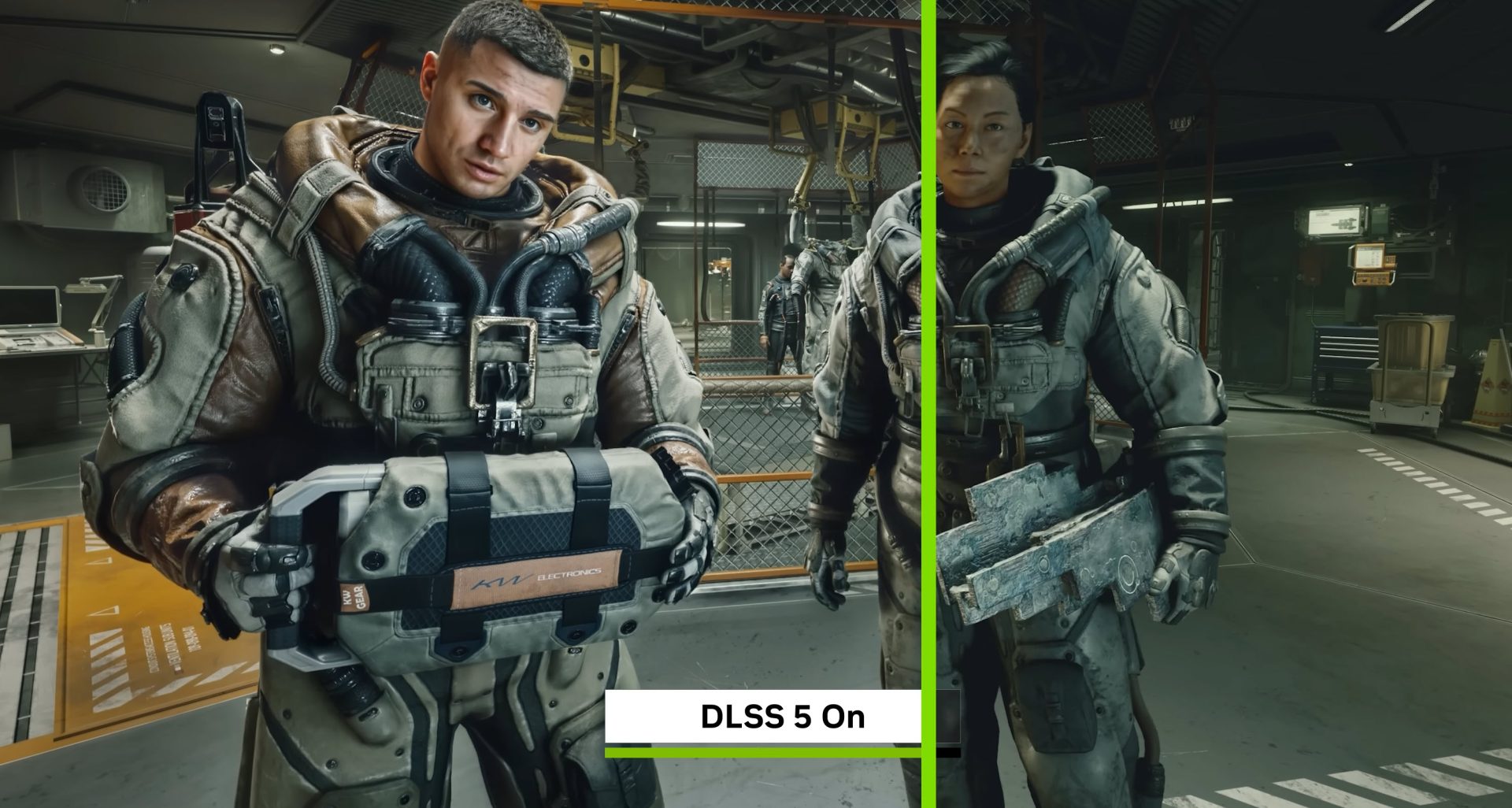
NVIDIA is pulling back the curtain a little further on DLSS 5, its newly announced leap in AI-powered graphics that uses neural rendering to push visual quality beyond what traditional upscaling can achieve. The initial reveal turned heads for its dramatic improvements to lighting and overall realism, but it also sparked an important question among gamers and developers: will this kind of AI enhancement override the look and feel that an art team intentionally builds into a game?
NVIDIA says DLSS 5 is specifically designed to respect and preserve artistic vision, rather than “repainting” a scene into something the creators didn’t intend. According to the company, it does this in two key ways.
First, DLSS 5 anchors its output to the game’s real underlying 3D data by feeding the model critical inputs each frame, including color and motion vectors. In other words, the system isn’t guessing blindly—it’s being guided by the actual content and movement the game engine is producing.
Second, developers (and by extension, the artists shaping a game’s presentation) get granular controls to tailor how DLSS 5 behaves. NVIDIA points to adjustable settings such as intensity and color grading controls that help teams fine-tune blending, contrast, saturation, and gamma so the game keeps its signature aesthetic. There’s also masking support, letting developers exclude specific objects or areas from enhancement entirely when needed.
Alongside these clarifications, NVIDIA’s GeForce team also addressed several practical questions about DLSS 5 availability and hardware. DLSS 5 is currently planned to launch this fall, and NVIDIA says an early preview will be available for attendees at GTC 2026.
One concern that quickly surfaced is whether DLSS 5 will require extremely high-end setups to run—especially after a demo configuration was shown running with two GPUs. NVIDIA explained that the early version being demonstrated uses two GeForce RTX 5090 graphics cards: one GPU renders the game, while the second GPU is dedicated to running the DLSS 5 model. However, NVIDIA emphasizes that this is only for the early preview stage and does not reflect what consumers will need.
For the actual release, NVIDIA says DLSS 5 is being optimized to run on a single GPU, meaning gamers will not need a dual-GPU system to use it.
As for how DLSS 5 fits into modern rendering pipelines, NVIDIA positions it as a companion to advanced lighting techniques—not a replacement. DLSS 5 can significantly enhance the look of lighting, shadows, and reflections across characters, objects, and environments, but it isn’t meant to replace ray tracing or path tracing. Instead, NVIDIA describes these technologies as working together.
DLSS 5 is also expected to support the broader DLSS feature set, including super resolution, frame generation, multi-frame generation, and ray reconstruction. That puts it in line with what many players already associate with DLSS—higher performance and smoother gameplay—while adding a new layer of neural rendering-driven visual reconstruction.
NVIDIA also highlighted the major benefits DLSS 5 is aiming to deliver:
Cinematic lighting improvements, including reconstruction of advanced effects like rim lighting, subsurface scattering for more realistic skin, and contact shadows for higher-fidelity depth.
Better material detail and depth, enhancing physically based rendering (PBR) characteristics such as roughness and adding micro-level realism to complex elements like eyes and hair.
Stronger temporal consistency, keeping image quality stable from frame to frame while staying true to the underlying game content.
Real-time performance targets, with NVIDIA aiming for photorealistic enhancements up to 4K while maintaining responsive, smooth gameplay.
High controllability for developers, with tuning for intensity, color behavior, and masking so enhancements appear exactly where creators want them—and nowhere they don’t.
For studios wondering how difficult it will be to adopt, NVIDIA suggests integration should be relatively straightforward for many teams. DLSS 5 reportedly follows a similar integration approach to DLSS Frame Generation, and NVIDIA’s Streamline SDK is positioned as a way to simplify support across a wide range of games that already include DLSS features.
NVIDIA has not yet shared minimum system requirements or detailed performance metrics for DLSS 5. Those specifics are expected closer to launch, along with a clearer picture of how the technology scales across different RTX GPU tiers.