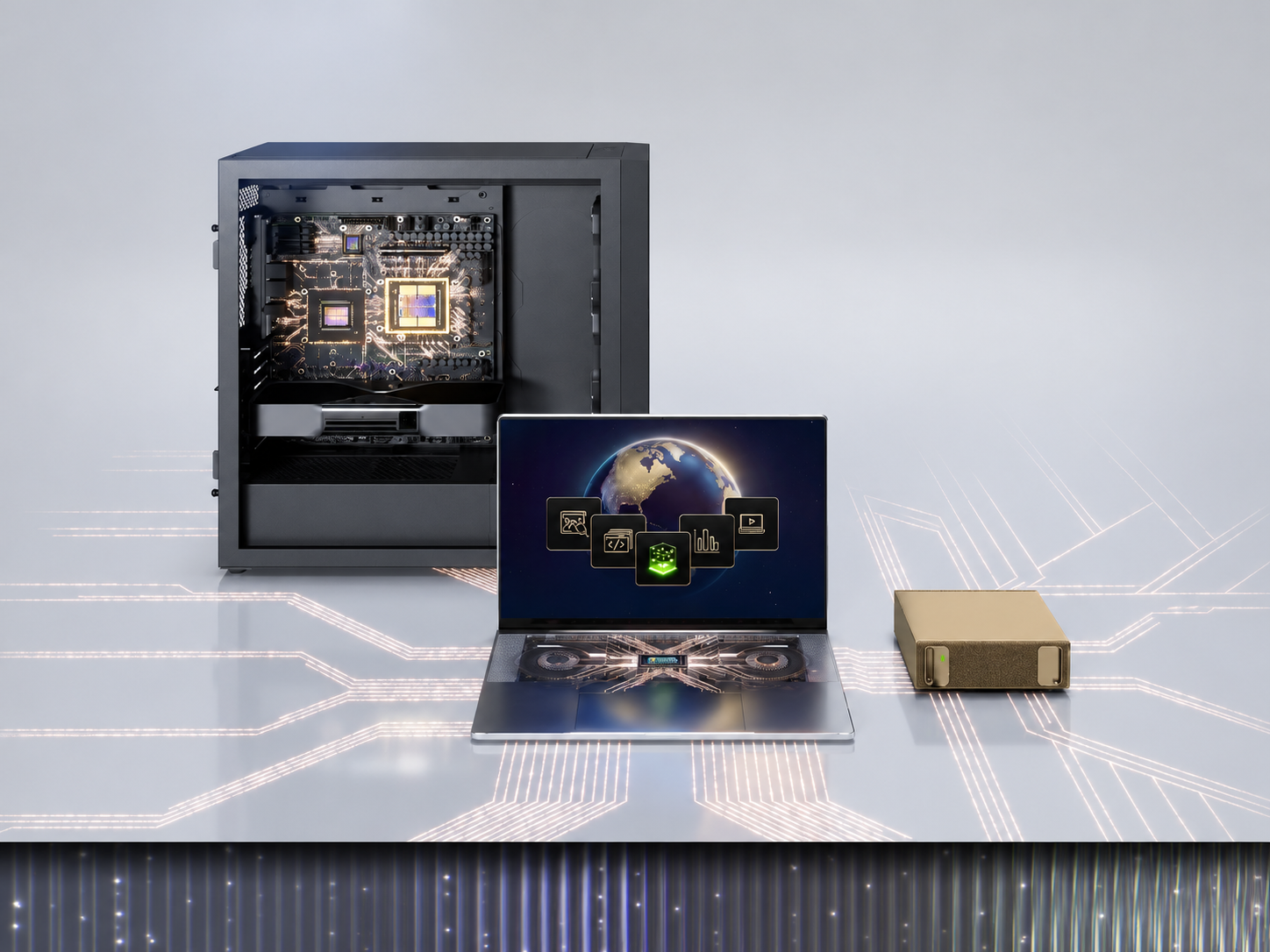
Nvidia DGX Spark can now scale up to eight systems with 1 TB unified memory for larger AI workloads
Nvidia has announced a major upgrade for its DGX Spark AI mini PC, giving owners a new way to expand local AI performance by clustering multiple systems together. Revealed at GTC Berlin, the update allows up to eight DGX Spark units to work as one cluster, creating a powerful compact AI setup with as much as 1 TB of unified memory.
The timing is notable, as Nvidia is preparing to launch its previously announced 64 GB DGX Spark models on October 23. When using the current 128 GB DGX Spark systems, an eight-unit cluster can reach 1 TB of total unified memory. Clusters made with the upcoming 64 GB models can scale up to 512 GB.
That extra memory is a big deal for developers, researchers, and AI enthusiasts working with more demanding models. Larger memory pools can help support bigger AI models, longer context windows, and multiple AI agents running at the same time. Nvidia says frontier-class models such as GLM 5.3 can benefit from the full 1 TB configuration, especially when handling complex inference tasks.
DGX Spark systems connect through built-in ConnectX-7 networking hardware. For now, setting up an eight-system cluster requires manual configuration, but Nvidia plans to make the process easier soon. The company says its Nvidia Sync utility will gain support for eight-system configurations later this month.
A new Model Launcher feature is also on the way. This tool is designed to simplify the process of downloading compatible AI models, deploying them across connected DGX Spark systems, and accessing them through coding environments such as OpenCode. For users building local AI workflows, this could make DGX Spark clusters more practical and less time-consuming to manage.
Nvidia is also improving AI inference performance across several systems. DGX Spark is getting up to a 30% speed boost when running Qwen3.8 27B, while DGX Station can see up to 20% higher throughput with GLM 5.3 Flash.
The company has also confirmed new software-level inference optimizations developed with the llama.cpp and vLLM communities. On select RTX hardware, including the RTX PRO 6000 Blackwell, Nvidia says agentic AI tasks using Qwen 3.8 Flash Next can run up to 40% faster. This improvement comes from speculative decoding enhancements, a technique that can help speed up model output by predicting and verifying tokens more efficiently.
However, these performance gains are workload-specific. Nvidia’s numbers apply to certain models and tasks, so users should not expect a universal 30% or 40% performance increase across every AI model. The company has also not shared detailed benchmarks showing how well an eight-system DGX Spark cluster scales in real-world workloads, so practical performance will depend on the model, configuration, and software stack.
To further improve efficiency, Nvidia is introducing a new set of memory-optimized AI model checkpoints. These include Qwen3.8 Flash Next FP4 and GLM 5.3 Flash FP4 variants. The goal is to lower memory usage while leaving more space available for KV cache, which is especially important when running AI models with long context windows.
The upcoming 64 GB DGX Spark models will still use the GB10 Grace Blackwell Superchip and will start at $4,999. That price may raise eyebrows, since the 128 GB version previously occupied a similar price range. Still, the expanded clustering support gives DGX Spark a stronger position as a compact local AI platform for users who need scalable memory and performance without relying entirely on cloud infrastructure.
With support for up to eight connected systems, new inference optimizations, and upcoming software tools to make deployment easier, Nvidia is turning DGX Spark into a more flexible option for local AI development. For teams working with large language models, agentic AI workflows, and long-context inference, the ability to scale up to 1 TB of unified memory could make the tiny AI workstation much more capable than its size suggests.


