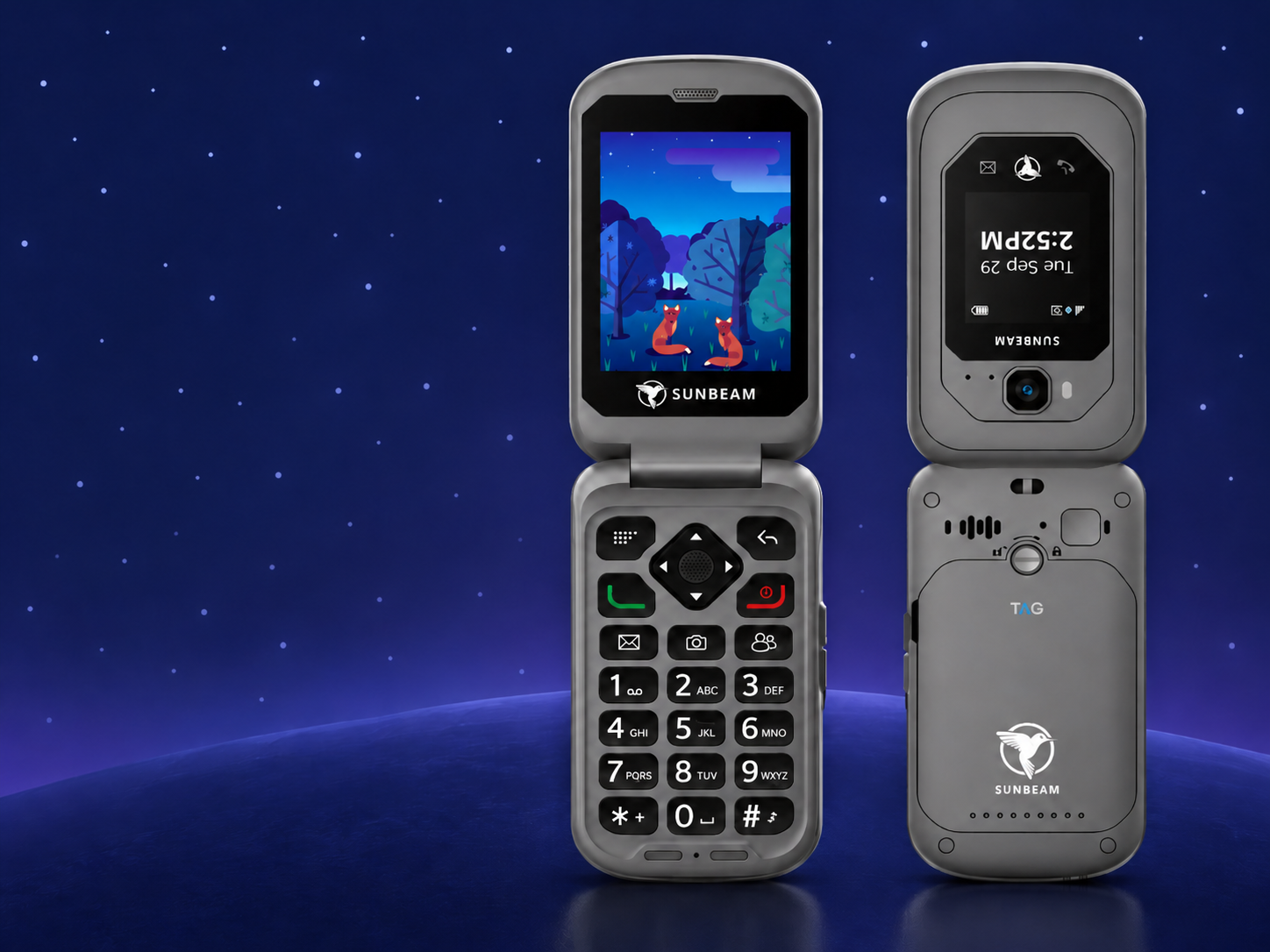
Sunbeam F1 Pro Poplar and Walnut bring Signal messaging to rugged flip phones
Sunbeam Wireless is expanding its F1 Pro range with two new rugged flip phones designed for people who want fewer distractions without giving up essential modern communication tools. The Sunbeam F1 Pro Poplar and F1 Pro Walnut are expected to launch in November 2026, offering a more capable take on the minimalist phone concept.
These devices are built for users who want to step away from traditional smartphones, social media, app stores and web browsing, while still keeping access to practical features like messaging, navigation, email attachments and limited video recording.
The standout feature is Dewdrop, Sunbeam’s own messaging platform. Dewdrop allows F1 Pro Poplar and Walnut users to message each other, but it also supports messaging with Signal users on regular smartphones. That could make these phones much more appealing to families, friend groups or communities where some people still use full smartphones and others want a simpler device.
However, the phones do not support RCS messaging. That means existing RCS group chats will still need to fall back to MMS or move to another supported messaging option.
Although the F1 Pro Poplar and F1 Pro Walnut share many of the same features, they are not identical. The Walnut model includes Wi-Fi hotspot support, allowing it to share mobile data with other devices. The Poplar model does not offer hotspot functionality. The Poplar also blocks calls and texts to AI numbers, while no such restriction is listed for the Walnut.
Both models support Signal messaging through Dewdrop, email attachments, GPS navigation, Waze, and video recording up to two minutes. Rideshare support is also planned for both phones, but it will not be ready at launch.
The hardware is modest but practical. According to Sunbeam’s 2026 F1 Pro specifications, the phones feature a 2.8-inch touchscreen with a 480 x 640 resolution. They are powered by a MediaTek MT6739 processor with four ARM Cortex-A53 cores running at 1.28 GHz, paired with 3 GB of RAM and 32 GB of internal storage. Storage can be expanded using a microSD card up to 32 GB.
Other hardware features include a 5 MP camera, a removable 2,200 mAh battery, USB-C charging, Bluetooth, and a 3.5 mm headphone jack. The phones run Sunbeam’s BasicOS, a restricted operating system designed to keep the experience simple and distraction-free.
The chassis is described as water and dust resistant, though Sunbeam does not list an official IP rating. That means the phones should not be treated as fully waterproof, even if they are built to handle more demanding daily use than a typical feature phone.
The F1 Pro Poplar and Walnut also improve email functionality compared with some earlier F1 Pro models. Users can send and receive email attachments and configure multiple accounts, including Google, Microsoft, AOL and Yahoo. This makes the phones more useful for people who need occasional email access but do not want the endless distractions of a smartphone.
Additional features include an offline music player, voice recorder, visual voicemail, navigation tools, Waze support, and video playback. Video recording is available too, but clips are limited to two minutes, keeping the feature useful without turning the phone into a full smartphone replacement.
Sunbeam is also working on rideshare functionality, which would allow users to request a ride without needing a conventional smartphone. This could be a major advantage for people who want to simplify their digital life but still need access to essential transportation services. However, the feature remains in development and will not be available when the phones first ship.
Some features will require a paid subscription, including voice-to-text, advanced weather information and certain navigation tools.
Despite the added capabilities, these are still intentionally limited phones. There is no web browser, no app store, no social media support and no open-ended app ecosystem. The Poplar model also lacks Wi-Fi hotspot support, although it does include Wi-Fi for data transfers. The Walnut is the better choice for users who want mobile hotspot functionality while still avoiding a full smartphone experience.
Each phone will ship with a charging dock and USB-C charger, and Sunbeam includes a two-year warranty.
At $389, the Sunbeam F1 Pro Poplar and F1 Pro Walnut are more expensive than most basic flip phones. But they are aimed at a specific audience: people who want a rugged minimalist phone with modern essentials, especially secure messaging, email attachments and navigation, without the distractions of a smartphone.
Network compatibility is another important detail. These phones are designed mainly for North and South American mobile networks. Compatibility may be limited in Europe, Africa and Asia due to supported LTE bands, so buyers outside the Americas should check carrier support carefully before purchasing.
The Sunbeam F1 Pro Poplar and F1 Pro Walnut could become compelling options for anyone searching for a rugged flip phone, a distraction-free phone, or a modern “dumb phone” with just enough smart features to stay connected.