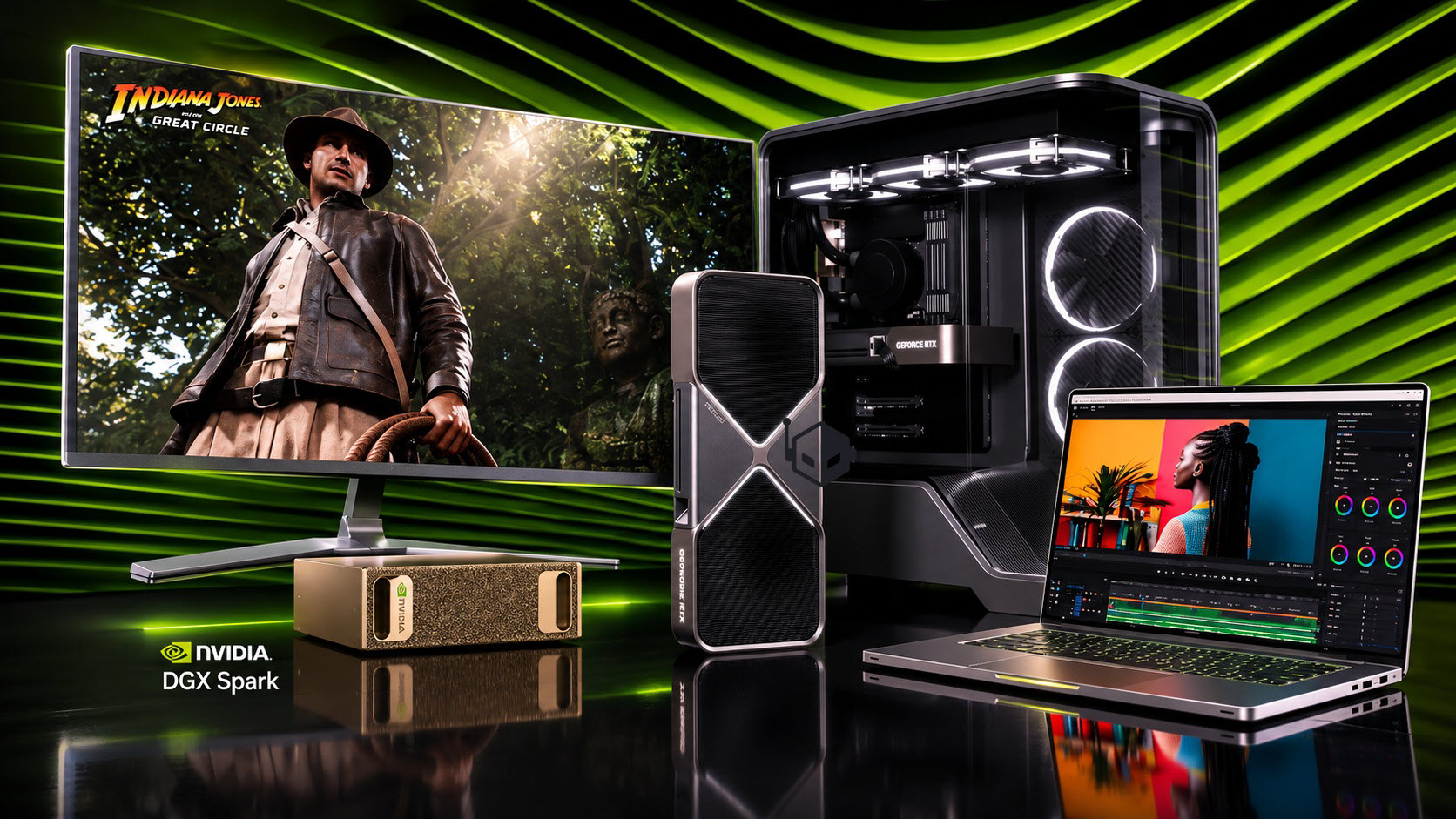
NVIDIA Expands AI PC Capabilities With Faster Open Model Support for DGX and RTX Systems
NVIDIA is pushing deeper into the AI PC market with a major wave of updates for its DGX and RTX platforms. The latest improvements focus on accelerating open AI models, boosting local performance, improving video generation workflows, and making multi-system AI setups easier to manage.
With support for new models such as Nemotron 3.5 Lightning, Meta’s Muse Glimmer, LTX-2.5, Cosmos 3 Edge, MiniMax-H3, DeepSeek V4-Flash, and more, NVIDIA is strengthening its position as one of the leading forces behind on-device AI computing.
The update is especially important for creators, developers, researchers, and AI enthusiasts who want to run advanced workloads locally instead of relying entirely on cloud-based services. By optimizing open models for RTX GPUs and DGX systems, NVIDIA is giving users more speed, privacy, and flexibility directly on their own machines.
NVIDIA Adds Support for More Open AI Models
A major part of this update is expanded support for a wide range of open AI models across NVIDIA DGX and RTX platforms. These models cover different use cases, including language processing, video generation, animation, coding, agentic AI, and local inference.
The newly supported models include Cosmos 3 Edge, a 4-billion-parameter model; MiniMax-H3, with 33 billion parameters; Laguna S 2.1, with 118 billion parameters; DeepSeek V4-Flash, with 284 billion parameters; Wan-Animate-2, with 14 billion parameters; and Inkling-Small, with 276 billion parameters.
This broader model support gives users more options for building AI applications, experimenting with local agents, generating media, and handling productivity-focused workflows. For businesses and professionals, it also means more advanced AI tasks can be performed on local hardware while keeping sensitive data on-device.
Unsloth Desktop Brings Open-Source AI Tools to Local PCs
NVIDIA is also adding support for Unsloth Desktop, a fully open-source desktop application designed to simplify local AI workflows. The app supports local model inference, image and video diffusion, fine-tuning, agent integrations, web research, and code execution.
For users who want more control over AI model customization, Unsloth Desktop could become a useful tool. It allows AI developers and creators to experiment with models locally, fine-tune them for specific tasks, and run agent-based workflows without depending on remote infrastructure.
RTX 5090 and RTX PRO Blackwell GPUs Deliver Big AI Performance Gains
NVIDIA’s latest RTX platforms, including the GeForce RTX 5090 and RTX PRO 5000 Blackwell, show significant gains in AI workloads. In Wan-Animate-2, NVIDIA says the RTX 5090 delivers up to 26 times higher performance than Apple’s M3 Ultra, while the RTX PRO 5000 Blackwell offers up to 16 times higher performance.
Wan-Animate-2 is an open-weight model designed to transfer motion and facial expressions from a driving video onto a static character image. This can be especially valuable for animation, digital avatars, content creation, and AI-driven character workflows.
These performance improvements highlight why powerful local GPUs are becoming increasingly important for AI creators. Instead of waiting for cloud processing or paying for remote compute resources, users can generate, edit, and iterate on AI content directly from their own systems.
LTX-2.5 Improves Local AI Video Generation
NVIDIA is also bringing attention to LTX-2.5, a new video generation model designed to improve the quality and efficiency of generative video workflows. LTX-2.5 introduces a new diffusion video decoder that works alongside the existing variational autoencoder video decoder. This gives users a second decoding path for higher-quality final video renders.
The model supports multishot video generation and generative editing, making it more useful for creators who want to produce longer, more consistent, and more polished AI-generated video content.
On NVIDIA RTX GPUs, DGX Spark, and DGX Station, LTX-2.5 receives a 2x performance boost along with up to 40% memory savings. On the RTX PRO 6000 96 GB GPU, NVIDIA says users can see 20% faster performance and 40% memory savings when creating videos.
Users can also take advantage of NVIDIA technologies such as NVFP4, FastVideo, and ComfyUI to improve text-to-video, image-to-video, and video-to-video generation workflows.
Meta’s Muse Glimmer Runs Locally on NVIDIA RTX and DGX Systems
Meta’s Muse Glimmer is another major addition. This 30-billion-parameter open-weight model is designed for coding, agentic AI, and long-context workflows. It supports a context length of more than 120,000 tokens, making it useful for complex projects that require large amounts of information to stay in memory.
The model is optimized for NVIDIA RTX and DGX systems and also supports NVIDIA Jetson platforms. On a single RTX 5090 GPU, Muse Glimmer can reach more than 200 tokens per second, making it fast enough for responsive local AI agents.
Muse Glimmer is built for always-on local agents that can assist with real tasks across documents, code, tools, and private files. Some of its key capabilities include custom agents for specialized workflows, private data processing for local documents and emails, secure credential handling, multistep task execution, and long-running workflows that can resume with context intact.
For developers, this means a local AI assistant could help review code, manage files, process documentation, and complete tool-based tasks without sending sensitive data to external servers.
DGX Spark Gets Multi-System Clustering With NVIDIA Sync Cluster Assistant
NVIDIA is also improving DGX Spark with the new NVIDIA Sync Cluster Assistant. This tool allows users to connect two or more DGX Spark systems into a high-speed cluster, creating more memory, compute, and inference capacity for larger AI models.
The feature includes streamlined networking, workload routing, and health monitoring, making it easier to manage multiple systems as a single AI compute environment. NVIDIA Sync Cluster Assistant is available on both Windows and macOS.
This is a meaningful update for users who want to scale local AI performance without moving to a full data center setup. By linking multiple DGX Spark systems together, developers and researchers can handle larger models and more demanding workloads from a compact local cluster.
Google Chrome Comes to DGX Spark as a Native ARM64 Linux Build
DGX Spark is also receiving Google Chrome as a native ARM64 Linux build. Users will be able to install it directly from the DGX Dashboard on DGX OS.
This may sound like a smaller update compared with new AI model support, but it improves the overall usability of DGX Spark as a workstation. A native browser experience can help users manage web-based tools, dashboards, documentation, and AI workflows more smoothly on the platform.
NVIDIA Sync Resource Monitor Adds Better System Tracking
Another useful addition is NVIDIA Sync Resource Monitor. This tool provides real-time and historical views of CPU and GPU usage across either a single DGX Spark system or an entire DGX Spark cluster.
For AI workloads, system monitoring is essential. Users need to understand how models are using memory, compute, and processing resources, especially when running large language models, video generation models, or multi-agent workflows.
With NVIDIA Sync Resource Monitor, users can track performance trends, diagnose bottlenecks, and manage resources more effectively across their local AI setup.
NVIDIA Strengthens Its Lead in the AI PC Market
These updates show NVIDIA’s continued focus on making AI PCs more powerful and practical. By combining high-performance RTX GPUs, scalable DGX systems, and optimized support for open models, NVIDIA is building an ecosystem where advanced AI workloads can run locally with greater speed and efficiency.
The biggest benefits are clear: faster local inference, better video generation, stronger support for open-weight models, improved privacy, and easier scaling through DGX Spark clustering.
For creators, this means faster AI video production and animation tools. For developers, it means stronger local coding assistants and agentic AI workflows. For researchers and businesses, it means more control over data and infrastructure.
As open AI models continue to grow in size and capability, hardware optimization is becoming just as important as the models themselves. NVIDIA’s latest DGX and RTX updates are designed to meet that demand, giving users the performance needed to run next-generation AI tools directly on their own machines.