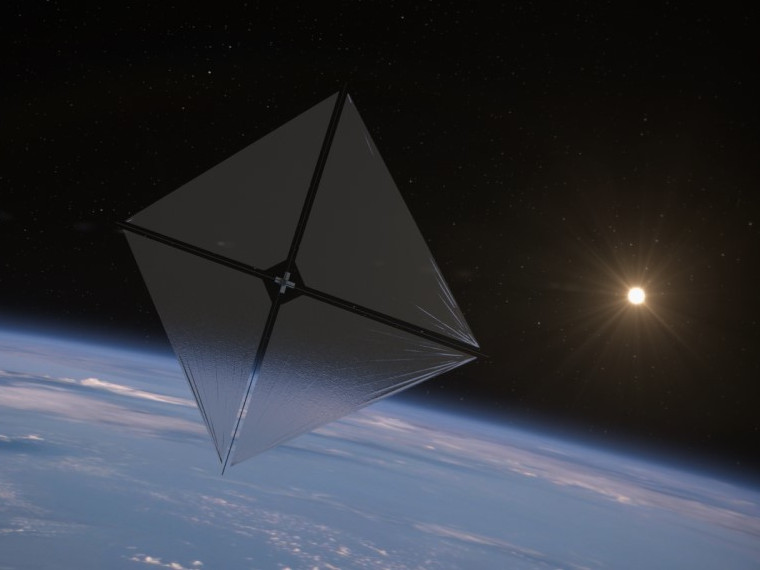
NASA is gearing up to take a significant step forward in space propulsion technology by launching a test run of the “Advanced Composite Solar Sail System” (ACSS). The launch, scheduled for April, will take place from a site in New Zealand and is a pioneering venture to explore the use of solar sails for satellite propulsion.
The heart of this mission is a compact satellite, no larger than a shoebox, that will embark on a journey into low-Earth orbit at an altitude of approximately 1,000 kilometers (600 miles) above the planet. The feature that sets this satellite apart is its 9 by 9 meter (30 by 30 foot) solar sail, an engineering marvel designed to catch the solar wind and propel the satellite through space.
NASA’s solar sail boasts a unique construction with booms composed of a cutting-edge blend of carbon fibers and an adaptable polymer. This innovative design allows the booms to be compactly rolled up, akin to a roll of adhesive tape, highlighting the material’s space-saving and flexible properties. A single 6-meter (20-foot) mast is so compact that it can be easily handled with one hand. Once unfurled, these masts provide the stability needed for the satellite to undergo initial tests.
The trials aim to demonstrate that the small satellite is capable of not only picking up speed but also being steered much like a sailing vessel at sea. These maneuvers will be achieved by adjusting the sail’s orientation with respect to the flow of solar wind, which comprises charged particles emanating from the sun at considerable velocities.
A successful round of testing could revolutionize the way we employ satellites within our solar system. For perspective, the Voyager 2 probe travels at roughly 15 km/second (30,000 miles per hour), while solar storms can propel particles at speeds ranging from 150 to 300 km/second, nearly 600,000 miles per hour. Harnessing such velocity, a solar sail could dramatically reduce the travel time to distant planets like Neptune from 10 years to a mere six months.
Looking ahead, NASA is already contemplating larger-scale solar sails, with potential dimensions of 40 by 40 meters (140 by 140 feet), which would be about 25 times the size of the prototype currently set for testing. Such advancements could propel today’s mini-satellites with the necessary momentum for deep space exploration.
The initial test sail, despite its relatively modest size, should be sufficient to catch the eyes of skywatchers. NASA reports that when the ACSS’s sail is fully deployed and favorably illuminated, the satellite could shine as brightly as Sirius, the most luminous star in our night sky.
This imminent test represents a step towards a new frontier in space innovation. With solar sails, we may soon harness the power of the sun’s particles to voyage across the cosmos more efficiently than ever before, marking a new era of space exploration and expanding our capabilities to navigate the infinite sea above us.