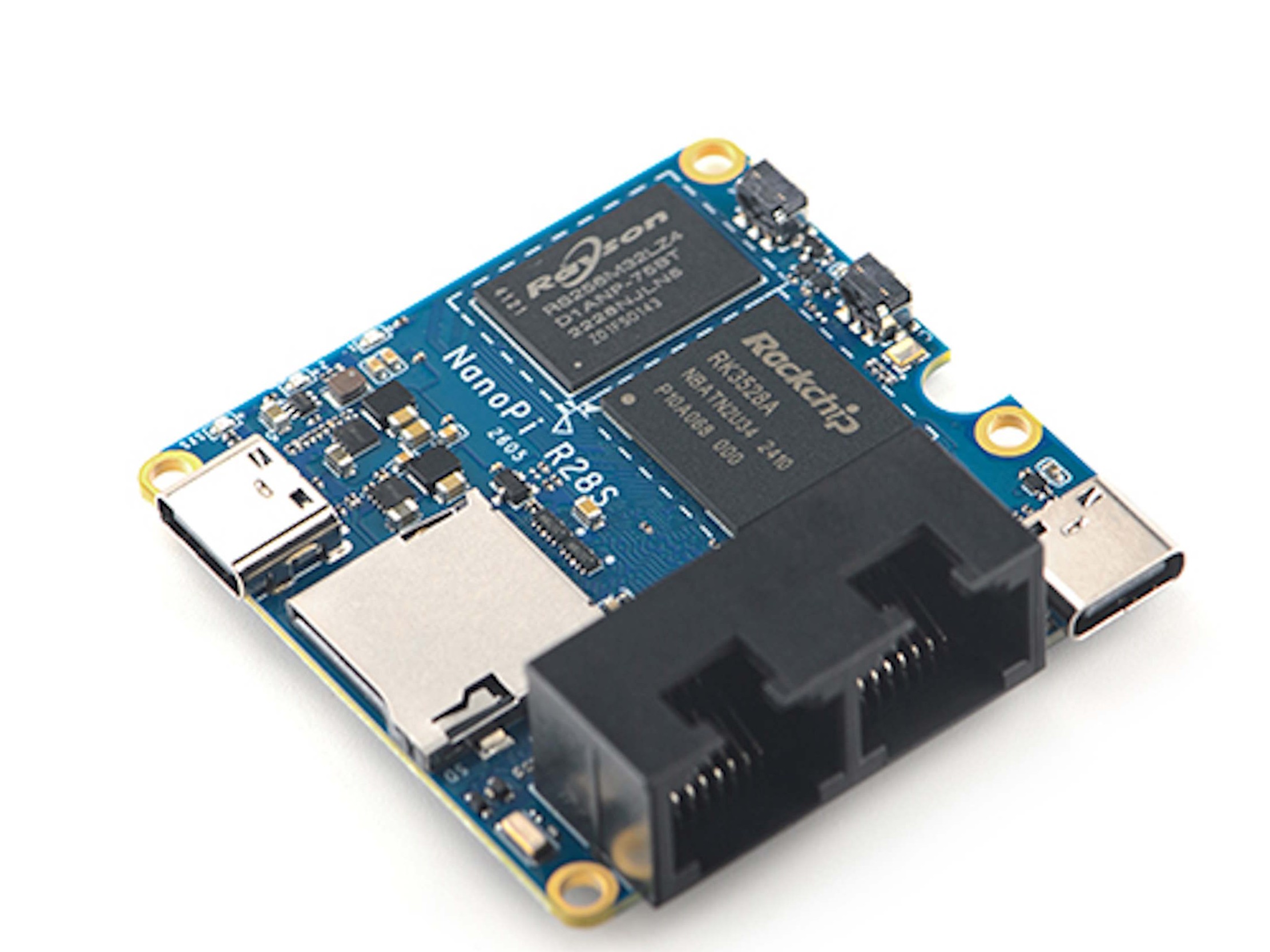
NanoPi R28S arrives as a tiny $20 Raspberry Pi alternative built for networking
FriendlyELEC has introduced the NanoPi R28S, a compact single-board computer aimed at users who need a small, low-cost device for network-focused projects rather than a general-purpose mini PC.
Although it belongs to the same broad category as popular Raspberry Pi boards, the NanoPi R28S takes a very different approach. Instead of offering display output and broad hardware expansion, this board is designed for routing, firewall, gateway, and lightweight network appliance tasks. Its standout feature is the inclusion of two Gigabit Ethernet ports, making it far more suitable for wired networking projects than many entry-level single-board computers.
The NanoPi R28S is exceptionally small, with the bare board measuring just 45 x 45 x 1.2 mm. When placed inside its optional enclosure, the full unit measures 49.5 x 49.5 x 24 mm, making it easy to deploy in tight spaces such as network cabinets, desk setups, smart home installations, or portable lab environments.
In terms of hardware, the board comes with 1 GB of RAM. That is modest compared with many modern development boards, but it should be enough for its intended use cases, especially lightweight networking tasks. Wireless connectivity is also included, with Wi-Fi 6 support offering a useful option for modern wireless network setups.
One important thing to note is that the NanoPi R28S does not include a video output. This means it is not intended to be used like a desktop computer. It also lacks a GPIO header, so users cannot directly attach external sensors, motors, or actuators in the same way they might with more maker-oriented boards. As a result, its expandability is more limited, but that trade-off helps keep the design compact and focused.
For storage and system setup, the NanoPi R28S includes a microSD card slot and support for an eMMC module. A USB Type-C port is used for both power and data transfer, though data is limited to the USB 2.0 standard. The board also supports UART debugging, which can be useful for developers and advanced users during setup or troubleshooting. A dedicated battery connector is available for powering the real-time clock.
On the software side, FriendlyELEC lists support for Ubuntu 24.04 Core and FriendlyWrt 25.12. The latter is especially relevant, as it is designed for network applications and makes sense for a board built around dual Ethernet connectivity.
At $20, the NanoPi R28S could be an attractive option for users looking for an affordable Raspberry Pi alternative for networking projects. It is not the best choice for desktop use, media playback, robotics, or sensor-heavy builds, but for compact routing, firewall experiments, network monitoring, and lightweight server roles, it offers a focused feature set at a very low price. Buyers should keep in mind that import duties or additional fees may apply depending on the region.