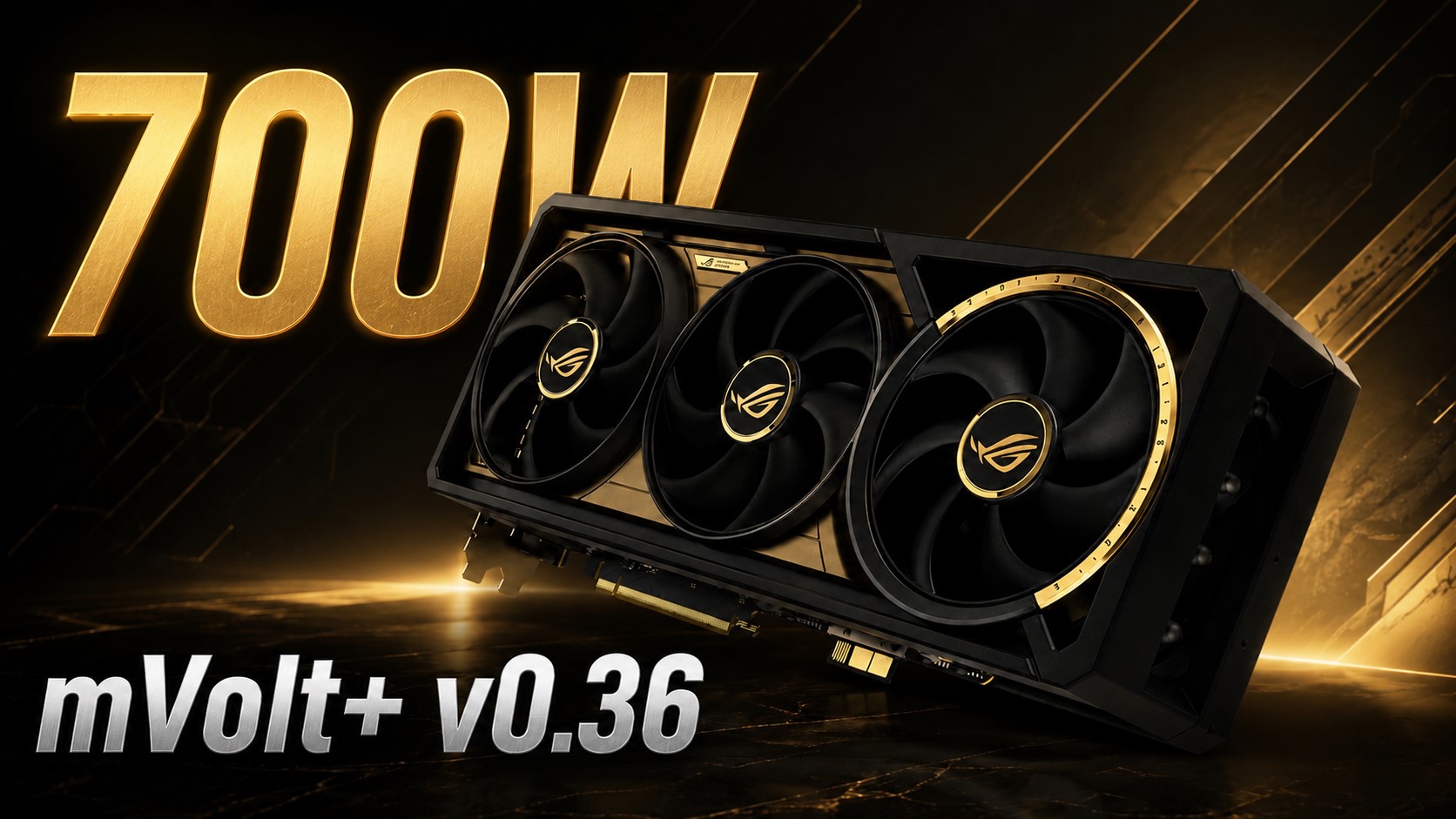
mVolt+ 0.36 Unlocks New RTX 50 Series Power Controls, Letting Overclockers Push RTX 5090 Toward 700W
A new version of mVolt+ is giving GPU overclocking enthusiasts a much wider playground on NVIDIA’s GeForce RTX 50 series graphics cards. Version 0.36 of the tool reportedly exposes hidden Blackwell-era controls that allow users to raise internal power limits beyond what standard overclocking software and default VBIOS restrictions typically allow.
The biggest attention-grabber is the GeForce RTX 5090. According to user reports from the enthusiast community, the flagship Blackwell GPU has been pushed as high as 700W using mVolt+ 0.36. That is a massive jump over its rated power target and represents the kind of headroom extreme overclockers usually chase through hardware modifications.
What makes this especially interesting is that these results were achieved without shunt modding. Traditionally, pushing a graphics card far beyond its built-in power limits could require physical modifications to the card’s power-sensing circuitry. With mVolt+ 0.36, users appear to be gaining access to deeper software-level controls instead.
The updated tool exposes several low-level tuning options for RTX 50 series GPUs. These include separate controls for core and memory channel power limits, GPU clock ranges, and voltage-demand offsets across multiple domains, including Core, XBAR, SYS, and Video. In simple terms, it gives experienced users more ways to adjust how the GPU requests and consumes power under load.
Reports suggest the RTX 5090 can reach around 600W to 650W in some setups, while at least one user claimed to hit 700W. Another enthusiast said their card was running near 3.2 GHz on the GPU core with an XBAR clock around 2.8 GHz. For comparison, that same user previously reached around 3.0 GHz using more conventional GPU overclocking software.
The RTX 5080 has also seen extreme results. One high-end custom RTX 5080 model was reportedly pushed to around 680W, far beyond the official power target available through standard BIOS-based tuning options for that card. This shows that mVolt+ is not simply adjusting the visible power slider most users are familiar with. Instead, it appears to unlock another internal power ceiling that can allow the GPU to keep drawing more power until it runs into a different limiting factor.
However, results are not the same across every graphics card. Lower-tier Blackwell GPUs may see much smaller gains. One RTX 5060 Ti user reportedly gained only around 20W from the new Core Power Limit option, showing that the available headroom depends heavily on the specific GPU, board design, cooling setup, BIOS configuration, and power delivery hardware.
The key feature in mVolt+ 0.36 appears to be the new Core Power Limit control. Unlike traditional overclocking utilities that mainly raise the overall power limit within the boundaries set by the VBIOS, this setting seems to target an additional internal restriction. Once raised, the graphics card can exceed the normal BIOS-defined power ceiling until another protection mechanism or hardware limitation takes over.
For extreme overclockers, this is a major development. The GeForce RTX 5090 and RTX 5080 are already among the most powerful consumer graphics cards available, and unlocking additional power headroom could help users chase higher benchmark scores and higher sustained clock speeds. For competitive overclocking, even small frequency gains can make a meaningful difference.
That said, this is not something casual users should rush to try. Power levels such as 680W or 700W place enormous stress on the GPU, power connectors, voltage regulation components, cooling system, and power supply. Higher wattage also means dramatically more heat, and long-term reliability at these settings is unknown. Even if a card can run at these power levels for a benchmark session, that does not mean it is safe for daily use.
Users experimenting with mVolt+ should understand the risks. Exceeding manufacturer-defined limits can cause instability, crashes, overheating, reduced hardware lifespan, or permanent damage. It may also void warranty coverage. Proper monitoring, high-end cooling, a capable power supply, and strong knowledge of GPU tuning are essential before attempting this type of overclocking.
Still, mVolt+ 0.36 is quickly becoming one of the most talked-about tools in the RTX 50 series overclocking scene. By exposing deeper Blackwell GPU controls, it gives enthusiasts a way to push NVIDIA’s latest graphics cards beyond limits that were previously difficult or impossible to bypass with standard software.
For now, the tool is best viewed as an extreme tuning utility for experienced overclockers rather than a mainstream performance booster. But its arrival shows that the RTX 50 series still has hidden performance territory waiting to be explored, especially for users willing to trade efficiency and safety margins for maximum power and clock speed.