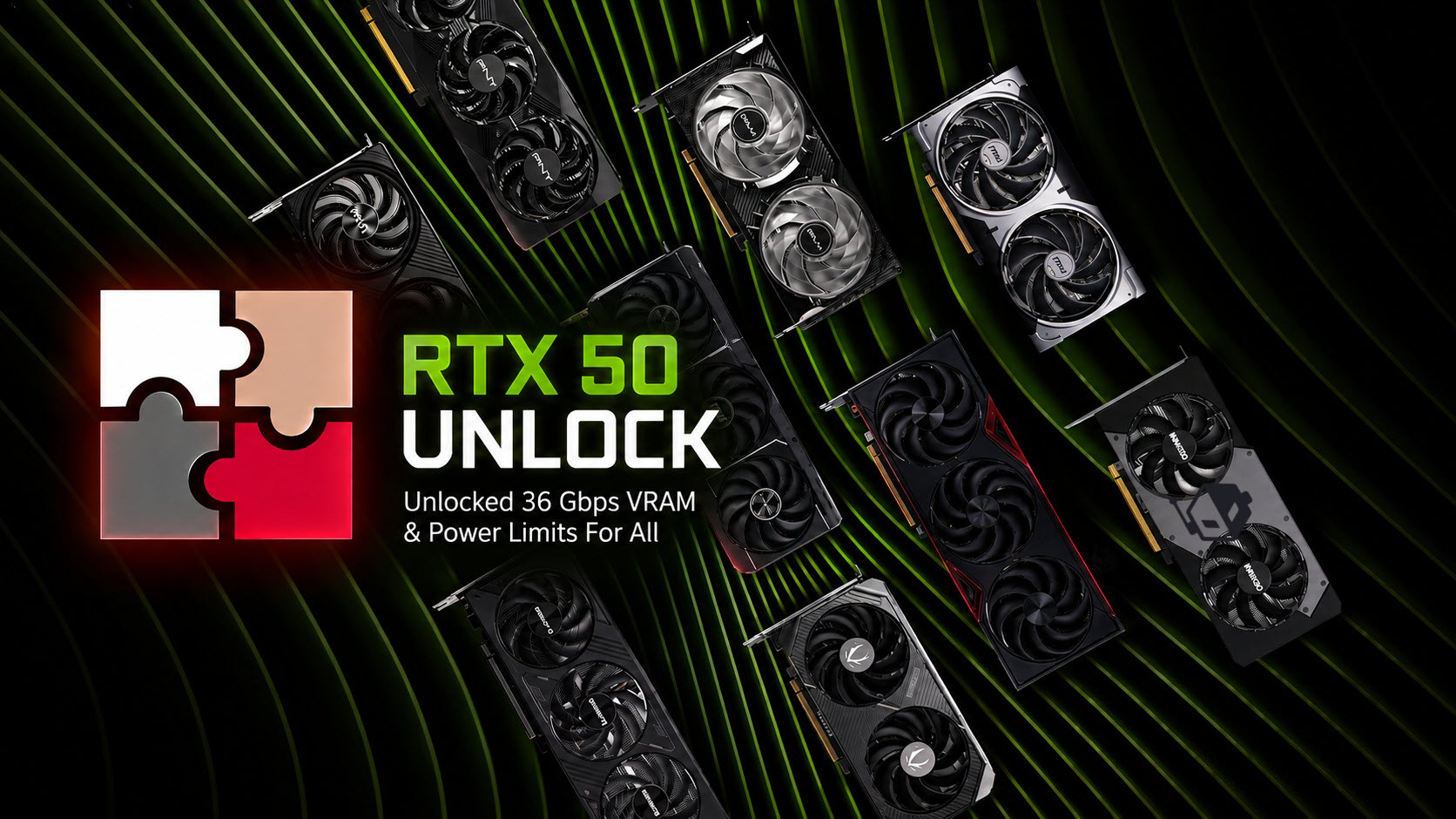
HYDRA Update Unlocks VRAM Overclocking and Power Limit Control for NVIDIA RTX 50 GPUs
The HYDRA tuning utility has received a major upgrade, and it is especially exciting for NVIDIA GeForce RTX 50 series owners. The latest update introduces unlocked GDDR7 VRAM overclocking and power limit control, giving PC enthusiasts more room to tune their graphics cards beyond standard restrictions.
Developed by Yuri Bubliy, also known as 1usmus, HYDRA has become a popular tool among overclockers and hardware enthusiasts who want deeper control over CPU and GPU performance. With this new release, the utility adds several important features aimed at NVIDIA’s newest RTX 50 graphics cards, including memory frequency tuning, expanded power limit adjustment, and improved voltage-related controls.
This update matters because NVIDIA has kept tighter control over power limit adjustments on recent GPU generations. Many GeForce RTX 50 graphics cards do not allow users to increase power limits much beyond the factory-approved range. Only select high-end custom models offer more flexibility, and even then, the options can be limited. HYDRA’s new RTX-focused features give users a more accessible way to experiment with advanced tuning.
One of the biggest highlights is support for GDDR7 memory overclocking up to 36 Gbps on RTX 50 series GPUs. NVIDIA’s latest graphics cards already use fast GDDR7 memory, with speeds typically ranging from 28 Gbps to 34 Gbps depending on the model. However, the memory itself appears to have additional headroom. In the past, reaching higher speeds often required complex hardware or firmware-level modifications, which are not practical for most users. HYDRA aims to simplify that process by offering native control through its own tuning environment.
According to 1usmus, the new HYDRA functionality is not a security exploit, vBIOS modification, or unofficial driver trick. Instead, it is presented as a native feature built into the utility to provide users with greater control over supported NVIDIA RTX 50 hardware. The first version of the update is designed with user safety in mind, so the limits are not pushed to extreme levels by default.
The initial RTX 50 tuning limits include GDDR7 memory overclocking up to 36 Gbps, power limit control up to 125%, and compatibility with NVIDIA RTX 50 graphics cards from multiple board partners.
To demonstrate the update, 1usmus used an ASUS ROG Astral LC GeForce RTX 5090 and increased its memory speed to 36 Gbps. At that frequency, the card reached a memory bandwidth of 2.3 TB/s. That represents a 28.5% improvement in bandwidth, which could help boost performance in bandwidth-sensitive games, rendering tasks, AI workloads, and other GPU-heavy applications.
HYDRA’s RTX-TUNER feature has also been improved as part of this update. Users should no longer face the same curve modification restrictions as before, giving them more freedom when tuning GPU behavior. The tool now includes support for rail offsets such as MSVDD and NVVDD, along with XBAR offset control. These additions are aimed at advanced overclockers who want more precise control than the reference configuration normally allows.
In the power limit demonstration, the tested RTX 5090 was configured to run at 105% power limit. This increased the card’s power draw from the standard 600W level to around 640W. While that is not the maximum limit supported by the tool, it shows how HYDRA can be used to unlock additional tuning headroom while keeping settings relatively controlled.
As with any manual GPU overclocking, there are important risks to consider. Increasing memory speeds, raising power limits, changing voltage behavior, or adjusting GPU curves can cause instability, overheating, crashes, or even permanent hardware damage if done incorrectly. These features are best suited for experienced users who understand GPU tuning, cooling requirements, and system stability testing. Beginners should be extremely cautious before changing settings beyond the stock configuration, especially on high-end graphics cards.
The first HYDRA release with these new RTX 50 features is expected to arrive soon for early access users, with a wider public release planned afterward. Experimental support for NVIDIA RTX PRO 6000 graphics cards is also included, making this update relevant not only for gaming enthusiasts but also for professional users interested in workstation GPU tuning.
Overall, the latest HYDRA update could become an important tool for NVIDIA RTX 50 owners who want more control over GDDR7 memory speeds, GPU power limits, and advanced overclocking behavior. For enthusiasts willing to tune carefully, it opens the door to higher memory bandwidth, improved performance potential, and deeper customization than many RTX 50 graphics cards currently provide out of the box.