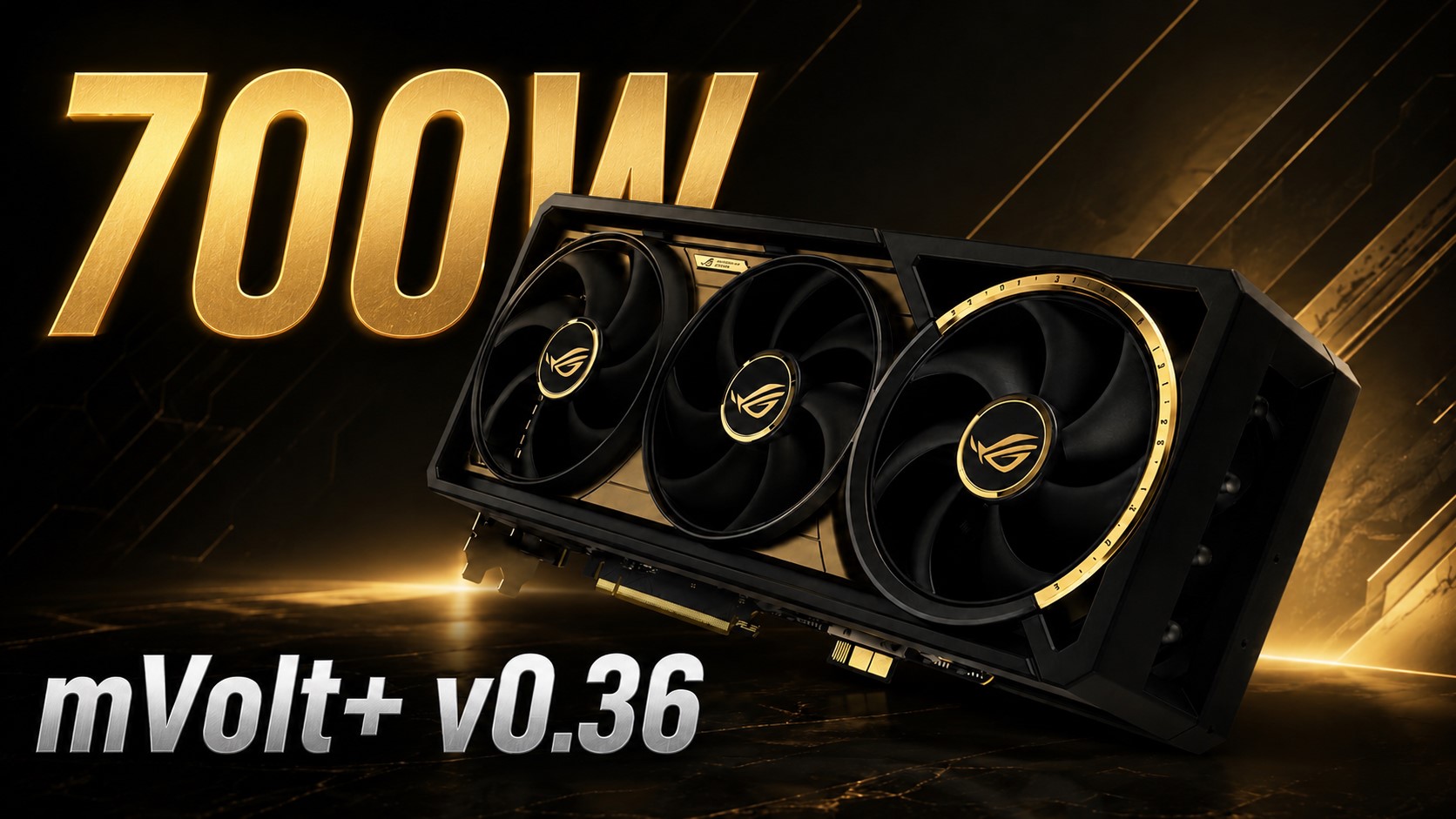
mVolt+ v0.36 Unlocks Hidden RTX 50 Series Controls, Letting Overclockers Push RTX 5090 to 700W
A new version of mVolt+ is giving GPU enthusiasts far more control over NVIDIA’s latest Blackwell-based GeForce RTX 50 series graphics cards. With version 0.36, the tool exposes hidden low-level power and voltage controls, allowing overclockers to push cards like the GeForce RTX 5080 and RTX 5090 well beyond their standard power limits.
The update has quickly caught the attention of extreme overclockers because it does more than simply raise a typical power-limit slider. Instead, mVolt+ v0.36 appears to unlock deeper internal controls that can influence how much power the GPU is allowed to draw before hitting a limiter.
For users chasing higher clocks and benchmark scores, this is a major development. For everyday users, however, it also comes with a clear warning: pushing high-end GPUs far beyond their rated power limits can increase heat output, stress components, and potentially reduce long-term reliability.
RTX 5090 reportedly pushed up to 700W
The GeForce RTX 5090 already carries a very high power target, but early reports from overclocking communities suggest that mVolt+ v0.36 can take things much further.
One user reportedly managed to push an RTX 5090 to around 700W, which is roughly 50% higher than its rated power level. Other users have reported power draw figures in the 600W to 650W range, which is still far above the card’s normal operating limits.
Another enthusiast claimed to run an RTX 5090 at approximately 3.2 GHz, paired with an XBAR clock of around 2.8 GHz. That is a notable jump compared to previous results achieved with more traditional GPU overclocking software, where the same card reportedly topped out closer to 3.0 GHz.
These results suggest that mVolt+ may be opening a new path for RTX 50 series overclocking, especially for users with advanced cooling setups and a strong understanding of GPU power behavior.
RTX 5080 also sees extreme power increases
The RTX 5080 is also seeing significant gains under the new mVolt+ controls. One ASUS ROG Astral RTX 5080 was reportedly pushed to around 680W, a huge increase over the official power range normally available through manufacturer-approved tuning options.
That kind of power draw is far beyond what most users would ever need, but it shows how much hidden headroom may exist on certain high-end Blackwell GPUs when deeper power constraints are adjusted.
However, results are not consistent across every RTX 50 series model. For example, an RTX 5060 Ti reportedly gained only around 20W from the new Core Power Limit adjustment. This suggests that the effect of mVolt+ v0.36 depends heavily on the specific GPU, board design, BIOS limits, cooling system, and power delivery hardware.
What makes mVolt+ v0.36 different?
Most overclocking utilities focus on familiar controls such as GPU clock offsets, memory clock adjustments, fan curves, voltage tuning, and power-limit sliders. These tools are useful, but they are usually restricted by limits set in the card’s VBIOS.
mVolt+ v0.36 appears to go deeper.
The latest version exposes additional controls for NVIDIA GeForce RTX 50 series graphics cards, including:
Core power limit controls
Memory channel power limits
GPU clock range controls
Voltage-demand offsets for multiple domains
Core, XBAR, SYS, and Video domain tuning
The most important addition appears to be the new Core Power Limit setting. Instead of only adjusting the standard board power limit, this setting may lift an internal restriction that previously capped how far the GPU could go. Once that internal limit is raised, the graphics card can continue drawing more power until another bottleneck takes over.
That is why some RTX 5080 and RTX 5090 cards are now reaching power levels that would not have been possible with conventional overclocking tools alone.
A powerful tool, but not for casual users
While the results are impressive, this kind of tuning is aimed squarely at advanced users. Running an RTX 5090 at 700W or an RTX 5080 near 680W is not something most gaming PCs are built to handle.
Higher power draw means more heat, more stress on the GPU’s voltage regulation hardware, greater load on the power supply, and potentially more risk for cables and connectors if the system is not properly configured. Users attempting this level of overclocking need strong cooling, a high-quality power supply, careful monitoring, and a clear understanding of the risks involved.
There is also no guarantee that every card will respond the same way. Two GPUs with the same model name can behave very differently depending on silicon quality, cooling capacity, BIOS configuration, and board-level power delivery.
mVolt+ is becoming a key tool for RTX 50 series overclockers
The arrival of mVolt+ v0.36 is quickly making the utility one of the most talked-about tools in the RTX 50 series overclocking scene. By exposing hidden Blackwell GPU controls, it gives enthusiasts the ability to experiment with power limits and voltage behavior in ways that standard software does not allow.
For competitive overclockers, this could help unlock higher benchmark scores and better peak clock speeds. For hardware enthusiasts, it offers a deeper look at how NVIDIA’s latest GPUs manage power internally. But for regular gamers, the safest approach is still to stay within manufacturer-approved limits unless they fully understand the consequences.
The RTX 5080 and RTX 5090 are already extremely powerful graphics cards at stock settings. With mVolt+ v0.36, overclockers are proving that there is even more performance headroom available, though accessing it requires serious cooling, careful tuning, and a willingness to take on added risk.