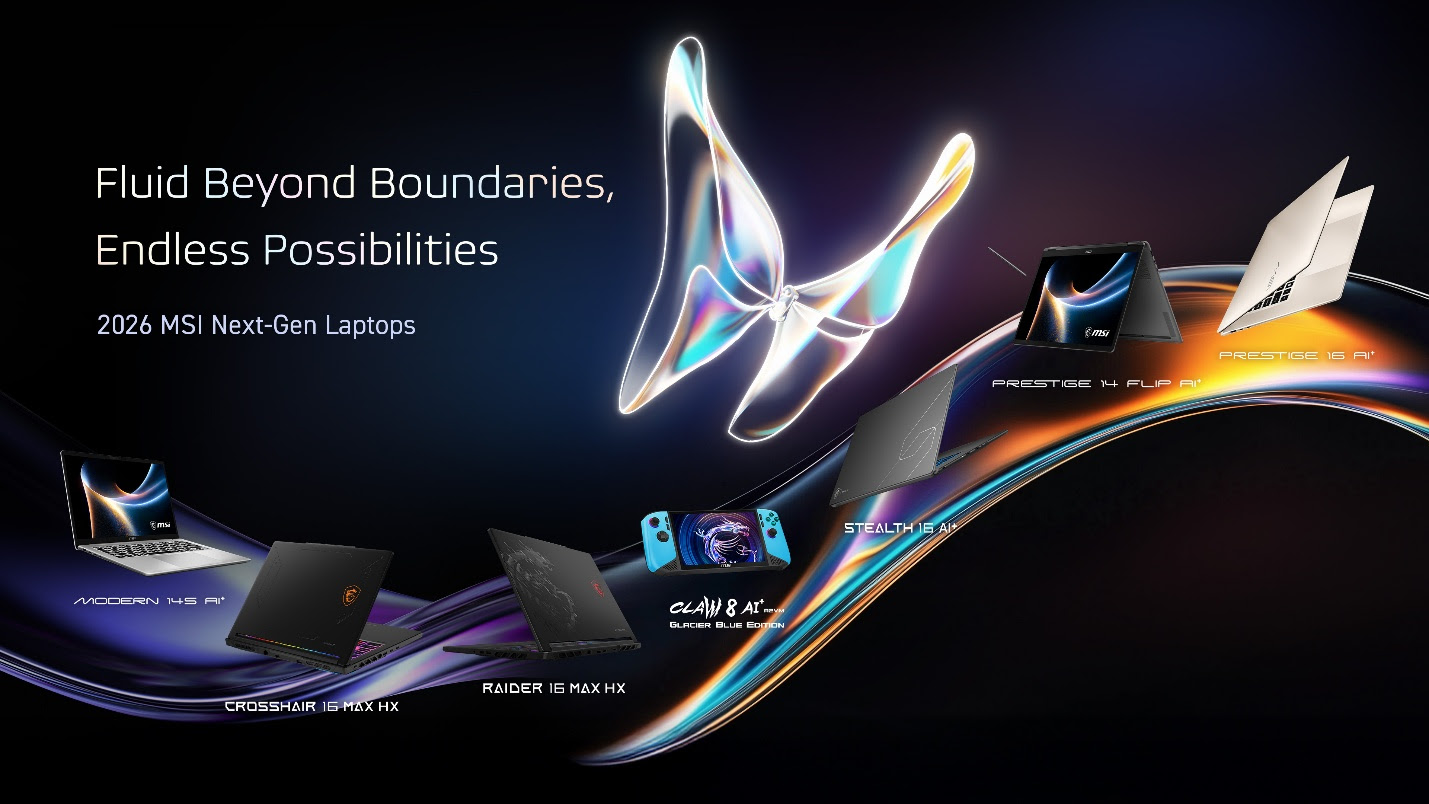
MSI is kicking off 2026 with a meaningful refresh to its laptop lineup, leaning heavily on Intel’s latest Core Ultra 300 “Panther Lake” processors to push performance higher while keeping thin-and-light designs truly portable. Revealed alongside a wave of CES 2026 hardware, MSI’s updates stretch across multiple families—including Prestige, Modern, and several gaming-focused Raider configurations—giving buyers more options whether they want an OLED creator laptop, a travel-ready daily driver, or a no-compromise powerhouse built for high-FPS gaming.
MSI Prestige gets Panther Lake power and a lighter design
MSI’s Prestige 14 and Prestige 16 updates are aimed at users who want premium portability without giving up speed. Both models move to Intel Core Ultra Series 3 processors and can be configured with Intel Arc B390 integrated graphics, a notable step up for visual performance in an ultraportable-style machine—useful for creative workloads, light gaming, and accelerated apps.
Portability is a clear theme here. MSI says the new Prestige 14 is 22% lighter than before, now landing at 1.32 kg. The Prestige 16 holds steady at 1.59 kg, keeping the larger-screen option appealing for users who prefer more workspace without moving into bulky territory.
Display quality is another big Prestige selling point. The Prestige 16 Flip AI+ C3M features a 16-inch 2.8K OLED touchscreen with a 48–120Hz variable refresh rate and VESA DisplayHDR True Black 1000 certification, plus MSI Nano Pen support for note-taking and drawing. The Prestige 14 AI+ D3M focuses on a compact 14-inch FHD+ OLED panel with full DCI-P3 coverage.
Other highlights across these Prestige models include up to 64GB of onboard LPDDR5x memory, PCIe Gen4 NVMe storage support, Wi‑Fi 7, Bluetooth 6, and modern ports like dual Thunderbolt 4 alongside HDMI 2.1—making them practical for both desk setups and travel.
MSI Modern 14S and Modern 16S bring Core Ultra to thinner, upgrade-friendly laptops
MSI is also extending the Panther Lake-era improvements into its Modern series with the Modern 14S and Modern 16S. These laptops focus on being flexible, lightweight, and capable—built for students, hybrid workers, and everyday multitaskers who still want strong CPU performance.
Both models can be configured up to an Intel Core Ultra 7 355 and, importantly for buyers who like to upgrade later, they include two DDR5 memory slots (up to 32GB). Storage is handled by an NVMe M.2 SSD slot with PCIe Gen4 x4 support.
Connectivity is unusually complete for thin machines: USB-A, USB-C with display and charging support, HDMI, RJ‑45 Ethernet, and a microSD card reader are all included—ideal for presentations, external monitors, wired networking, and quick file transfers.
Despite the practical port selection, MSI is still keeping the Modern S models highly portable. The aluminum chassis can be as thin as 11.1mm, and the Modern 14S OLED version can weigh as little as 1.3 kg. Buyers can also choose between OLED panels with wide color coverage or IPS-level displays that support a 48–120Hz variable refresh rate.
MSI Raider pushes laptop performance to extremes with massive 300W power delivery
For gamers and enthusiasts who want maximum performance above all else, the Raider series takes the spotlight. MSI’s updated Raider 16 Max HX is designed to break past typical laptop limits, with a claimed total power delivery of 300W—an eye-catching figure for a portable gaming system.
On the graphics side, MSI pairs the platform with NVIDIA GeForce RTX 5090 (and options that include RTX 5080 in certain Raider 16 HX configurations). CPU options in the lineup include Intel Core Ultra 200HX series, and MSI also lists an AMD-powered Raider A16 HX configuration that can be equipped up to a Ryzen 9 9955HX while still offering an RTX 5090 Laptop GPU option.
High-end displays match the high-end components. MSI pairs these Raider systems with 16-inch QHD+ (2560 x 1600) panels up to 240Hz, with OLED options available that include 100% DCI-P3 coverage and VESA DisplayHDR True Black 1000 certification—great for both competitive gaming and cinematic single-player titles.
To keep performance stable during long sessions, MSI includes its Cooler Boost Trinity system with an Intra Flow thermal design, intended to manage heat under heavy load. The platform also targets high-speed expansion and connectivity, offering configurations with PCIe Gen5 NVMe storage support, Wi‑Fi 7, up to 2.5GbE Ethernet, and a wide range of I/O such as Thunderbolt 4/USB4 Type‑C, HDMI 2.1, and even an SD Express card reader on select models.
Why this MSI 2026 laptop refresh matters
MSI’s 2026 updates show a clear strategy: bring Intel’s newest Core Ultra 300 “Panther Lake” architecture into more mainstream premium laptops (Prestige and Modern), while simultaneously pushing the ceiling on gaming laptop performance in the Raider family. The result is a lineup that covers multiple priorities—lighter builds and better efficiency for everyday users, OLED displays and modern connectivity for creators, and extreme wattage plus flagship GPUs for gamers who want desktop-class ambition in a laptop form factor.
If you’re shopping for a new MSI laptop in 2026, these updates are worth watching closely—especially if you want Core Ultra 300 Panther Lake performance in a portable design, or if you’re aiming for a high-refresh OLED gaming laptop built to handle top-tier GPUs.MSI is refreshing its gaming and creator laptop lineup with notable upgrades in performance, cooling, display quality, and connectivity, giving buyers more compelling options in 2025. Across key series like the Stealth and Crosshair families, the big story is “more power, better thermals, and better screens,” paired with modern I/O and high-end audio features that make these machines feel truly current.
Stealth 16 AI+ B3W: flagship-grade power in a lighter build
The Stealth 16 AI+ B3W is positioned as a premium thin-and-light gaming laptop that doesn’t compromise on speed. It can be configured up to an Intel Core Ultra 9 386H and up to an NVIDIA GeForce RTX 5090 Laptop GPU, making it one of the most performance-driven options for high-FPS gaming, creative workloads, and accelerated AI tasks.
A major highlight is the 16-inch QHD+ OLED display (2560 x 1600) with a fast 240Hz refresh rate, 100% DCI-P3 color coverage, and VESA DisplayHDR True Black 600. For anyone shopping for an OLED gaming laptop that can also handle color-sensitive work, this panel is a strong selling point.
Memory support scales up to DDR5-7200 with two slots and up to 128GB, while storage includes two NVMe M.2 SSD slots (PCIe Gen4 x4), which is ideal for users who want both speed and expansion. Connectivity is also future-facing, with Intel Wi‑Fi 7, Bluetooth v6, and Ethernet up to 2.5GbE.
Port selection is aimed at power users: two Thunderbolt 4 ports (with DisplayPort and Power Delivery 3.0 support), two USB 3.2 Gen2 Type‑A ports, HDMI 2.1 (up to 8K at 60Hz or 4K at 120Hz), an audio combo jack, and a Gigabit Ethernet port. The keyboard includes 4-zone RGB lighting plus a Copilot key, and the webcam is an IR FHD (1080p) unit with HDR and enhanced noise reduction.
Audio is another standout. MSI includes a 4-speaker system (two 2W speakers plus two 2W woofers) tuned with Nahimic 3 Audio Enhance and Hi‑Res Audio support. Battery capacity is a substantial 90Whr (4-cell Li‑Polymer), and despite the power inside, the system stays portable at 1.99 kg with a 354 x 246 x 16.65–19.9 mm chassis.
Crosshair 16 HX series: performance value with modern CPU/GPU options
MSI’s Crosshair 16 HX lineup continues to target gamers who want strong specs and gaming-focused features in a chunkier chassis that can better sustain performance. Two configurations are highlighted: the Crosshair 16 HX E2W and the Crosshair 16 HX E14W.
The Crosshair 16 HX E2W upgrades to Intel Core Ultra 200HX Series processors, while the Crosshair 16 HX E14W can be configured up to an Intel Core i9-14900HX. Both models go up to an NVIDIA GeForce RTX 5070 Laptop GPU, aiming for a sweet spot of high-refresh 1440p gaming and modern features without jumping to the extreme top end.
Display choices differ slightly. The E2W offers either a 16-inch QHD+ OLED 165Hz option (with 100% DCI-P3, VESA DisplayHDR True Black 500, and eye-care certification) or an IPS-level 16-inch QHD+ 240Hz option. The E14W lists a 16-inch QHD+ IPS-level 240Hz panel with 100% DCI-P3 coverage.
Memory is DDR5 with two slots, supporting up to 96GB, and storage is designed for both speed and flexibility: one NVMe M.2 slot with PCIe Gen5 x4 plus another with PCIe Gen4 x4. For wireless and wired networking, these laptops include Intel Wi‑Fi 6E and Bluetooth 5.3, plus Ethernet up to 2.5GbE.
I/O differs by model. The E2W lists a Thunderbolt/USB‑C connection along with USB-A, HDMI 2.1, audio combo jack, and Gigabit Ethernet. The E14W includes two USB 3.2 Gen2 Type‑C ports with DisplayPort and Power Delivery 3.0, three USB 3.2 Gen1 Type‑A ports, HDMI 2.1, audio combo jack, and Gigabit Ethernet.
Audio is handled by dual 2W stereo speakers with Nahimic 3 Audio Enhance and Hi‑Res Audio support. Both Crosshair models use an 80Whr 4-cell Li‑Polymer battery and weigh 2.6 kg. Physical dimensions are similar, though thickness varies by configuration. MSI also notes that I/O ports and speaker design can vary depending on the exact model and configuration.
Prestige laptop preorder and release timing
MSI also confirmed availability timing for its new Prestige laptop models featuring Panther Lake SKUs. Preorders begin on January 6, with retail availability starting January 27.
What to take away if you’re shopping
If you’re trying to choose between MSI’s updated laptops, the Stealth 16 AI+ B3W is the premium pick for shoppers who want top-tier GPU options, a high-end OLED panel, next-gen connectivity like Wi‑Fi 7, and a lighter chassis. The Crosshair 16 HX series leans into performance-per-dollar with strong CPUs, RTX 5070 graphics, high-refresh QHD+ displays, and PCIe Gen5 storage support, while keeping the design geared toward sustained gaming performance.
As always, the exact port layout and speaker configuration can vary by specific build, so it’s worth double-checking the final configuration details before buying.