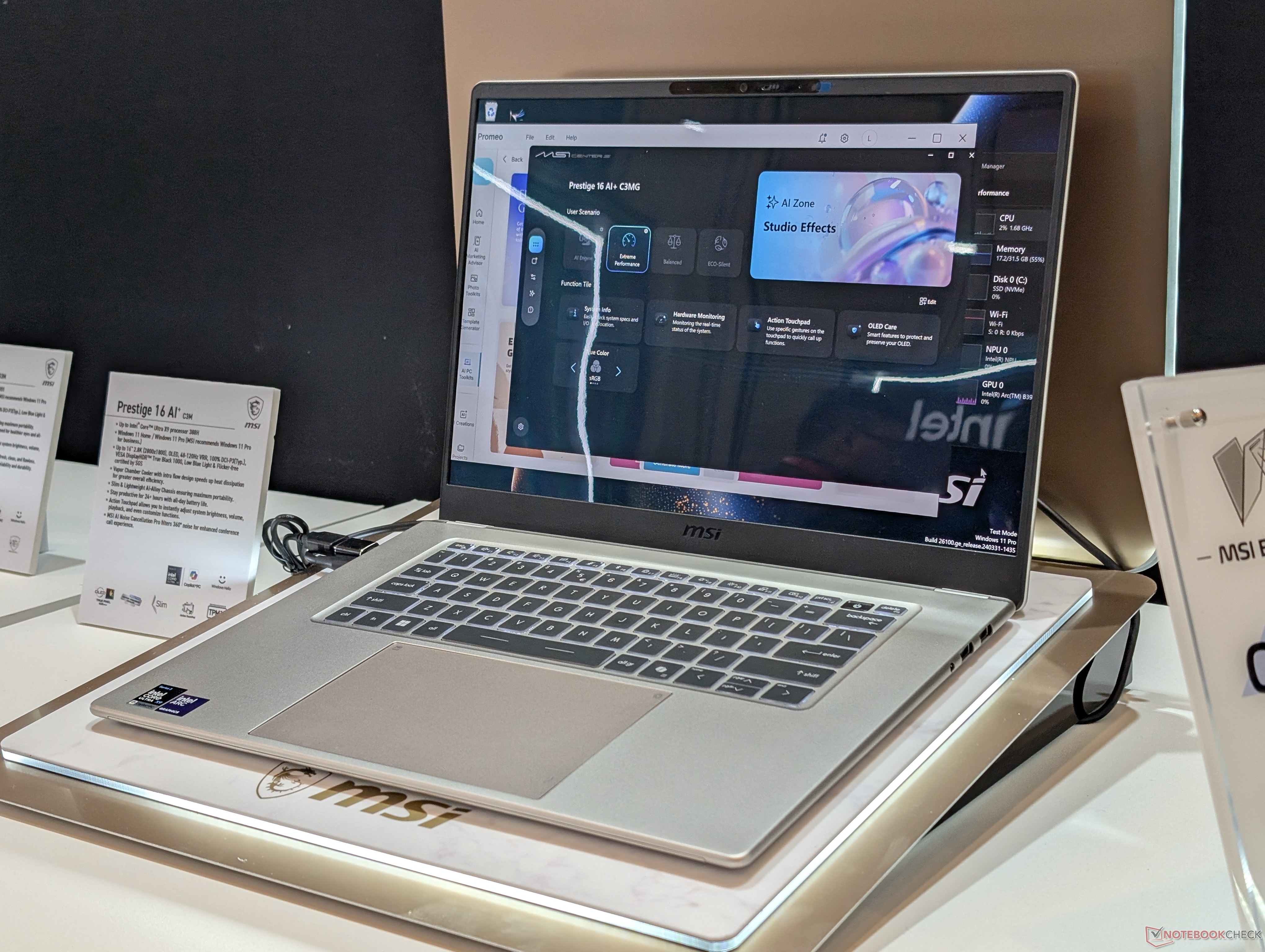
Intel’s new Panther Lake laptops are finally starting to show up in more models, giving shoppers real choices beyond the familiar Dell XPS lineup. If you want Panther Lake performance in a thinner, lighter, travel-friendly 16-inch machine, the refreshed MSI Prestige 16 AI+ C3MTG is shaping up to be one of the most compelling alternatives.
What makes the updated Prestige 16 especially appealing is how it focuses on everyday practicality. It comes in slimmer and lighter than the XPS 16, and it pairs that portable design with a larger 81 Wh battery that can translate into strong real-world endurance. For people who work on the go, another big win is connectivity: the Prestige includes more built-in ports, which can reduce how often you need to carry dongles.
MSI also adds a small but surprisingly useful quality-of-life feature: the screen hinges open almost a full 180 degrees. Compared with a more limited hinge range on the competing model, that wider opening angle can make it easier to avoid reflections and glare in bright rooms, offices, classrooms, and airports.
That said, the XPS 16 still has important strengths that may matter depending on your priorities. Cooling is a major one. With its thicker build and larger cooling solution, the XPS can run significantly cooler—by as much as 20°C in certain situations—which may be a deciding factor for sustained performance workloads. Dell’s system can also offer more flexible USB-C charging, a sharper 5 MP webcam option, and display choices that include a higher-resolution OLED touchscreen. Interestingly, battery life can also swing in Dell’s favor in the right configuration: opting for an IPS panel instead of OLED can help it last longer, even with a smaller battery.
Here’s how the key specs compare for shoppers deciding between a 2026 Dell XPS 16 and the 2026 MSI Prestige 16 AI+ C3MTG:
Both can be configured with up to an Intel Panther Lake X9 CPU, and both support up to a single M.2 2280 SSD for storage.
Ports are one of the clearest differences. The XPS 16 focuses on three USB-C Thunderbolt ports with DisplayPort 2.1 and Power Delivery plus a 3.5 mm headset jack. The Prestige 16 offers a more mixed selection: two USB-A 3.2 Gen 1 ports, HDMI 2.1, two USB-C Thunderbolt 4 ports with DisplayPort and Power Delivery, plus a 3.5 mm headset jack.
Battery capacity favors MSI at 81 Wh versus 70 Wh on the XPS. Reported WLAN runtime figures vary by configuration: the XPS is listed at 10.3 hours with OLED and 26.6 hours with IPS, while the Prestige is listed at 12.6 hours.
Charging hardware differs too. The XPS includes a 100 W USB-C adapter, while the Prestige ships with a 65 W USB-C adapter (with a more compact brick shape).
For input devices, the Prestige also has the edge on clickpad size, with a 16 x 10 cm pad compared with 15.2 x 9 cm on the XPS.
Display options are another key separator. The XPS 16 can be configured with a 1920 x 1200 IPS 120 Hz panel rated at 500 nits, or a 3200 x 2000 OLED 120 Hz panel rated at 400 nits. The Prestige 16 comes with a 2880 x 1800 OLED 120 Hz display rated at 400 nits. In other words, MSI may not match the highest-resolution OLED option found on the XPS, but it still delivers a sharp OLED experience while leaning into portability and port variety.
Size and weight also favor MSI for commuters and frequent flyers. The XPS 16 measures 14.62 x 352.58 x 237.47 mm and weighs 1.72 kg, while the Prestige 16 measures 13.9 x 357.7 x 254.3 mm and weighs 1.64 kg—lighter, and slightly thinner.
Bottom line: if your ideal Panther Lake laptop is a sleek 16-inch system built for travel with more built-in ports, a lighter chassis, a large battery, and a hinge that opens nearly flat, the MSI Prestige 16 AI+ C3MTG deserves a close look. If you care more about cooler operating temperatures, higher-end webcam options, and the highest-resolution OLED touchscreen choices, the XPS 16 remains a strong pick—especially if you choose the IPS model for maximum battery life.


