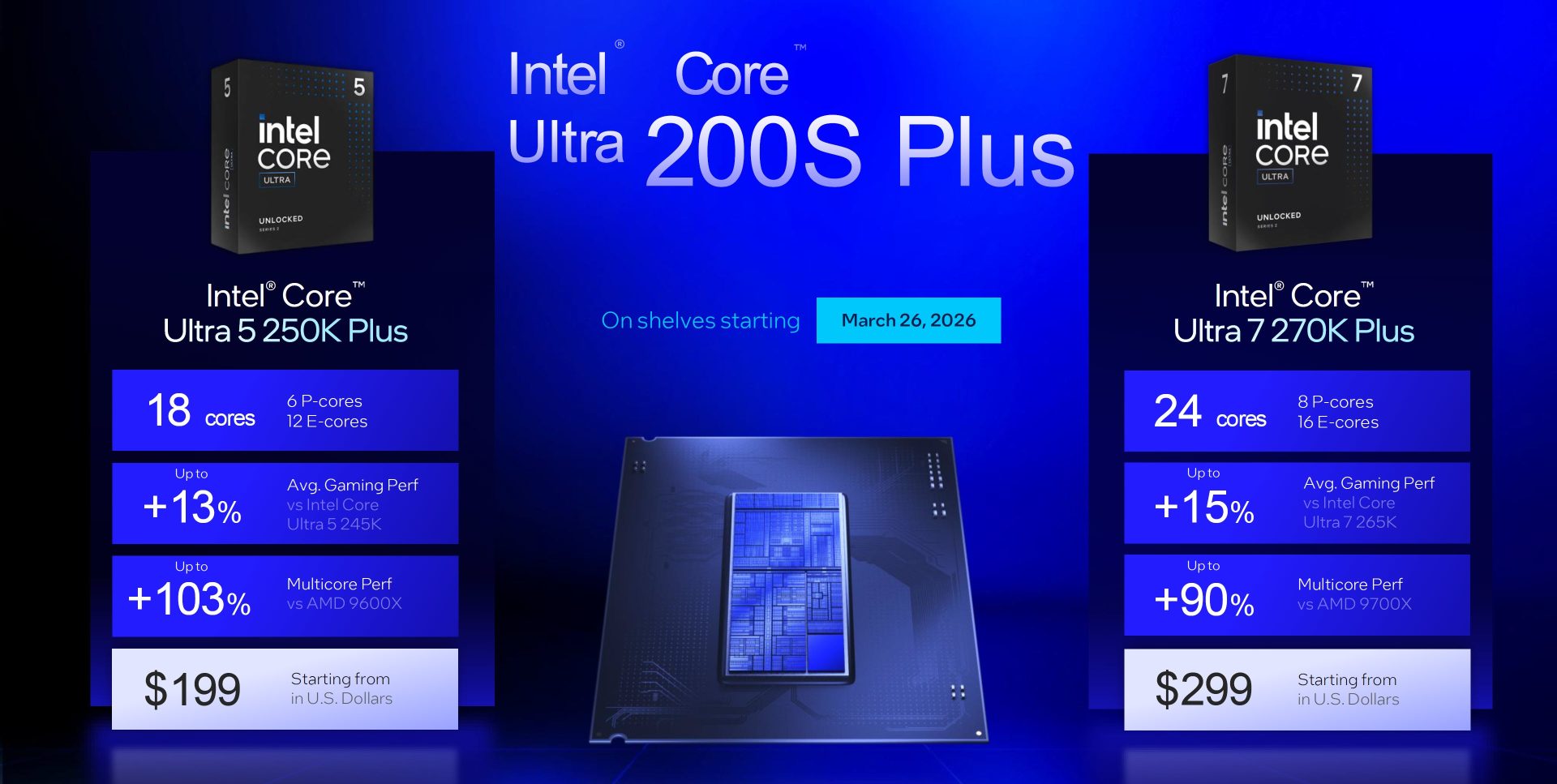
Intel is expanding its LGA 1851 desktop lineup with two new “Plus” processors aimed squarely at gamers and value-focused PC builders: the Core Ultra 7 270K Plus and Core Ultra 5 250K Plus. These chips are part of Intel’s Core Ultra 200S Plus family, described as a light refresh of Arrow Lake designed to squeeze more performance, introduce new optimization tech, and improve the overall platform value without forcing users into an entirely new ecosystem right away.
What makes Core Ultra 200S Plus different comes down to three key upgrades. First, Intel is applying architectural and process refinements to improve real-world performance. Second, the Plus parts boost performance on the existing LGA 1851 platform, which matters for people already invested in compatible motherboards. Third, Intel positions the Plus series as the most complete version of its current desktop architecture, pairing higher speeds and broader memory support with a new software-driven performance feature.
Core Ultra 7 270K Plus specifications and what’s new versus 265K
The Core Ultra 7 270K Plus sits at the top of this new value-oriented refresh. It includes 24 total cores made up of 8 Lion Cove performance cores (P-cores) and 16 Skymont efficiency cores (E-cores). It reaches up to 5.5 GHz max boost, with all-core boosts listed at up to 5.4 GHz on P-cores and 4.7 GHz on E-cores. Cache is also upgraded, with 36 MB of L3 and 40 MB of L2. Intel lists a 3.0 GHz die-to-die (D2D) fabric frequency, plus an integrated GPU with 4 Xe cores clocked at up to 2.0 GHz. Maximum turbo power (MTP) is rated at 250W.
Compared with the Core Ultra 7 265K, the 270K Plus adds four extra E-cores (moving from 20 cores total to 24), increases cache (30 MB to 36 MB L3, and 36 MB to 40 MB L2), raises the D2D fabric frequency from 2.1 GHz to 3.0 GHz, and nudges all E-core boost up by 100 MHz. One of the biggest attention-grabbers is pricing: $299 for the 270K Plus versus a higher MSRP previously associated with the 265K.
Core Ultra 5 250K Plus specifications and what’s new versus 245K
The Core Ultra 5 250K Plus is positioned as a major step up in core count for the money. It features 18 total cores, combining 6 Lion Cove P-cores with 12 Skymont E-cores. Max boost reaches 5.3 GHz, with all-core boosts up to 5.1 GHz on P-cores and 4.6 GHz on E-cores. Cache increases to 30 MB L3 and 36 MB L2, the D2D fabric is listed at 3.0 GHz, and the iGPU includes 4 Xe cores clocked up to 1.9 GHz. MTP is 159W.
Against the Core Ultra 5 245K, the 250K Plus adds four E-cores (14 total cores up to 18), raises boost clocks by 100 MHz, bumps all P-core boost by 100 MHz, increases cache (24 MB to 30 MB L3, and 26 MB to 36 MB L2), and lifts D2D fabric from 2.1 GHz to 3.0 GHz. The price drop is dramatic: $199 for the 250K Plus compared with a much higher MSRP associated with the 245K.
The three platform-focused upgrades: optimization tool, faster interconnect, faster DDR5
Alongside the new chips, Intel is emphasizing several improvements intended to translate into better gaming smoothness and lower system latency.
One is a new Intel Binary Optimization Tool. Intel frames it as a way to increase instructions per cycle (IPC) and improve performance in supported workloads by using Intel compiler and profiling technology to streamline libraries and executables. The key point is that it’s meant to help even when software was originally optimized for different x86 processors, earlier architectures, or even game-console-like targets.
Another major change is the die-to-die (D2D) fabric frequency jump. Intel is pushing D2D up to 3.0 GHz, which is roughly a 900 MHz uplift compared to certain non-Plus parts. The practical goal here is to speed up the CPU-to-memory-controller link, lowering latency and improving gaming performance.
Memory support also gets a headline-worthy bump. Core Ultra 200S Plus adds support for DDR5-7200 (up from DDR5-6400 on non-Plus models) and remains compatible with Intel’s Boost BIOS profile, including warranty-backed support for up to 8000 MT/s memory overclocking. Intel is also talking up early support for 4-Rank CUDIMM DDR5 on select Intel 800-series chipset motherboards. These emerging modules can scale up to 128GB per DIMM, enabling very high memory capacity on a mainstream desktop platform while still targeting strong bandwidth and latency characteristics.
Gaming and productivity performance claims
For comparisons in the same price neighborhood, Intel positions the Core Ultra 7 270K Plus against the Ryzen 7 9700X and the Core Ultra 5 250K Plus against the Ryzen 5 9600X.
In multi-threaded workloads, Intel claims the Plus chips can deliver up to double the performance in a range of tests, which aligns with the raw core-count advantage (24 cores versus an 8-core/16-thread competitor in the Ultra 7 comparison, and 18 cores versus a 6-core/12-thread competitor in the Ultra 5 comparison).
On the gaming side, Intel highlights gains versus its own non-Plus lineup. The Core Ultra 7 270K Plus is shown averaging roughly 15% faster than the Core Ultra 7 265K in 1080p gaming across a selection of titles, with double-digit improvements in multiple games. The Core Ultra 5 250K Plus is shown averaging about 13% faster versus the Core Ultra 5 245K, also with double-digit gains in several games.
Pricing, value, and the LGA 1851 upgrade question
Intel is pricing the Core Ultra 7 270K Plus at $299 and the Core Ultra 5 250K Plus at $199. Those price points put them directly in the ring with popular alternatives at similar street pricing, and Intel’s pitch is straightforward: stronger multi-threaded horsepower for the dollar plus improved gaming results thanks to the D2D fabric uplift, memory boosts, and the new optimization approach.
The big hesitation is platform longevity. LGA 1851 is expected to be replaced by a new socket later this year, which complicates the decision for brand-new system builders who care about dropping in future CPUs without changing motherboards. For current LGA 1851 owners, the new Plus chips may be most attractive to people coming from lower-tier parts, non-K models, or those who really want the extra E-cores, higher interconnect speed, and improved memory support.
Release timing
Intel’s Core Ultra 200S Plus desktop CPUs are slated to arrive at retail on March 26, with additional new LGA 1851 motherboards expected to roll out in the months that follow.