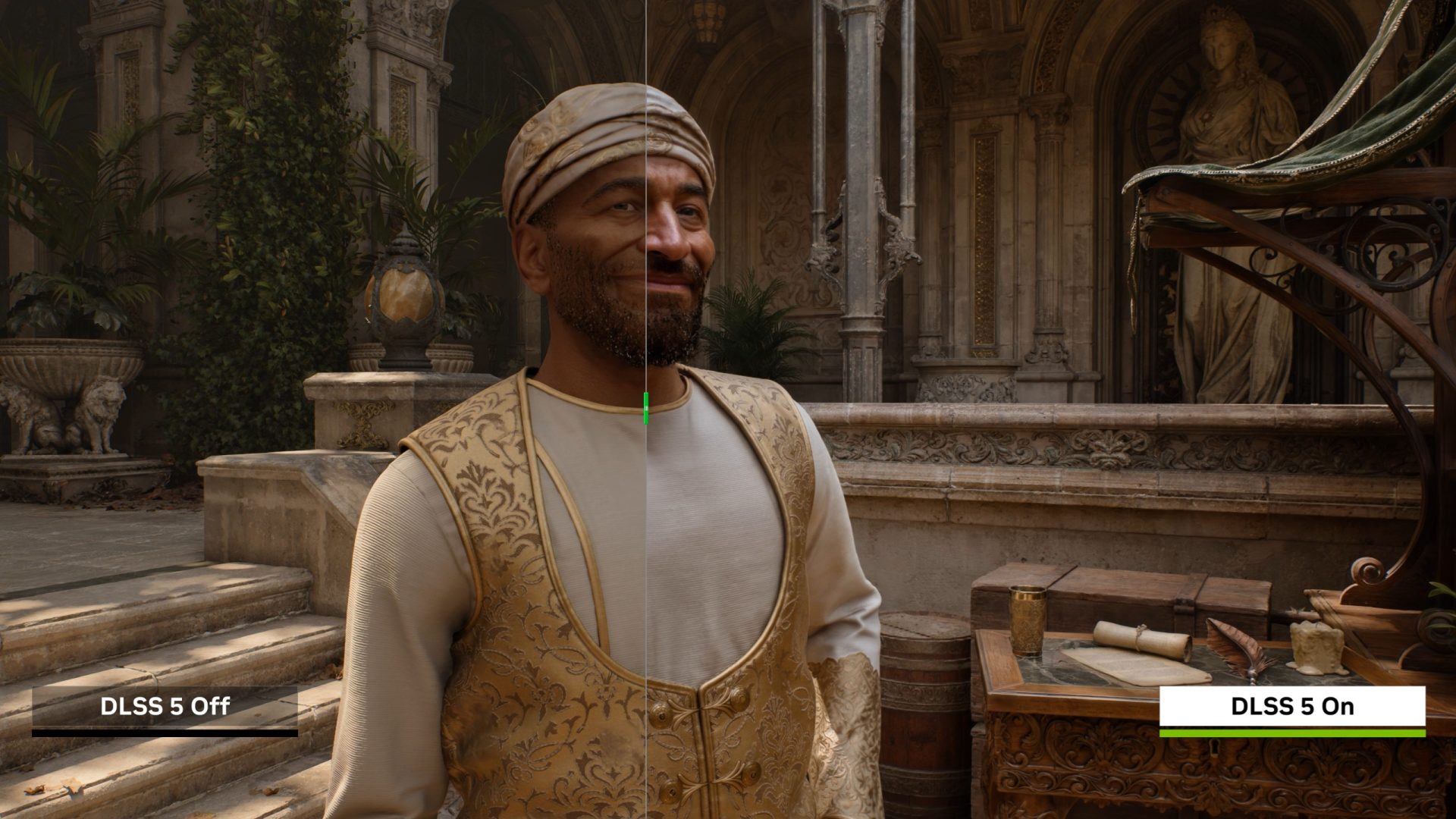
NVIDIA DLSS 5 may be nearing its official debut after an early runtime file tied to the technology appeared inside the early-access build of NBA 2K27. The discovery has already sparked major interest in the PC gaming and modding communities, especially after modders managed to get part of the new Neural Rendering feature running in an existing game.
The file in question is named nvngx_dlssnr.dll and is reportedly a 158 MB library identified as NVIDIA DLSSNR version 310.8.0.0. It appears to contain the runtime for DLSS 5 Neural Rendering, one of the key technologies expected to define NVIDIA’s next generation of AI-powered graphics features.
Shortly after the file was found, members of the RenoDX modding community successfully loaded it into Control, Remedy’s visually demanding action-adventure game. This resulted in what appears to be one of the first unofficial demonstrations of DLSS 5 Neural Rendering outside a game with native support.
For now, the implementation is very limited. The feature has reportedly been applied only to character models, with testing focused on Jesse Faden, the main character in Control. Even in this early state, the modders were able to expose seven different Neural Rendering styles, each changing the way the character model appears on screen.
DLSS 5 is expected to be more than a typical upgrade to NVIDIA’s existing DLSS upscaling technology. Instead of only reconstructing frames at higher resolutions, Neural Rendering is designed to use AI to enhance visual elements such as lighting, materials, and surface detail in real time. The technology takes a rendered frame and motion vectors as input, then attempts to infer material properties and other visual characteristics from the image.
That makes this early experiment especially interesting, even if it is far from polished. According to the developers testing the feature, HDR is not currently working correctly, so the demonstration was done in SDR. They also believe Neural Rendering is being applied late in the graphics pipeline, possibly after upscaling and tone mapping.
Performance is another major concern in this unofficial test. On an RTX 5070 Ti running at 4K resolution, the modded DLSS 5 Neural Rendering implementation reportedly caused performance to drop by nearly 50%. That is a significant hit and makes the current experimental version impractical for normal gameplay.
However, this does not necessarily reflect how DLSS 5 will perform when officially released. The current setup is a community-made experiment using a file discovered in another game’s early-access build. It does not represent a full game-level integration or a final NVIDIA-optimized implementation. Official support is expected to be much more efficient, especially when built directly into games and paired with the appropriate GeForce RTX 50 series hardware.
NVIDIA is expected to launch DLSS 5 this fall for GeForce RTX 50 series graphics cards. If this early discovery is any indication, the company may be preparing a major step forward in AI-driven real-time rendering. While the current modded version is rough, limited, and performance-heavy, it offers an exciting first glimpse at how Neural Rendering could change the visual quality of future PC games.