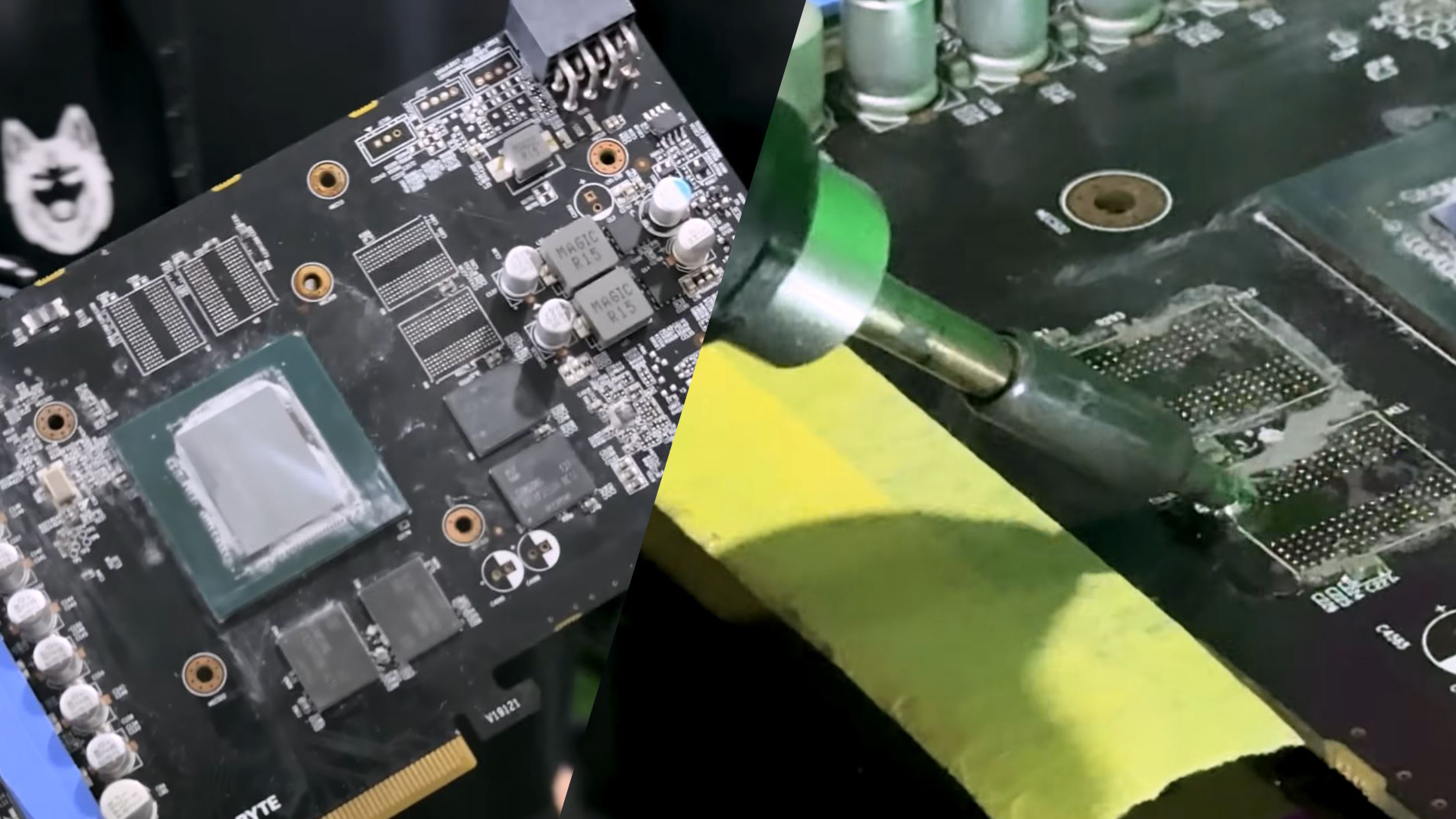
GeForce GTX 1650 gets an 8GB VRAM upgrade with a simple GDDR6 memory swap
A hardware modder has shown that certain versions of NVIDIA’s GeForce GTX 1650 can be upgraded from 4GB to 8GB of GDDR6 memory with a relatively straightforward VRAM module replacement. The modification is especially interesting because it reportedly required no firmware changes, making it one of the cleaner memory upgrades seen on a budget graphics card.
The project was carried out by YouTuber Paulo Gomes, who modified a GeForce GTX 1650 by replacing its original 1GB GDDR6 memory chips with higher-capacity 2GB Samsung GDDR6 modules. Since the card originally used four 1GB chips for a total of 4GB VRAM, swapping them for four 2GB chips increased total video memory to 8GB.
However, this upgrade is not possible on every GeForce GTX 1650. NVIDIA released several GTX 1650 variants over time, and they are not all based on the same GPU design. Some models use TU117, others use TU116, while certain versions are based on the larger TU106 GPU. According to the mod, the upgrade is only suitable for TU106-based GTX 1650 cards using compatible GDDR6 memory layouts.
The reason this mod works comes down to memory chip compatibility. GDDR6 modules are available in different capacities, including 1GB and 2GB versions. If a graphics card already uses 1GB GDDR6 modules and the GPU memory controller supports higher-density chips, replacing the existing memory with 2GB modules can increase total VRAM without adding extra chips to the PCB.
In this case, the original four 1GB GDDR6 chips were swapped for four Samsung HC16 2GB GDDR6 chips. The process was not completely trouble-free, as the modder initially had to deal with two faulty memory chips. Once the faulty chips were replaced, the card successfully operated with 8GB of VRAM.
The performance result in a synthetic benchmark was impressive. Before the upgrade, the GTX 1650 scored 624 points in Unigine Superposition. After the VRAM upgrade, the score increased to 1,245 points. That is nearly double the previous score, showing a major gain in that specific test.
Still, this does not mean the GeForce GTX 1650 will suddenly deliver twice the gaming performance in real-world use. Synthetic benchmarks can be heavily affected by VRAM limitations, especially when the test settings exceed the original 4GB memory capacity. In actual games, performance gains would vary depending on the title, graphics settings, resolution, and how much VRAM the game needs.
Even so, the upgrade is highly relevant because modern PC games are becoming increasingly demanding when it comes to video memory. Many newer titles can exceed 4GB of VRAM even at 1080p with higher texture settings. In those cases, a GTX 1650 with 8GB of memory could reduce stuttering, improve texture loading, and provide a smoother experience compared to the standard 4GB model.
The mod also highlights how memory capacity can become a major bottleneck for otherwise usable graphics cards. The GTX 1650 was designed as an entry-level gaming GPU, and while its core performance remains limited, doubling the VRAM could make it more practical for certain workloads and games that are memory-heavy rather than purely GPU-bound.
For most users, this is not a recommended do-it-yourself upgrade. Replacing GDDR6 memory chips requires proper soldering equipment, experience with GPU repair, and access to compatible memory modules. A mistake during the process could permanently damage the graphics card. However, for skilled modders and repair technicians, this experiment shows that some budget GPUs may have more upgrade potential than expected.
The biggest takeaway is that a TU106-based GeForce GTX 1650 can be modified from 4GB to 8GB GDDR6 by replacing its memory modules, and in at least one benchmark, the extra VRAM delivered a dramatic improvement. While real gaming results would likely be more modest, the mod is an interesting example of how hardware enthusiasts continue to push older graphics cards beyond their original specifications.