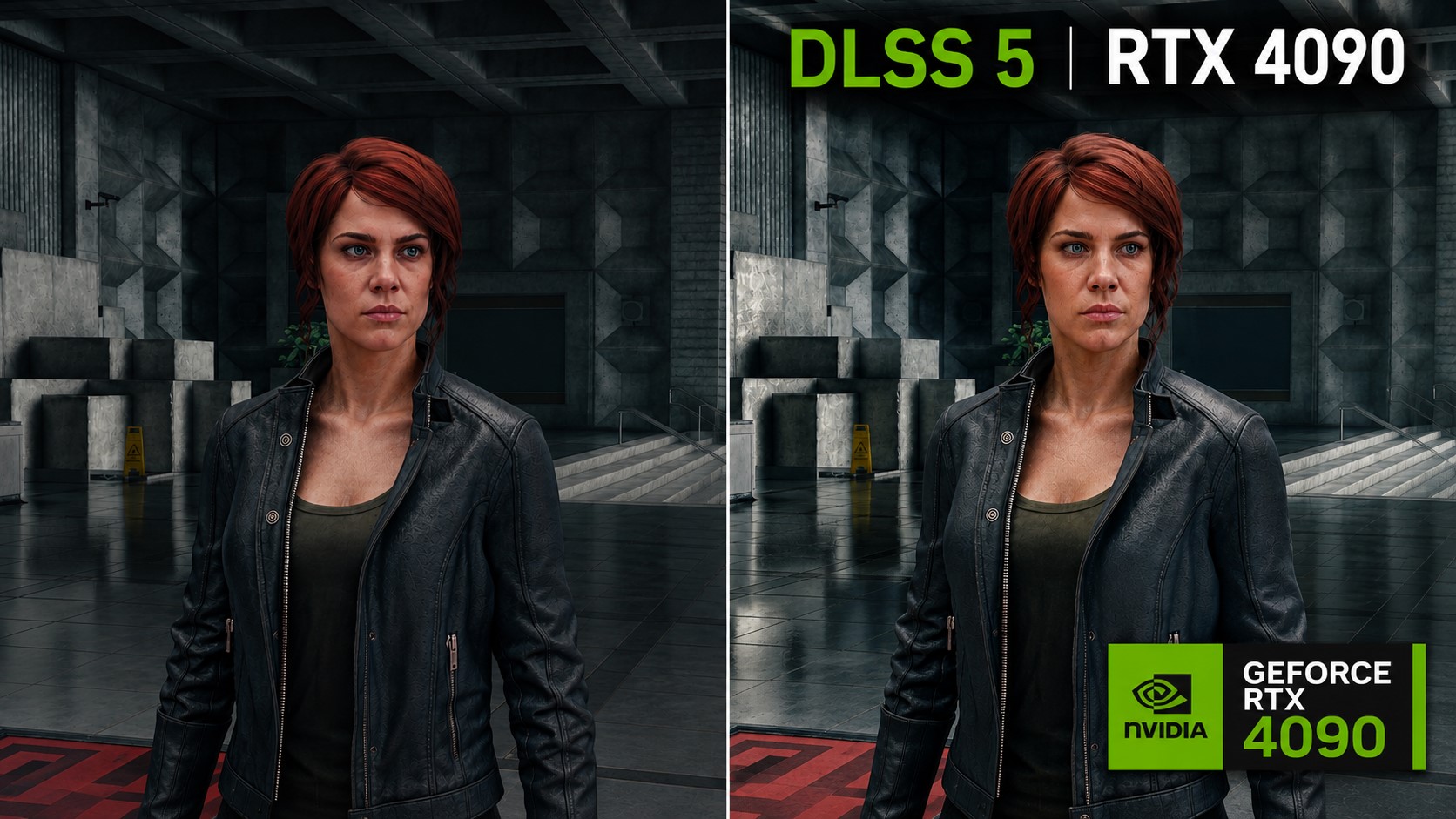
NVIDIA DLSS 5 Neural Rendering Reportedly Enabled on RTX 40 GPUs Before Official Launch
NVIDIA’s next-generation DLSS 5 Neural Rendering technology has already sparked major interest in the PC gaming and modding community, even before its official rollout. In just a short time, enthusiasts have managed to get the experimental feature running in multiple games, and more surprisingly, on GeForce RTX 40 series graphics cards.
The recent activity began after a DLSS 5 Neural Rendering DLL file surfaced through an early-access build of NBA 2K27. Once the file became available, modders quickly began testing it in different games. One of the first notable attempts involved Control, where members of the RenoDX community enabled an early implementation of the feature. Soon after, similar experiments appeared in other titles, showing that DLSS 5 NR could potentially be pushed beyond its expected launch environment.
DLSS 5 Neural Rendering is designed to use rendered frames and motion vectors to improve image quality in a major way. The technology is expected to be closely associated with NVIDIA’s upcoming Blackwell-based GeForce RTX 50 series GPUs. However, recent modding efforts suggest that the feature may not be strictly limited to next-generation hardware, at least in its current experimental form.
A modder known as Uncle Burrito demonstrated DLSS 5 Neural Rendering running on an RTX 40 series graphics card, specifically the GeForce RTX 4090. Through an experimental patch, the modder was able to expose additional image-quality controls and get the latest DLSS implementation functioning on Ada Lovelace hardware.
According to the findings, the leaked DLSS 5 file contained CUDA binaries that were apparently intended only for RTX 50 series GPUs. To work around this limitation, the incompatible binaries were swapped with versions compatible with RTX 40 series cards. That change allowed DLSS 5 Neural Rendering to run on the RTX 4090. The same approach reportedly worked on the RTX 4080 as well.
At this stage, it remains unclear whether the method can be extended to older NVIDIA GPUs, such as the RTX 30 series or RTX 20 series. The modder noted that testing on those cards has not been possible due to lack of access to the hardware.
While the breakthrough is exciting, performance remains a key concern. The RTX 4090 test showed a noticeable frame-rate drop when DLSS 5 Neural Rendering was enabled. Performance reportedly fell from around 135–145 FPS to approximately 83 FPS, representing a reduction of up to 39 percent.
That kind of performance hit is not unexpected for an unfinished and unofficial implementation. Since DLSS 5 Neural Rendering has not been publicly released in its final form, optimization is likely incomplete. NVIDIA’s official version may deliver better performance, improved compatibility, and broader support once it launches.
For now, the development highlights how quickly the PC modding scene can experiment with emerging GPU technologies. The fact that DLSS 5 Neural Rendering is already running on RTX 40 series cards suggests there may be more flexibility in the technology than initially expected.
However, users should keep expectations realistic. This is still an experimental workaround based on leaked files, not an official feature release. Stability, image quality, performance, and compatibility may vary significantly from game to game.
Still, the early results are promising. If NVIDIA eventually brings DLSS 5 Neural Rendering support to more GPUs, including the RTX 40 series, it could become one of the most important image-enhancement technologies for PC gaming in the coming years. For now, all eyes are on the official launch and whether the final implementation can deliver better performance while maintaining the impressive visual improvements that DLSS technologies are known for.